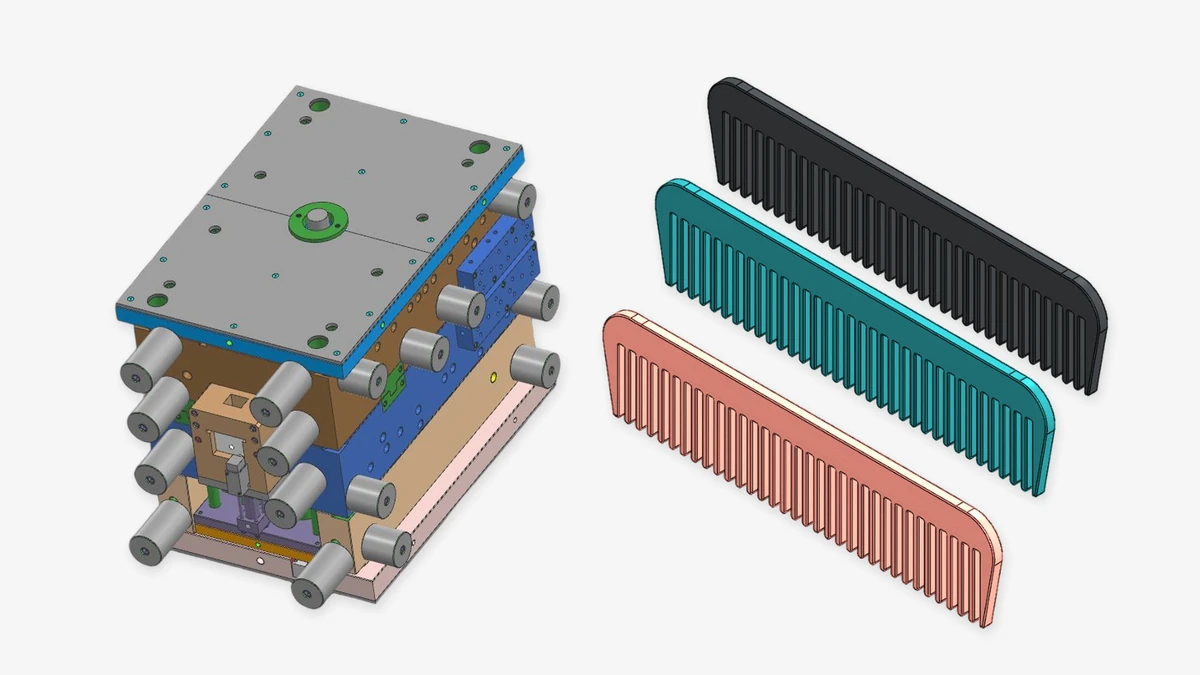
If you plan to have a comb mold made in China and ship it to your own country for injection molding, start by considering three options: two-plate cold runner molds, three-plate cold runner molds with pinpoint gates, and hot runner molds. All three can suit appropriate plastic comb designs. They differ in how plastic enters the cavities, how the combs are removed after the mold opens, and what additional equipment and maintenance they require.
Two-plate and three-plate describe the mold’s parting structure. Cold runner and hot runner describe the feed system. Cavity count tells you how many combs the mold produces per shot. These features can be combined; the sections below compare specific configurations.
This article focuses on ordinary, single-color plastic combs with the spine and teeth molded as one piece. At moldsteells, we assess the comb geometry, mold configuration, and production machine together. A mold that produces acceptable parts during trials in China must also fit your machine and operate as intended after shipment.
The prices below are preliminary planning estimates synthesized from public Chinese comb mold listings, moldmakers’ cost explanations, and industry discussions. The first three ranges use the same comparison basis: an ordinary single-color flat comb, 4-8 cavities, and a standard household-product finish, without complex side actions or two-color molding. A separate 16-cavity hot runner scenario follows. All prices are in US dollars per mold, to help you judge the scale of investment.
Two-Plate Cold Runner Molds: Start with a Simple Configuration
When the mold closes, the two molding surfaces form the comb geometry. Plastic flows from the machine nozzle into the sprue, then through the runners and gates into the comb cavities. After cooling, both the combs and the plastic in the feed system have solidified. This solidified sprue-and-runner material is removed when the mold opens. The mold opens at its main parting surface, and the combs and runner are taken out.
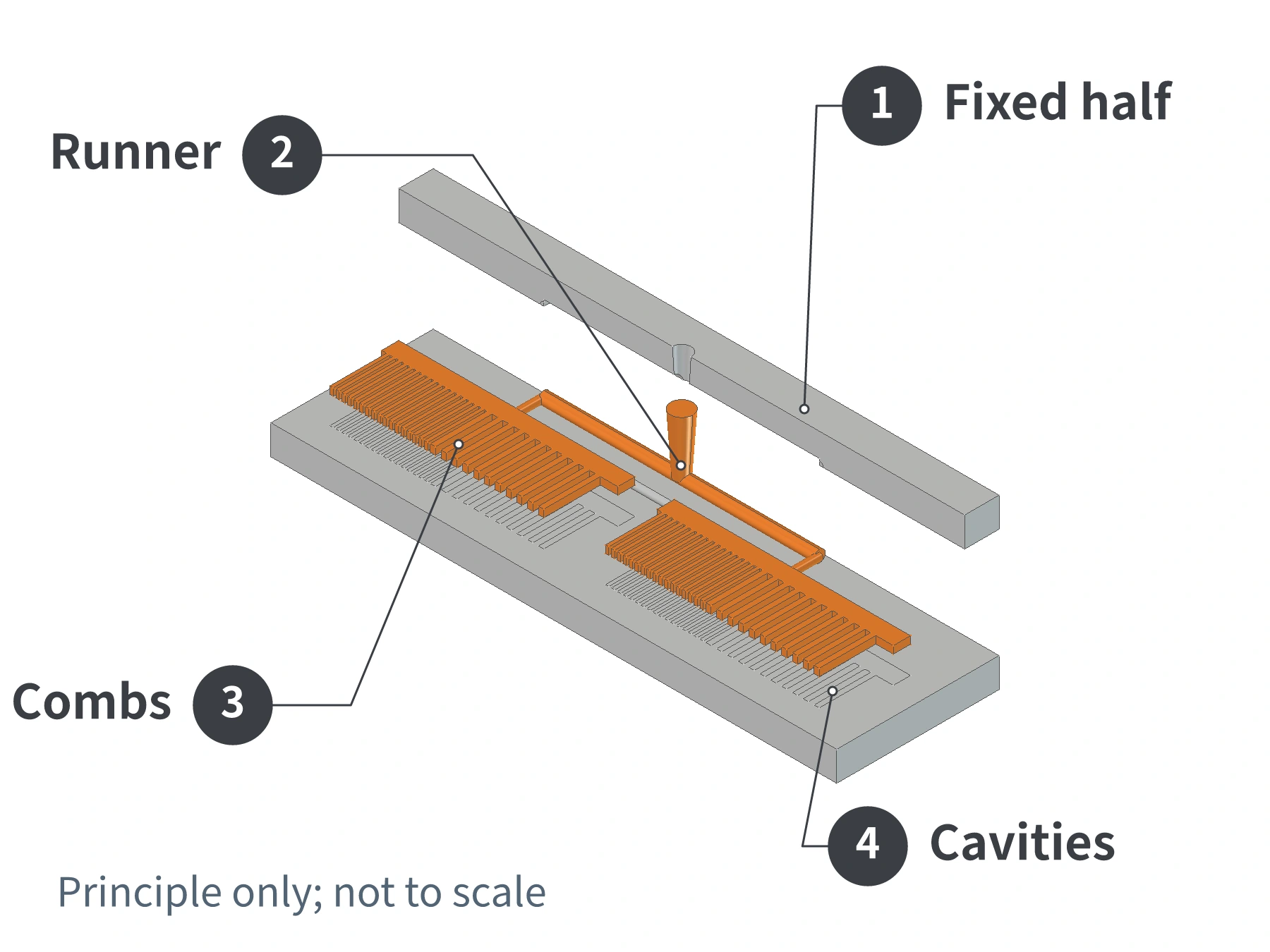
For an ordinary flat comb that can release along the main mold-opening direction, this is a useful starting point. It does not require a hot runner manifold or its temperature control system. For the same product and cavity count, the initial investment is usually lower than for a hot runner mold, and the configuration is easier to understand and maintain.
Check how the runner will separate from the combs. Ordinary side gates usually require the connection to be cut and the gate area trimmed. A suitable tunnel gate or another appropriate design can separate the runner automatically during demolding. A two-plate cold runner mold does not necessarily require manual gate cutting. Whether automatic separation is suitable depends on the gate location, material, and acceptable gate vestige on the comb.
A conventional single-color injection molding machine is a starting point, provided its mold capacity, shot capacity, clamping force, and ejection system match the mold. For manual removal, the production cycle must include part removal and runner handling. For continuous automatic operation, gate separation and either free-falling parts or robotic removal need to be designed together.
Approximate budget: US$2,000-5,000 per mold. This planning estimate combines the price scale of public listings for ordinary 4-8-cavity cold runner comb molds with a simple two-plate configuration. It provides an initial investment baseline for comparing the three options.
Three-Plate Pinpoint Gate Molds: Remove the Runner and Combs Separately
A three-plate cold runner mold adds a stripper plate and the mechanisms that control the opening sequence. The runner and products are removed through different parting interfaces, allowing the combs and runner to be handled separately.
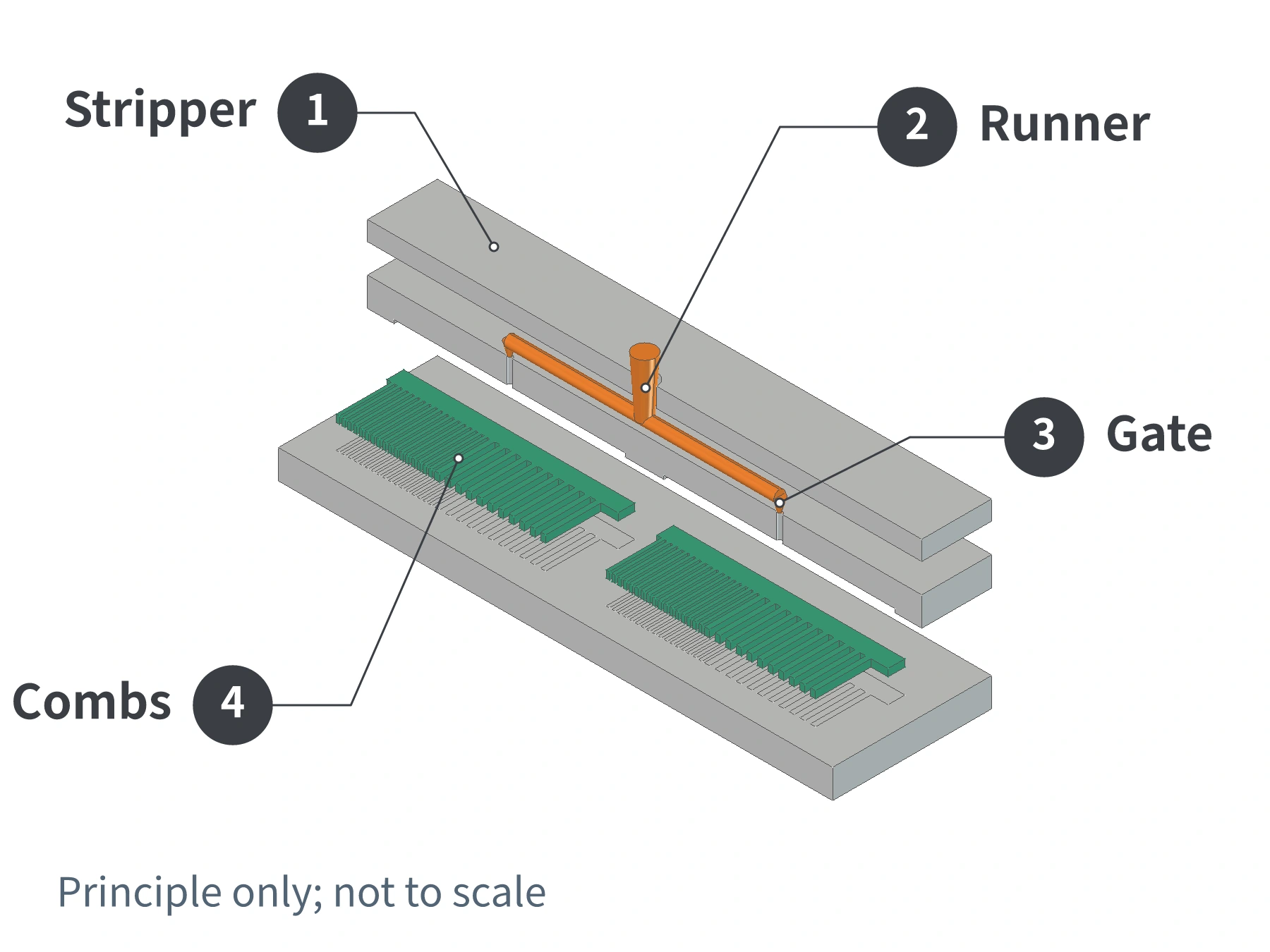
During gate separation, the runner puller holds the runner. As the molding section moves away relative to it, the small pinpoint gates connecting the runner to the combs break. The runner must then be stripped from the puller, followed by runner removal and product ejection.
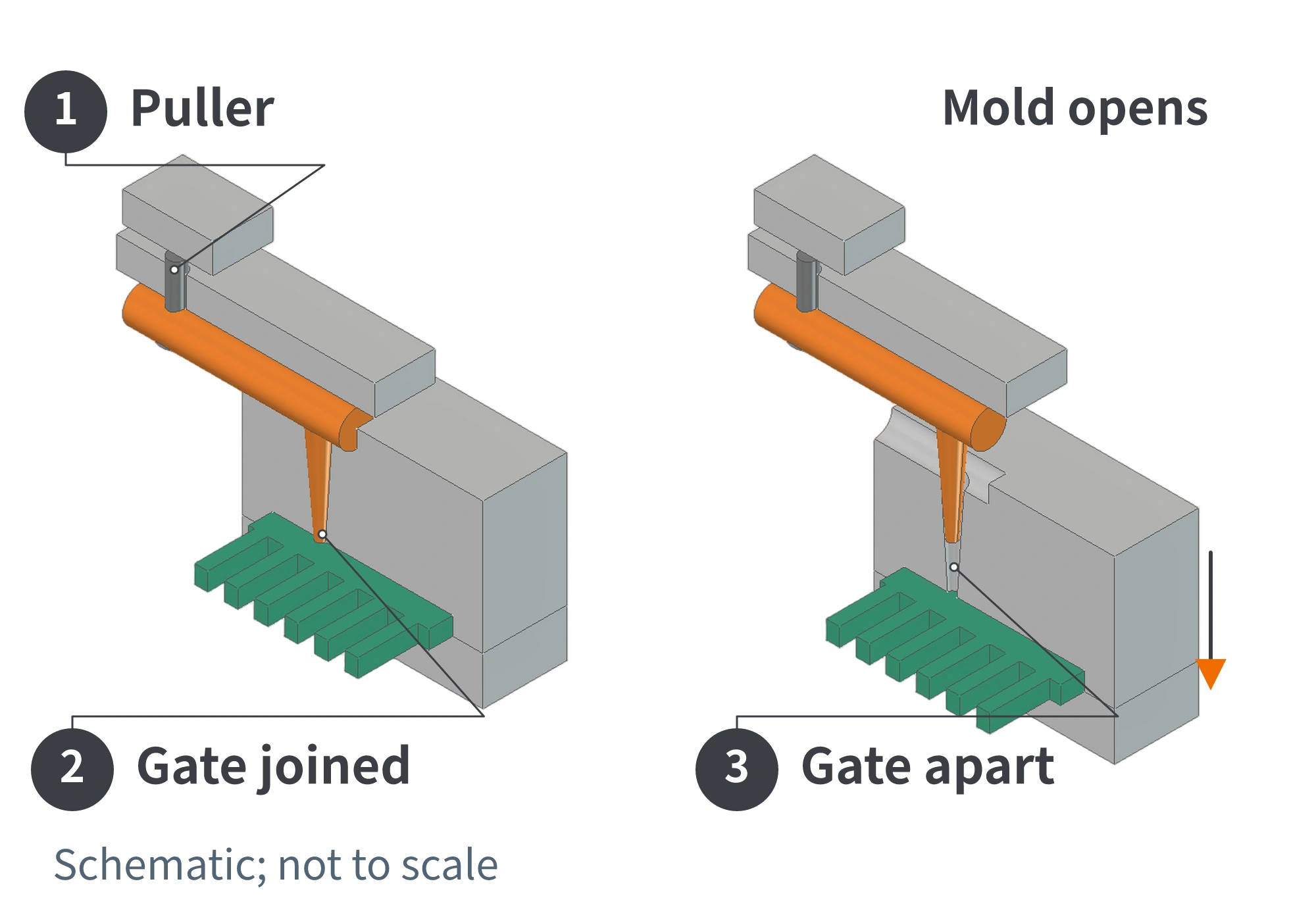
Consider this option when the comb’s gate location, appearance requirements, or automatic removal arrangement favor pinpoint gates, but the project still calls for a cold runner system. Pinpoint gates leave a gate vestige, so its location and any trimming requirements must be defined during design.
Compared with a simple two-plate mold for the same product, a three-plate mold adds plates, pull rods, or other sequence-control components. Manufacturing and maintenance work increase accordingly. It still produces a solidified runner; automatic gate separation does not eliminate that material consumption.
A three-plate mold can also run on a suitably matched conventional single-color injection molding machine. However, check mold thickness, opening stroke, and the space needed to remove the combs and runner separately. Machine tonnage alone is not enough. The actual mold mechanisms determine which parting interface opens first and how far each section travels.
Approximate budget: US$2,500-7,000 per mold. For the same comb geometry and cavity count, this estimate adds the plates, sequence-control mechanisms, and machining to the two-plate cold runner budget. The increase depends on the actual mechanisms; a single markup percentage cannot be applied to every three-plate mold.
Hot Runner Molds: Reduce the Runner Removed with Each Shot
A hot runner mold contains components such as a manifold and hot nozzles, fitted with heaters and temperature sensors and controlled by a temperature control system. Plastic travels through these passages into the cavities. The plastic inside the hot runner stays molten between production cycles, while the molded combs are released.
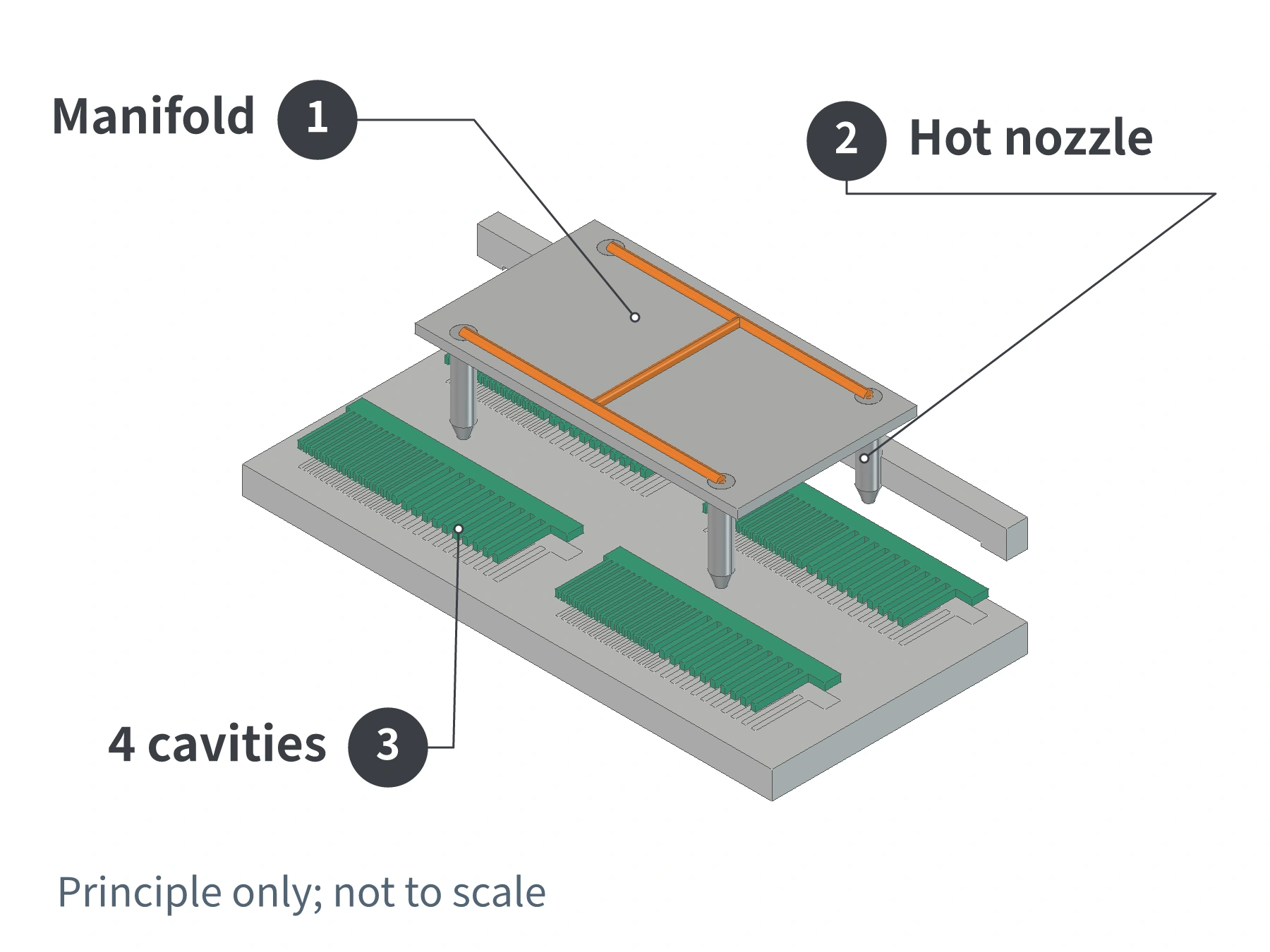
If the hot nozzles feed directly into the comb cavities, the corresponding cold runner can be eliminated. Other designs feed a short cold runner from the hot runner, so that portion still solidifies and is removed. Check where the hot nozzles deliver the melt; a hot runner does not automatically mean the entire production process generates no scrap.
For projects that continuously produce the same comb and aim to reduce runner handling, a hot runner is worth comparing with a cold runner. The manifold, hot nozzles, heaters, temperature sensors, and controller increase the initial investment. The material and labor savings depend on actual runner weight, cycle time, and acceptable output.
A hot runner does not require one particular type of machine drive. Whether a conventional single-color injection molding machine is suitable still depends on its injection unit, clamping unit, and mold interfaces. A compatible temperature control system is also needed. Confirm the local power supply, wiring, and connectors, and prepare suitable spare heaters, thermocouples, and other parts. For a factory importing a mold for use overseas, these arrangements should be settled before shipment.
Approximate budget: US$7,000-12,000 per mold. This range assumes the same ordinary 4-8-cavity flat comb and a basic Chinese-made hot runner system. It allows for the additional investment and a budget margin. It also draws on cost increases reported for other plastic parts when switching to hot runners at similar cavity counts. Confirm separately whether the controller, wiring, and spare parts are included. Imported-brand systems, valve gates, or higher cavity counts require a fresh estimate.
Higher Cavity Counts: A 16-Cavity Hot Runner Example
A four-cavity or eight-cavity mold produces four or eight combs per shot. Cavity count can be combined with two-plate, three-plate, cold runner, or hot runner configurations. Multi-cavity comb molds can also use cold runners. Increasing the cavity count does not automatically require a hot runner.
For example, a 16-cavity hot runner mold can produce 16 identical combs per shot, with a manifold distributing melt to the cavity groups. Hot nozzles may feed the cavities directly or supply cold runner groups that distribute melt to several cavities. A 16-cavity mold does not necessarily need 16 hot nozzles; the layout depends on comb dimensions and gate locations.
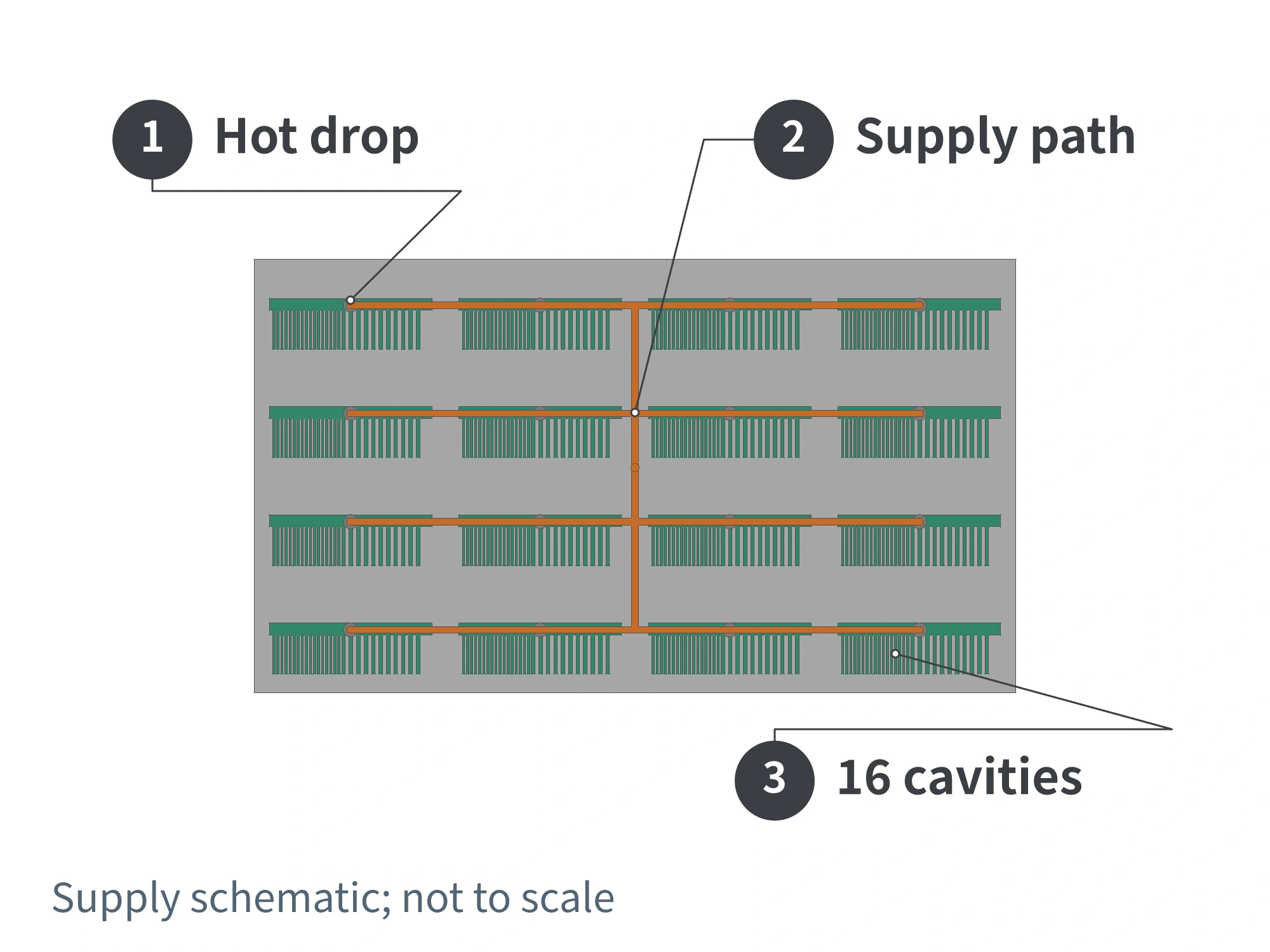
A conventional single-color injection molding machine remains a possible starting point, but it must accommodate the larger cavity layout and provide sufficient shot capacity, plasticizing capacity, and clamping force for all 16 combs and any cold runners. Filling, cooling, and ejection must also be coordinated across the cavities. Simply duplicating cavities does not establish that the existing machine can run the mold.
16-cavity budget scenario: approximately US$12,000-20,000 per mold. This example takes the earlier US$7,000-12,000 budget for a 4-8-cavity hot runner mold as an eight-cavity starting point. It then applies a US injection molder’s general rule of thumb that doubling the cavity count increases mold cost by about two-thirds. Both the choice of starting point and the use of that rule for comb molds are assumptions in this example. It also assumes similar comb geometry, steel and service-life requirements, a basic Chinese-made hot runner system, and a comparable scope of supply. Actual quotations may fall outside this range. This is not a verified Chinese market price for a 16-cavity comb mold.
For 32 cavities or more, the cavity layout, feed system, and cooling must be redesigned. Do not keep applying the same cost multiplier. Additional cavities are useful only when local demand, machine capacity, and operating and maintenance conditions can support them.
What Should You Check on Your Existing Injection Molding Machine?
Do not specify machine tonnage based only on the labels “eight-cavity comb mold” or “hot runner.” Comb dimensions, material, runner layout, and required cavity pressure all affect machine requirements.
| Item to check | What to examine | Effect on the comb mold |
|---|---|---|
| Mold installation space | Tie-bar spacing, platen dimensions, allowable mold thickness, and mounting method | The mold base and attachments must fit and be securely mounted |
| Mold opening and part removal | Opening stroke, ejector stroke, and clearance for runner and product removal | Allow enough space for three-plate separation, free-falling parts, or a robot |
| Injection capability | Total shot size for all combs and cold runners, plasticizing capacity, injection pressure, and injection speed | At a higher cavity count, the machine must feed and fill the mold within the intended cycle |
| Clamping capability | Projected area in the opening direction and the corresponding cavity pressure | Assess the projected area of the combs and relevant runners at the actual parting surface, rather than simply counting combs |
| Equipment interfaces | Nozzle and sprue bushing, cooling water, ejector connections, and any required temperature control or core-pull interfaces | The mold must connect to the factory’s equipment and operate correctly |
Clamping force resists the force that tends to separate the mold during injection. More cavities usually increase the projected area, but the required clamping force also depends on pressure inside the cavities. The machine’s maximum injection pressure cannot be treated directly as cavity pressure. Assess the product drawing, cavity layout, and existing machine specifications together to determine a suitable cavity count and mold configuration.
Choose a Configuration for Local Demand, Product Pricing, and Your Machine
If your local market mainly buys price-sensitive, ordinary single-color combs, compare simpler cold runner configurations first. Then assess whether your existing machine and order volume justify more cavities. If pinpoint gates and separate runner removal are needed, compare a three-plate cold runner mold. If demand for the same comb remains steady, weigh the extra hot runner investment against actual material savings and runner-handling labor.
These budgets are synthesized estimates for comparing configurations. They are neither formal quotations for one identical comb nor project quotations from moldsteells. They cover planned mold manufacturing investment and exclude overseas freight, import duties, the injection molding machine, external automation, and on-site installation and training. The actual scope of supply and mold acceptance requirements must be confirmed in the project quotation.
The final configuration must meet three conditions together: the type of comb your country needs, the price at which you intend to sell it, and the mold your existing machine can support. Local conditions for reusing runner material, labor, electricity, cooling, and repair parts also affect which option is more economical.
We are moldsteells, specializing in precision mold manufacturing. If you have a comb sample or drawing and specifications for the machine you plan to use, send them for a joint assessment. We can clarify the structure, cavity count, and equipment compatibility before defining the specific injection mold manufacturing configuration and quotation.