You receive two mold quotes for the same home appliance panel part: a standard injection mold at RMB 50,000 and a high-gloss injection mold at RMB 80,000—a 60% gap. The mold shop says the difference comes from the RHCM process, which needs steam channels, beryllium copper inserts, and high-temperature sealing. The question is simple: is that 60% justified, or is the quote inflated?
The price premium for a high-gloss injection mold—known in the industry as RHCM, or Rapid Heat Cycle Molding—is not a meaningless markup. Every added cost is tied to a visible structural upgrade. But the 30-50% figure is only the entry threshold. It is not the industry average, and it does not mean every cosmetic part should use RHCM. The cost breakdown below shows where the money goes and which orders justify it.
First, “high-gloss injection mold” is not the same as a “mirror-finish injection mold”
Many buyers assume a high-gloss injection mold simply means the mold surface is polished to a mirror finish and that the difference from a standard mold is just a few extra polishing steps. That is a misunderstanding. The 30-50% price gap does not come from polishing.
A high-gloss injection mold refers to an RHCM rapid heating and rapid cooling injection mold. The industry uses several names for the same concept—variable mold temperature, dynamic mold temperature, steam injection molding, paint-free injection molding, and high-gloss weld-line-free molding. In every case, the mold is heated quickly and then cooled quickly in each molding cycle. Dynamic mold temperature control suppresses appearance defects at the source—defects that standard injection molding cannot eliminate reliably. This is different from a Mirror Finish Injection Mold, which refers to a mold polished to SPI A1 optical-grade mirror finish. RHCM parts often use mirror polishing on the appearance side, but the core of RHCM is the variable-temperature process plus the steam-channel structure. Mirror polishing is only a supporting surface treatment.
A complete RHCM cycle runs like this: mold close → high-temperature steam or superheated water heats the mold cavity surface above the plastic’s glass transition temperature (Tg, the point where the plastic shifts from a glassy state to a highly elastic state) → the melt is injected and packed at high temperature → high-pressure air purges the residual hot medium from the channels → chilled water rapidly cools the mold to the setting temperature → the mold opens and ejects the part. The full heating and cooling switch is controlled automatically by a rapid heating and cooling mold temperature controller.
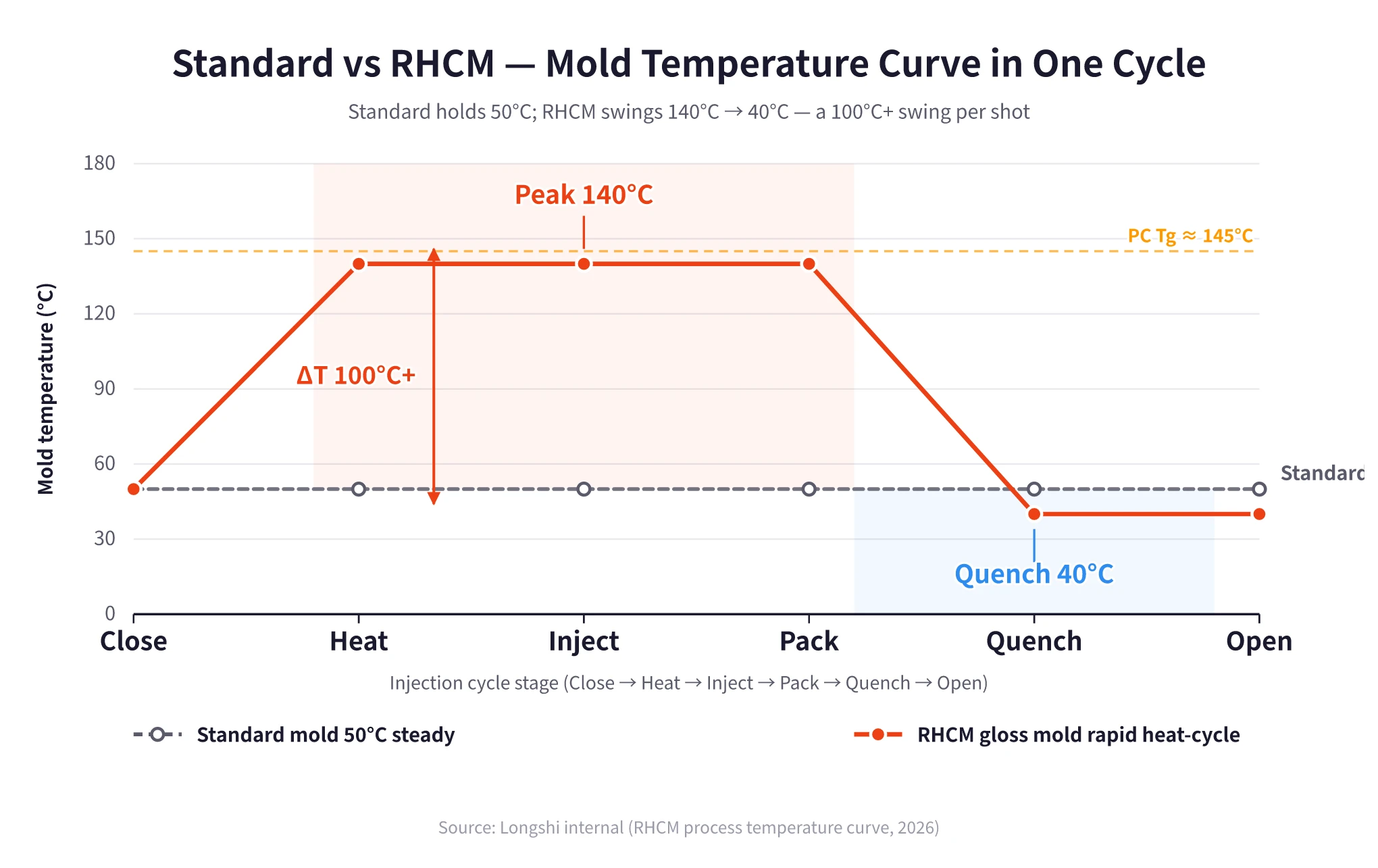
The higher mold temperature suppresses the formation of the condensation layer on the mold cavity surface. The melt stays fluid all the way to the flow front merge point so the two melt fronts can interlock fully. That is why weld lines disappear. The same mechanism also helps suppress flow marks, exposed glass fiber, splay, warpage, and sink marks. With standard injection molding, these defects are usually covered by a downstream coating step, or the parts are downgraded or scrapped. RHCM removes the defects during the molding itself. That saves not only the coating process but also scrap losses. The tradeoff is that the mold must survive repeated heating and cooling above 100 °C. That is the real source of the premium.
30-50% is the entry threshold, not the industry average
The phrase “30-50% more expensive” has a specific meaning—it is the entry threshold, not the market norm. If buyers apply that rule to every RHCM quote and push back on every supplier, they will negotiate against the wrong baseline.
Based on industry practice, RHCM mold premiums typically fall into four bands, using 2026 market conditions as a reference. Actual pricing varies widely with part complexity.
| Order Type | Typical Application | Premium Range (vs. standard mold of the same size) |
|---|---|---|
| Entry-level / small parts | Simple flat parts, no zoned temperature control, basic RHCM conversion | 30-50% |
| Mainstream cosmetic parts | 32-inch TV front frames, monitor bezels, small appliance panels, laptop A-covers | 50-65% |
| Large cosmetic parts | 55-inch TV rear housings, automotive dashboards, with zoned temperature control and imported seals | 65-100% or more |
| With supporting production line | Mold body plus mold temperature controller, steam boiler, and other auxiliary equipment | 1.8-2.5x the cost of a standard mold |
So two projects can both be called high-gloss injection molds, while one is a small upgrade at just over 30% and the other is a large-part production investment at 80% or even double the standard mold cost. The quote itself will not tell you that 30-50% is only the entry level. The buyer needs to ask directly which category the quote belongs to and whether auxiliary equipment is included.
The premium goes into six areas, and steel is not the main one
When buyers see an RHCM quote, the first reaction is often, Is the steel simply more expensive? But once the RHCM system premium is broken down, steel upgrades account for only a small share. Most of the added cost comes from the extra rapid heating and cooling system.
In industry practice, the premium usually comes from six cost items. The examples below use a standard mold priced at RMB 500,000 as the base, with an RHCM premium of RMB 350,000-600,000. At an exchange rate of 1:6.75, that equals about $74,074 for the standard mold and about $51,852-$88,889 in additional RHCM cost.
| Cost Item | Details | Industry Reference |
|---|---|---|
| Beryllium copper inserts | C17200 beryllium copper alloy, thermal conductivity about 105 W/m·K (steel is only 30-50; higher-conductivity C17510 can reach 180), used in local rapid heating and cooling zones, with a 1.3-1.5 loss factor | Largest share of the premium |
| Steam-channel machining | Deep-hole drilling or conformal-cooling inserts made by additive manufacturing, placed 8-15 mm from the mold cavity surface | Second-largest share |
| Temperature control system integration and tuning | Communication with the rapid heating and cooling mold temperature controller, plus zoned temperature control | From several thousand to more than ten thousand dollars |
| High-temperature sealing system | Standard rubber O-rings replaced by fluororubber or even metal C-rings, with enough spacing between steam and water ports to prevent cracking | Several thousand dollars |
| Mold temperature controller interface integration | Flanges and quick couplings | Several thousand dollars |
| Thermal insulation layer | Ceramic fiber or aerogel boards inserted between mold plates to keep the machine side below 60 °C | Several thousand dollars |
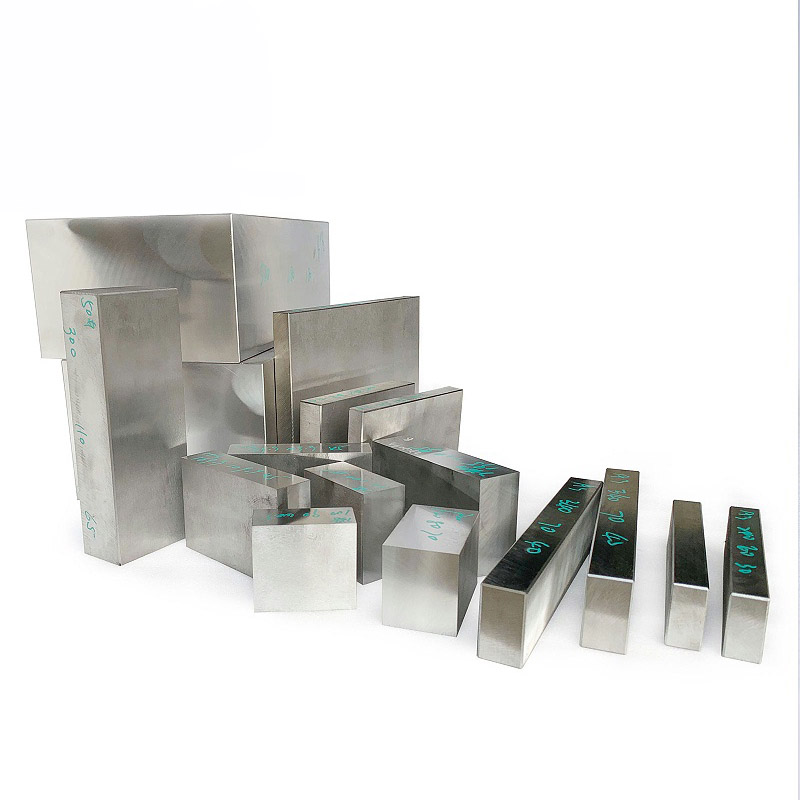
The steel issue also needs a clear view. P20, a standard pre-hardened steel priced at about RMB 9-15/kg in the Chinese market, cannot handle RHCM high-gloss surfaces well. Its polishability is average, and it does not hold up well under repeated rapid heating and cooling. RHCM usually needs NAK80, which is supplied in a pre-hardened condition and does not require quenching, making it a high-value option for home appliance panels, or S136, a corrosion-resistant mirror-polished steel hardened to HRC 48-52. The electroslag remelting (ESR) version, S136 ESR, offers better thermal fatigue resistance and is preferred for high-end RHCM molds. Imported ASSAB S136 at RMB 80-120/kg, or about $11.85-$17.78/kg, is 8-10 times the price of P20. That sounds dramatic, but mold steel typically accounts for only 15-25% of the total mold quote, so moving up one steel grade has a limited effect on the full project cost. If the budget is tight, Chinese FS136 from Fushun at RMB 35-50/kg, or about $5.19-$7.41/kg, is a compromise. Its polishability and corrosion resistance are close to imported S136 and are good enough for mainstream cosmetic parts. H13 is mainly a hot-work tool steel for Die Casting Molds, not the first choice for RHCM injection molds, so do not mix up the grade.
Two additional costs are easy to miss. The first is auxiliary equipment. When a mold shop says the mold is 30-50% more expensive, it usually means the mold body only. A real RHCM setup also needs peripheral equipment: a steam-type rapid heating and cooling mold temperature controller costs roughly RMB 200,000-450,000 in the 2026 market, or about $29,630-$66,667, and a steam boiler costs RMB 80,000-150,000, or about $11,852-$22,222. A 500 kg/h industrial boiler may also require licensing. By industry convention, the customer usually buys or outsources this equipment. The second is trial molding. A standard mold often reaches the target in three rounds—T0, T1, and T2. RHCM is much more sensitive to heating and cooling parameters, so it often needs 3-5 rounds of process validation. During those trials, steam is being consumed continuously, and engineers may need to stay on site to tune the process, which adds daily costs in the hundreds of dollars.
Which orders are worth the extra cost
Not every cosmetic part should use RHCM, but the following four categories usually justify it.
Visible Class-A appearance surfaces. TV housings, laptop A-covers, monitor bezels, and automotive A/B/C-pillar trim parts all fall into this category. On these parts, weld lines, flow marks, and exposed glass fiber from standard injection molding are unacceptable. In numerous instances, a standard mold simply cannot make the required appearance.
Parts that must eliminate painting. RHCM parts can come out with a high-gloss surface directly, so the conventional spray-painting step can be removed. Painting is a high-VOC process. Publicly reported RHCM applications showcase cases where the painting step was eliminated and annual VOC emissions were reduced by several tons. Emission limits are getting stricter. Removing one painting process can mean removing an entire coating line and its environmental compliance cost. That value does not appear on the mold quote, but it matters in the full project calculation.
High-value parts. Laptop housings and automotive interior and exterior trim parts usually have enough margin per part to absorb the extra mold cost. Once the premium is spread across each part, the cost impact is often small.
High-volume parts. This is what determines payback. Run the numbers: assume the RHCM premium is RMB 30,000, or about $4,444, and the added cost allocated to each part is about RMB 0.15, while the higher yield and lower defect rate save money at the same time. At an annual volume of 100,000 parts, the investment pays back in about two years. At 200,000 parts per year, the payback is about one year. Below 30,000 parts per year, buyers should be cautious. A standard mold plus downstream coating may cost less overall. In automotive interior and exterior trim, RHCM is already mainstream. Dashboards, center consoles, grilles, and spoilers all have mature mass-production cases.
Which orders lose money with RHCM
The next four categories usually do not justify RHCM. In these cases, the extra spending is wasted.
Internal structural parts that no one sees. Internal frames, mounting brackets, and reinforcing ribs do not need RHCM. If a standard P20 mold can make them and nobody sees the surface, paying for RHCM is unnecessary.
Small parts with tight cost targets. Internal parts for small appliances, connectors, and fasteners often have low margins per piece. A 30-50% mold premium cannot be recovered.
Low annual volume parts. If annual output is below a few tens of thousands of parts, the equipment and trial-molding cost cannot be spread thin enough. In that case, a standard mold plus a downstream coating process may still be the cheaper route.
Parts with moderate appearance requirements or textured surfaces. For B-side or C-side appearance parts, or parts that require a chemical-etched texture graded to VDI 3400, the texture itself can hide minor defects from standard mold temperatures. RHCM is often unnecessary.
The decision logic is simple: can the extra mold cost be recovered through lower painting cost, better yield, and higher product value? All four non-viable scenarios fail that calculation.
Material mismatch is another issue. If the part is a matte interior trim component, forcing a high-gloss injection mold into the project wastes money. The cost goes up by 30-50%, the rapid heating and cooling system brings little benefit, and the lead time gets longer. No buyer wants to pay 50% more for a matte part.
Ask the mold shop these four questions before placing the order
Mold quotations are dense with technical details, and many buyers cannot read them line by line. But these four questions quickly show whether the mold shop is credible.
1. What mold cavity steel grade are you using? If the answer is P20 or 718H, both standard pre-hardened steels, change suppliers. Those grades are not suitable for RHCM high-gloss surfaces. NAK80 is the best value choice for home appliance panels. S136 or S136 ESR is the preferred choice for high-end corrosion-resistant mirror-polish applications.
2. Are the steam channels made by deep-hole drilling or by conformal-cooling inserts? Deep Hole Drilling costs less, but the distance from the water channel to the mold cavity surface is limited. Conformal-cooling inserts made by additive manufacturing cost more, but they cool more uniformly. This affects both mold life and production yield.
3. How many trial runs are included? A standard mold usually reaches target condition in T0, T1, and T2. RHCM often needs 3-5 process validation rounds because the process is more sensitive. If the quote includes only three rounds, the contract must state who pays for additional trials.
4. Who supplies the mold temperature controller and the steam boiler? This is the biggest dispute point in the industry. Mold shops usually do not include them. The customer buys them or outsources them. But that must be made clear before signing the contract, not when production is about to start.
A quick production-volume check helps. Annual volume above 100,000 parts, Class-A appearance surface, and a weld-line problem—RHCM is worth considering. Annual volume below 30,000 parts, moderate appearance requirements, and a textured surface—a standard mold is more economical. Between those two cases, a mixed solution is often possible: partial high-gloss surfaces plus standard surfaces elsewhere. That can reduce the premium by 30-40%.
Common Questions
Is RHCM mold life shorter than standard mold life?
Not necessarily. Mold life depends on the steel grade and the thermal-cycle design. NAK80 and S136 ESR can handle rapid heating and cooling fatigue well, and with proper maintenance, they may not be much shorter-lived than standard molds. The key is proper thermal-cycle design. Do not place the steam channels too close to the mold cavity just to save costs. Industry practice is to keep at least 15 mm spacing to reduce cracking risk.
Can the price gap be negotiated?
Some parts can be reduced. The main negotiable items are the steel grade—for example, Chinese FS136 instead of imported S136 can cut the steel cost by about half—and the number of trial runs. The common industry baseline includes T0, T1, and T2, with extra process-validation runs charged separately. Beryllium copper inserts and steam-channel machining are hard costs. If those costs are forced down, the supplier is probably cutting corners.
Can only part of the mold surface be made high-gloss?
Yes. The industry already uses mixed structures where the Class-A surface uses RHCM and the B/C surfaces use standard mold temperature control. This can reduce the premium by 30-40%. It works well for parts where appearance requirements are concentrated on one or two surfaces, such as a laptop A-cover with RHCM and a textured D-cover.
Once the numbers are clear, the decision is not complicated. For Class-A appearance surfaces, high volume, and paint-free requirements, RHCM is worth it. For matte parts, low-volume runs, and internal structural parts, a standard mold is the better value.
If there is a cosmetic part project ready for tooling, send the product drawing, appearance requirements (A/B/C surface classification and whether texture is required), annual volume, and plastic material. moldsteells can provide a DFM analysis to judge whether RHCM makes sense, whether the added cost is justified, and how to split a mixed-surface solution. Medium-size high-gloss molds—such as home appliance panels, small and mid-size laptop parts, and automotive interior trim—fit within moldsteells’ process range, supported by mirror-finish EDM machine capability and 90-260T injection molding machines, with a standardized T0/T1/T2 process. For extra-large parts such as 55-inch TV rear housings or automotive dashboards, DFM evaluation is needed to confirm whether the project is within range. By industry convention, the RHCM rapid heating and cooling mold temperature controller and steam boiler are supplied by the customer. The mold shop does not include that auxiliary equipment package.