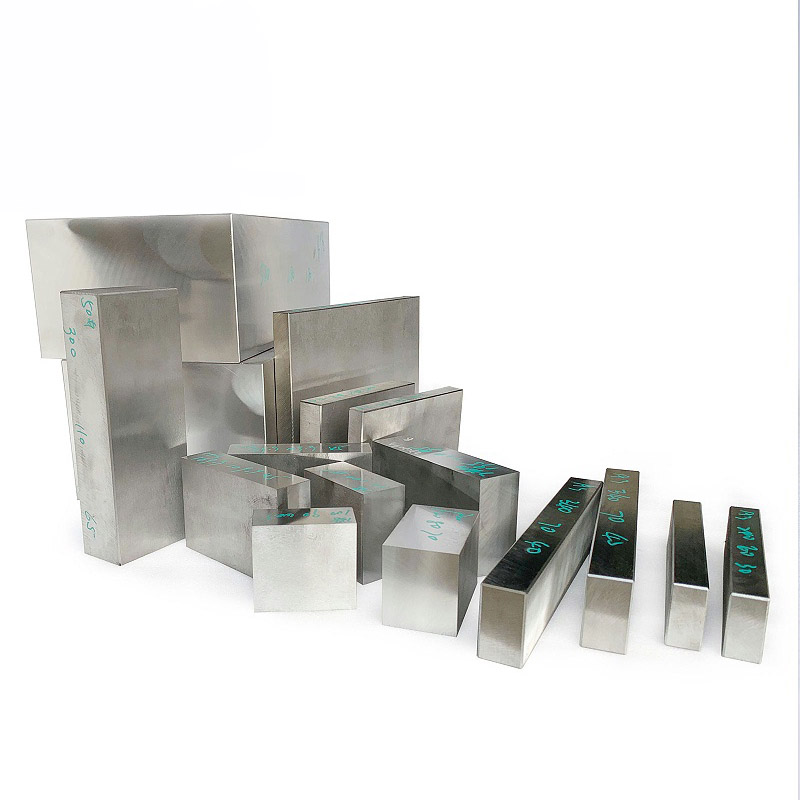
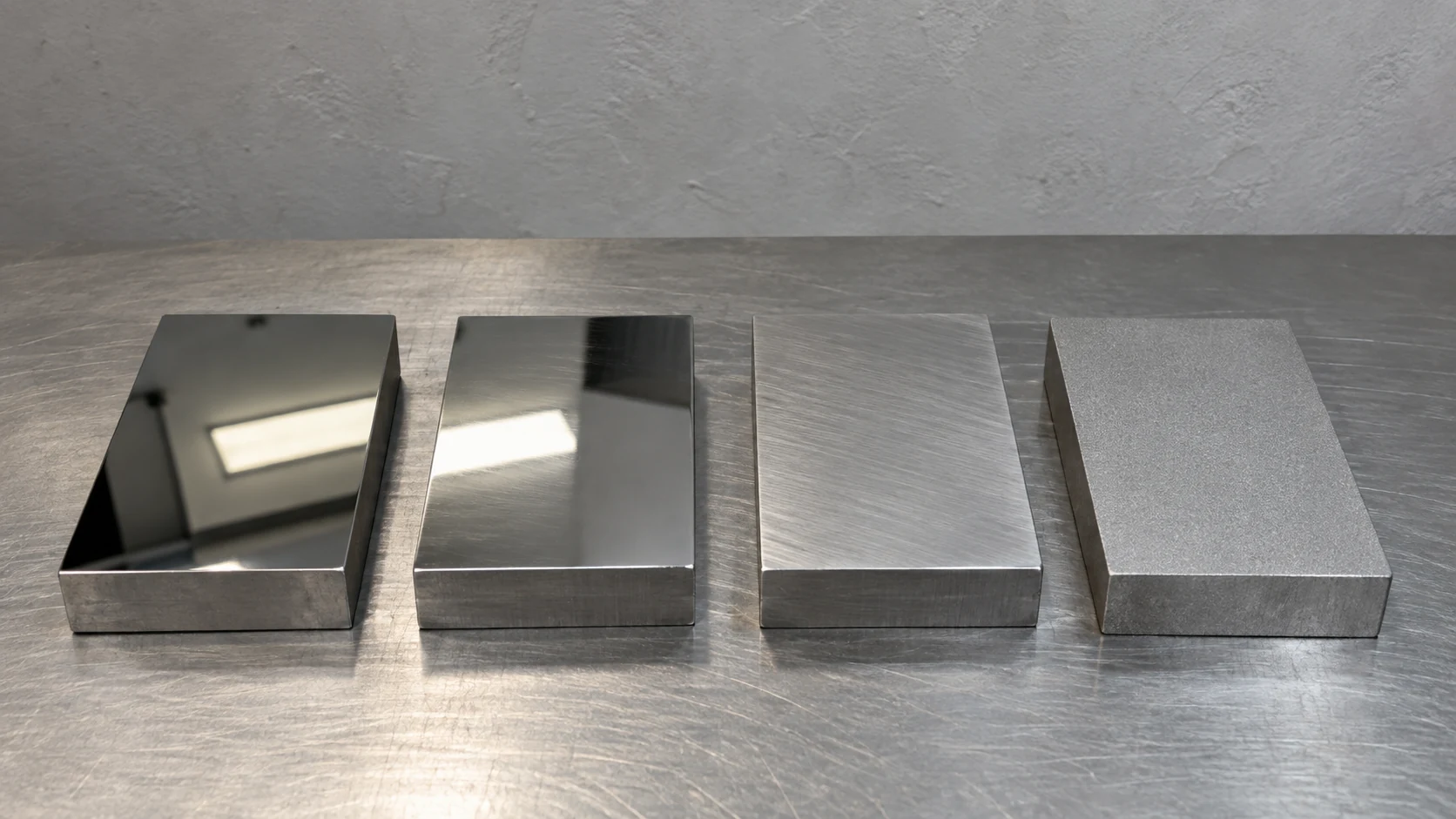
When a drawing specifies SPI A3 or VDI 27, asking only “how glossy is it?” misses the point. The SPI mold finish grades, originally established by the Society of the Plastics Industry in the United States, mainly describe polishing methods and appearance. VDI 3400, issued by the Association of German Engineers, was originally used to classify electrical discharge machining (EDM) textures and is now also commonly used to describe the roughness of etched surfaces. The two systems overlap only across some Ra surface-roughness ranges and cannot be converted precisely.
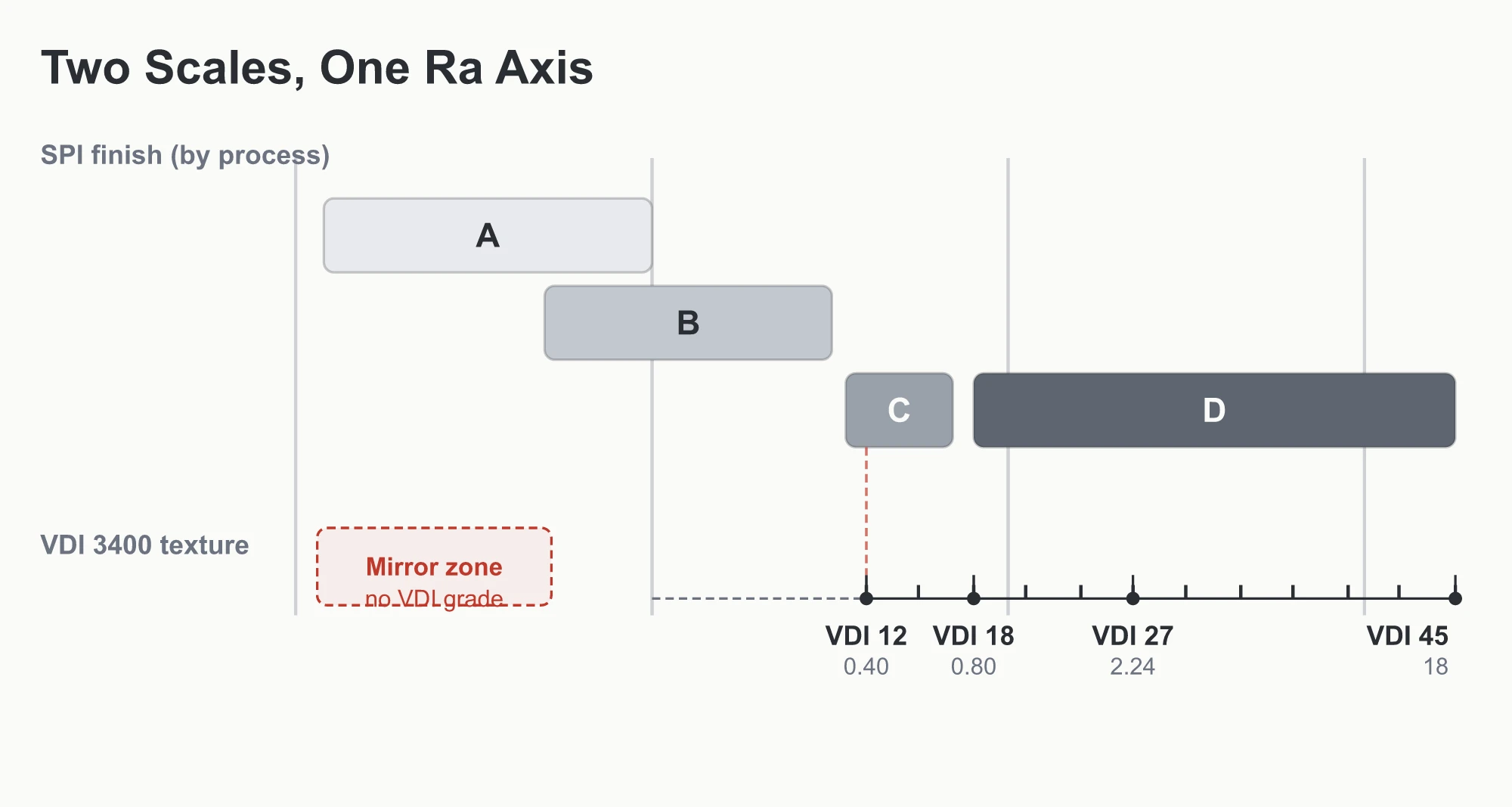
SPI A1 is a mirror finish, while A2 and A3 are high-gloss finishes. With VDI, a higher number indicates a coarser texture. SPI A1 and A2 have no equivalent VDI grade.
How to Read the Four SPI Categories and Twelve Grades
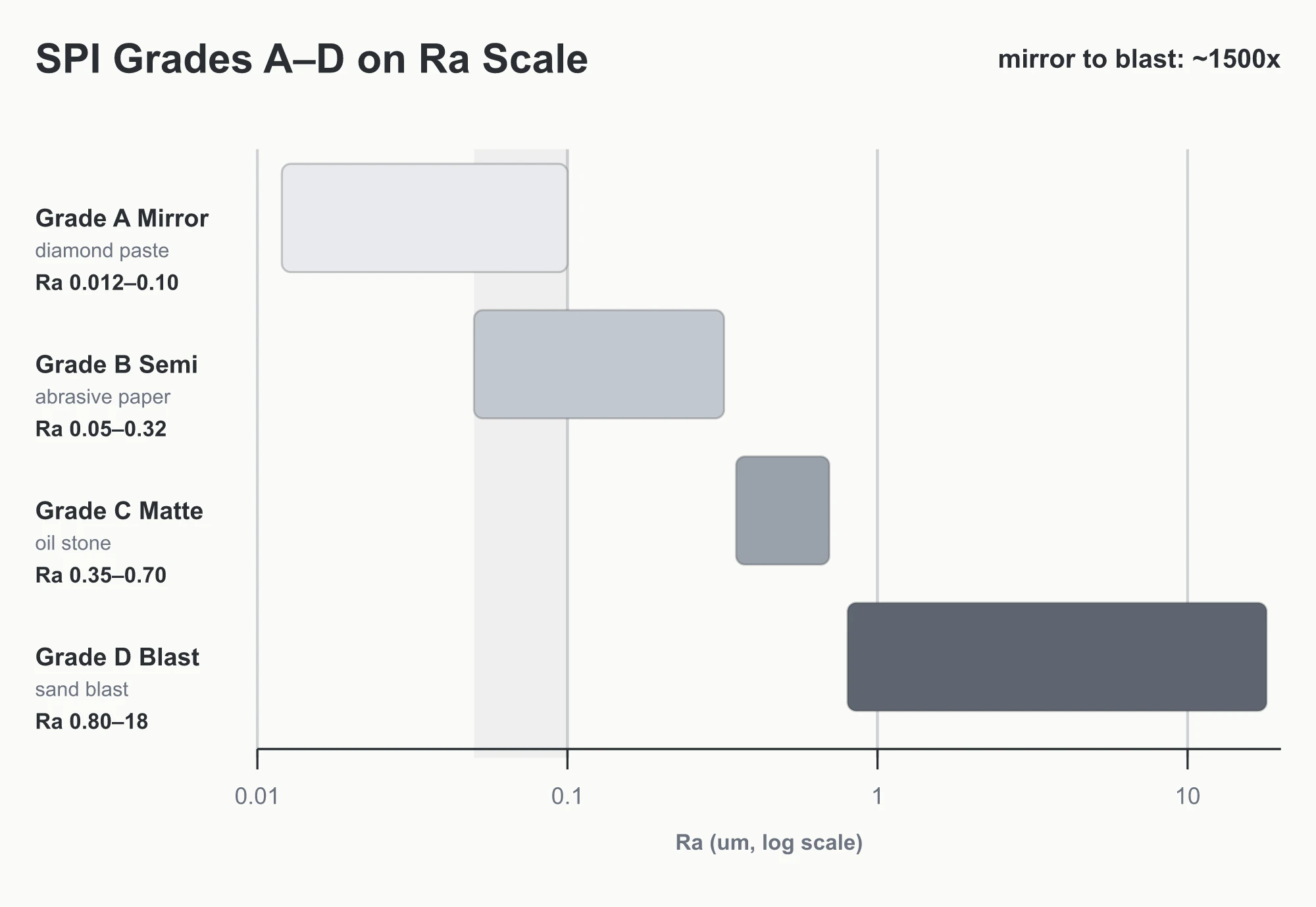
SPI divides the surface of an Injection Mold into four categories and twelve grades: category A uses a diamond compound, B uses abrasive paper, C uses polishing stones, and D uses abrasive blasting. As a result, even where the Ra ranges of A3 and B1 overlap, their surface patterns and appearance are not the same.
| Grade | Finishing Method | Ra (µm) | Appearance |
|---|---|---|---|
| A1 | 3 µm (approximately 6000 grit) diamond compound | 0.012–0.025 | Mirror finish |
| A2 | 6 µm (approximately 3000 grit) diamond compound | 0.025–0.05 | High gloss |
| A3 | 12 µm or 15 µm (approximately 1200 grit) diamond compound | 0.05–0.10 | High gloss |
| B1 | 600-grit abrasive paper | 0.05–0.10 | Semi-gloss |
| B2 | 400-grit abrasive paper | 0.10–0.15 | Semi-gloss |
| B3 | 320-grit abrasive paper | 0.28–0.32 | Semi-gloss |
| C1 | 600-grit polishing stone | 0.35–0.40 | Matte |
| C2 | 400-grit polishing stone | 0.45–0.55 | Matte |
| C3 | 320-grit polishing stone | 0.63–0.70 | Matte |
| D1 | No. 11 glass bead blasting | 0.80–1.00 | Fine blasted texture |
| D2 | No. 240 aluminum oxide blasting | 1.00–2.80 | Blasted texture |
| D3 | No. 24 aluminum oxide blasting | 3.20–18.0 | Coarse blasted texture |
Third-party supplier manuals and older customer drawings occasionally use “A0.” This is a nonstandard, company-defined grade and is not part of the twelve official SPI grades from A1 through D3. If a drawing specifies A0, ask the customer to provide a target Ra value, an approved sample, or a photograph rather than assuming that A0 means A1.
Higher VDI Numbers Indicate Coarser Textures
VDI 3400 is commonly used to describe EDM or textured surfaces. Engineering drawings most often use the following twelve reference grades from VDI 12 through VDI 45, in increments of three:
| VDI | Ra (µm) | VDI | Ra (µm) |
|---|---|---|---|
| 12 | 0.40 | 30 | 3.15 |
| 15 | 0.56 | 33 | 4.50 |
| 18 | 0.80 | 36 | 6.30 |
| 21 | 1.12 | 39 | 9.00 |
| 24 | 1.60 | 42 | 12.50 |
| 27 | 2.24 | 45 | 18.0 |
Deeper textures generally increase demolding resistance. Before setting the draft angle on a drawing, ask the texturing supplier to review the resin, texture direction, and sidewall depth instead of relying on the VDI number alone.
SPI and VDI Can Only Be Compared Approximately
The relationships below are engineering approximations based on Ra ranges, not a conversion formula. The complete VDI 3400 sequence covers VDI 0–45, while drawings most commonly use the twelve reference grades from VDI 12–45. This is why the table includes VDI 0–11, which are less common in industrial applications. SPI also specifies finishing methods and appearance, so two surfaces with similar Ra values may still differ in reflectivity and texture.
| SPI | Approximate VDI Range | Assessment |
|---|---|---|
| A1 | No equivalent | Mirror finish |
| A2 | No equivalent | High gloss |
| A3 | Approximately VDI 0–5 | High gloss |
| B1 | Approximately VDI 6 | Semi-gloss |
| B2 | Approximately VDI 7–8 | Semi-gloss |
| B3 | Approximately VDI 9–10 | Semi-gloss |
| C1 | Approximately VDI 11–12 | Fine matte |
| C2 | Approximately VDI 13–15 | Matte |
| C3 | Approximately VDI 16–17 | Matte |
| D1 | Approximately VDI 18–19 | Fine texture |
| D2 | Approximately VDI 20–29 | Medium texture |
| D3 | Approximately VDI 30–45 | Coarse texture |
For example, VDI 27 falls roughly within the surface-roughness range of SPI D2. It can be described as “close to the D2 range,” but the drawing should not be rewritten as D2. VDI 27 is usually a uniform EDM or etched texture, whereas D2 is a blasted surface, so the visible results are different.
Why SPI A1 and A2 Have No VDI Equivalent
In the complete VDI 3400 sequence, VDI 0 corresponds to an Ra of approximately 0.10 µm. SPI A1 ranges from 0.012 to 0.025 µm, and A2 ranges from 0.025 to 0.05 µm, so neither range overlaps VDI 0. The processes also work differently. EDM creates dense discharge craters by melting and removing material, which scatters light. Mirror polishing gradually removes microscopic peaks and scratches, producing specular reflection.
Even high-gloss EDM leaves finer, more uniform discharge craters and cannot be treated as equivalent to SPI A1 or A2. To deliver a category A surface, the specified SPI polishing requirements and a sample approved by both parties should remain the acceptance criteria.
SPI A1 places stricter demands than categories B and C on steel cleanliness, the surface condition before polishing, environmental cleanliness, and manual process control. Before quoting a Mirror Finish Injection Mold, confirm whether the requirement is an A1 mirror finish or an A2/A3 high-gloss finish.
How to Specify and Inspect Mold Finishes on Drawings
When moldsteells compared multiple supplier manuals, we found three differences that can easily be mixed into the same chart. Some VDI charts show the complete 0–45 sequence, while others show only the twelve commonly used reference grades. Some sources list A2 as Ra 0.012–0.025 µm, overlapping A1; this guide uses the continuous range of 0.025–0.05 µm. Unreviewed translations may also confuse an SPI A1 mirror finish with a VDI texture. When sources conflict, use the following order of precedence:
- Retain the customer’s original SPI or VDI designation; do not replace it with the other standard.
- State the target Ra range and the intended appearance: mirror, high gloss, matte, or textured.
- For appearance surfaces, use a physical sample or standard texture plaque approved by both parties as the primary acceptance reference.
- Agree before mass production whether acceptance will be based on Ra measurement, sample comparison, or both.
When reviewing a drawing, first determine whether it calls for a polished bright surface or an EDM/etched texture. Use SPI category A for mirror and high-gloss finishes and the VDI number for textured surfaces. When communicating across standards, compare only the roughness ranges; do not turn an approximate relationship into an equality sign.
We are moldsteells, focused on precision mold manufacturing. If an SPI, VDI, or Ra callout on your drawing is unclear, send us the drawing and the target appearance. We can review the surface requirements against a physical sample as part of a DFM (design for manufacturability) analysis, reducing discrepancies during quotation and acceptance.