People online often say that for a mirror-finish injection mold, all you need is rough machining with conventional EDM, and then a skilled polisher can bring the Ra value down by hand. That conclusion is wrong. This is a simple physics problem.
A mirror finish is not created in post-processing polishing. It is determined at the moment of electrical discharge machining (EDM). That is the underlying logic of the process.
In a Mirror Finish Injection Mold, the mold cavity surface roughness usually needs to stay within Ra 0.1 μm. Precision optical parts need to be pushed below 0.05 μm. At that level, a conventional EDM (sinker EDM) machine cannot get there. Both processes are called EDM, but the surfaces produced by a conventional EDM (sinker EDM) machine and a mirror-finish EDM machine differ in more than roughness. They follow two different discharge logics.
The sections below break down where conventional EDM gets stuck, why a mirror-finish EDM machine works, how key process parameters are set, how moldsteels run this process, and what buyers should check during acceptance. After reading, it will be clear what kind of supplier can handle mirror-finish parts.
Where Conventional EDM Falls Short for Mirror Finishes
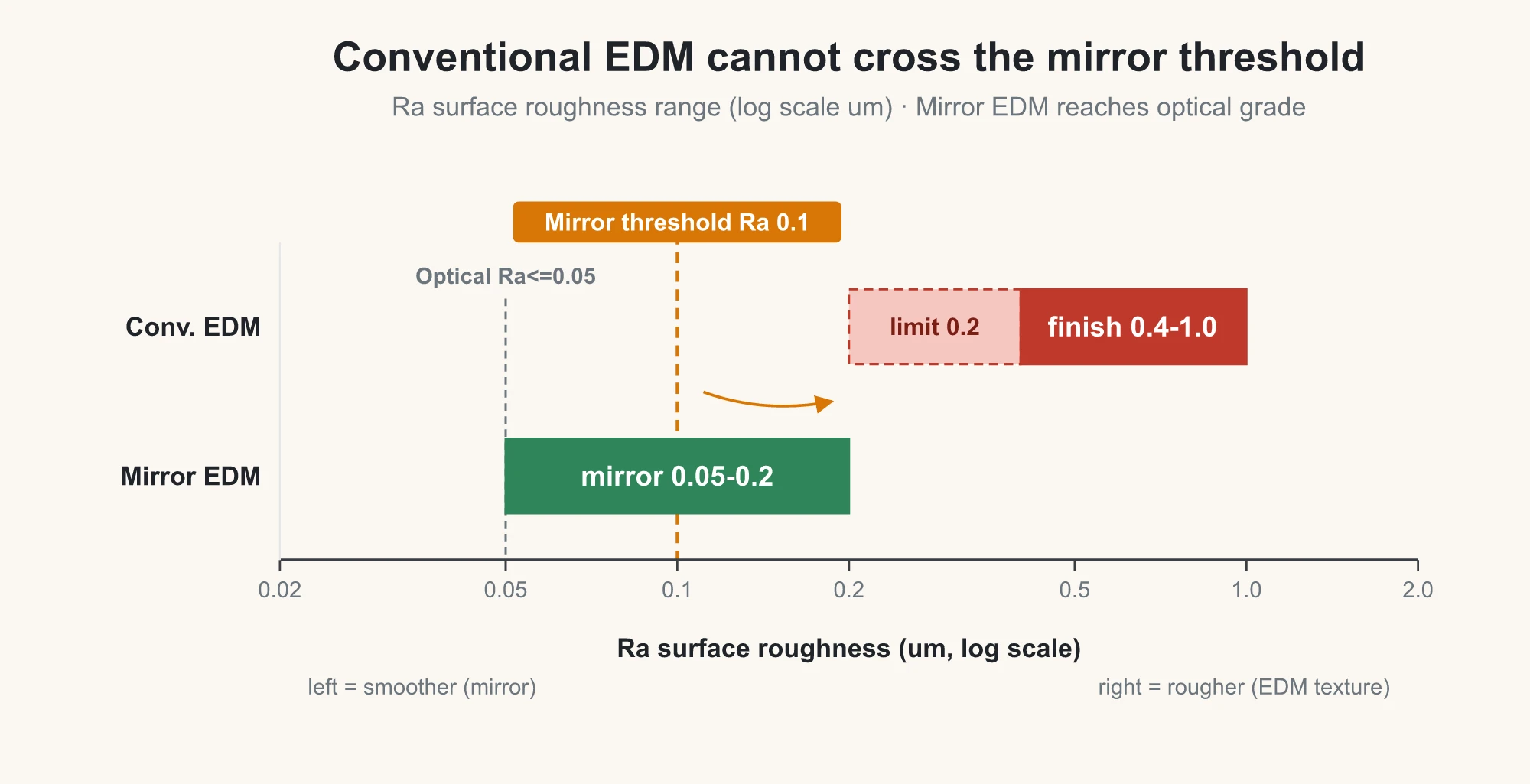
Mirror-grade Ra usually requires ≤0.1 μm. The practical limit of conventional EDM is Ra 0.4-1 μm in finishing. Some high-end machines, pushed to the limit, can reach 0.2-0.4 μm. They cannot go lower.
The bottleneck is not operator skill. It is physics. This is not about budget or worker effort. It is about hard physical limits. There are two dead ends, and neither can be bypassed.
The first dead end is the discharge crater.
An EDM surface is built from countless microscopic discharge crater features that the naked eye cannot see. In a conventional EDM (sinker EDM) machine, the energy in each pulse is high, so each crater is large and deep. The combined surface must be rough. Here is the key number: to reach a mirror-grade surface, the single-pulse discharge energy must be reduced to less than one-hundredth of a conventional machine. Each crater must become smaller than the wavelength of visible light so light can reflect in an orderly way. That is the basic logic behind a mirror finish.
The second dead end is the recast layer.
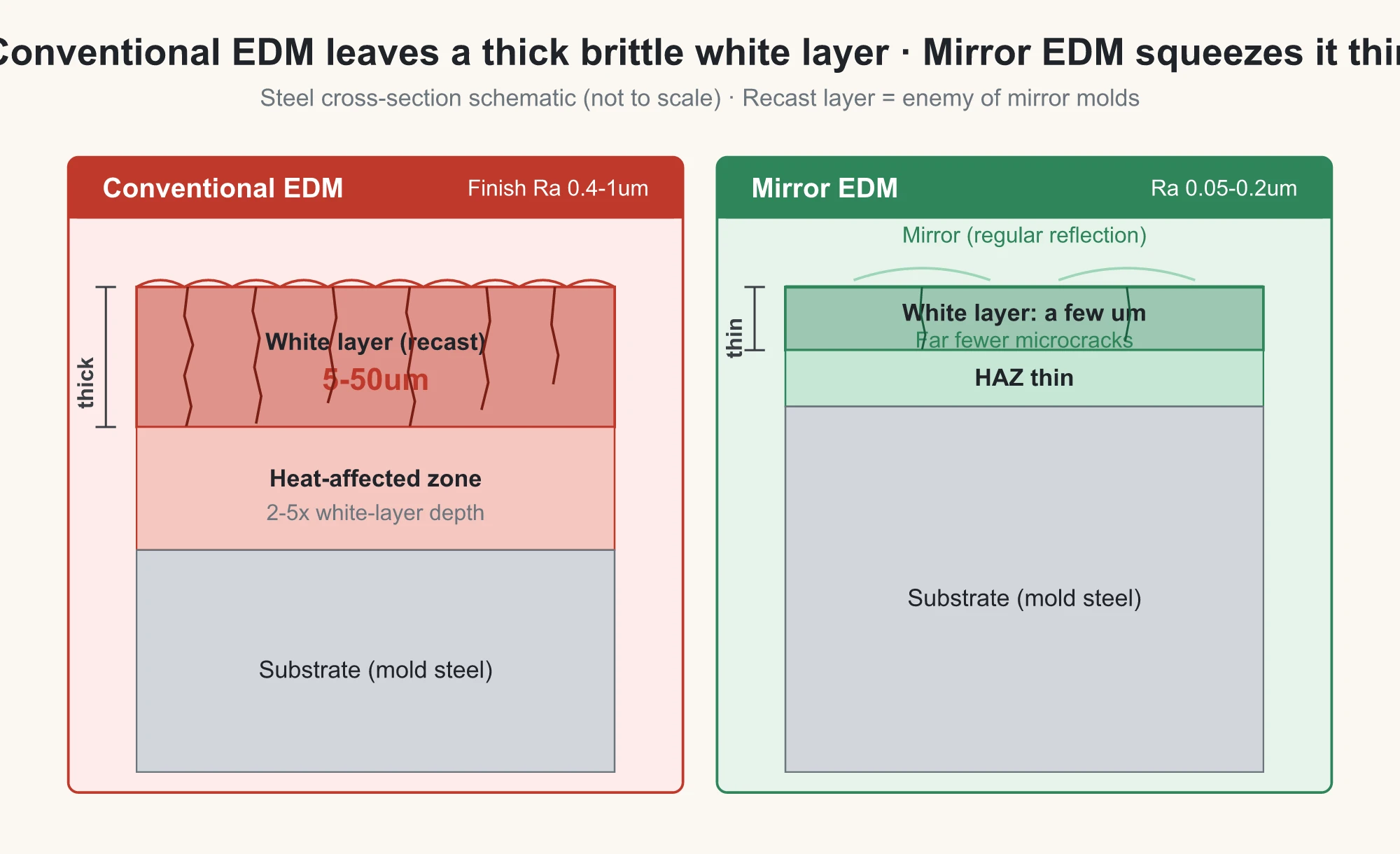
At the moment of discharge, the local temperature rises to several thousand degrees. The molten metal is then quenched rapidly by the dielectric fluid, forming a hard and brittle recast layer on the surface. In the trade, it is also called the white layer. It is filled with microcracks and residual tensile stress. Based on cross-checked data from multiple metallographic testing laboratories and academic literature, the typical recast layer thickness after conventional EDM falls in the 5-50 μm range. Finishing leaves a thinner layer, while rough machining leaves a thicker one. Beneath it sits a heat-affected zone (HAZ) that is typically 2-5 times thicker.
For a mirror-finish injection mold, this layer is exactly what causes trouble. It makes polishing much harder. If the process goes wrong, microcracks can be carried into the substrate. Under production temperature and pressure, they can later show up as flow marks/splay or orange peel on molded parts. This is why some suppliers produce an attractive RA report, but the mold fails once mass production starts. The root cause is here.
Conventional equipment also cannot support mirror finishing at the hardware level. Three factors stack up together:
The pulse power supply cannot produce small and ultrashort pulses. The servo drive relies on a ball screw, so the discharge gap drifts back and forth in the 20-100 μm range and cannot be held at the submicron level. In finishing, chip removal still depends on high-flow flushing, which disturbs discharge stability instead. Put those three together, and forcing a conventional machine down to Ra 0.2 can take four to five times longer than a mirror-finish machine. In a multi-cavity mold, cavity-to-cavity consistency cannot be guaranteed at all.
Why a Mirror-Finish EDM Machine Can Produce a Mirror Surface
How does a mirror-finish EDM machine solve those two dead ends? It comes down to three things. If one is missing, the Ra value will not come down.
First, the digital pulse power supply.
A mirror-finish EDM machine can output ultra-low-energy short pulses in the nanosecond-to-microsecond range. The single-pulse discharge energy is reduced to less than one-hundredth of that of a conventional machine. Lower energy means shallower discharge crater formation. When millions of shallow craters are distributed evenly, the result is a mirror surface. This is the core of the mirror-finish EDM machine.
Second, a servo drive powered by a linear motor.
High-end mirror-finish machines use a planar linear motor rather than a traditional ball screw. There is no mechanical contact and no screw wear. Sodick publicly claims that positioning accuracy does not drift for ten years, and electrode wear can be held below 0.06%. That is the number to remember: electrode wear below 0.06%. Only when the gap is stable can the machine avoid abnormally large sparks that burn pits into the workpiece.
Third, multi-stage finishing.
From roughing to semi-finishing, finishing, and ultra-finishing, the process reduces current and pulse duration step by step. Each stage links automatically to the next through a built-in parameter table. There is also an optional route called powder-mixed EDM (PMEDM), which suspends silicon powder or aluminum powder in the kerosene dielectric fluid at a concentration of several grams per liter. The suspended powder spreads what would otherwise be concentrated discharge into many small discharge events. The discharge gap becomes wider, the energy becomes more evenly distributed, and the Ra value can be pushed lower.
This is an enhancement method, not the only principle. Mainstream commercial mirror-finish machines rely primarily on ultra-fine pulse power supplies. Powder-mixed EDM is an additional route for improvement. A supplier should not claim that mirror finishing is impossible without powder-mixed EDM. That is a different issue.
The EDM electrode material also needs to change. Pure copper is fine for roughing. In finishing and mirror stages, copper-tungsten alloy (CuW70-CuW80) is required. It offers low wear, stable discharge, and good thermal stability, making it the standard choice for mirror-grade work. Above that is silver-tungsten alloy, used for ultra-mirror applications, but it is expensive. Another detail often missed is that the EDM electrode surface roughness transfers directly to the workpiece. If the electrode is not polished, the workpiece cannot be polished either. It looks minor, but it cannot be ignored.
With lower single-pulse discharge energy and lower heat input, the recast layer produced by a mirror-finish EDM machine is much thinner than that from conventional EDM. A conventional machine can easily leave a white layer tens of microns thick. A mirror-finish EDM machine can reduce it to only a few microns, with fewer microcracks. This directly affects how easy later polishing will be and how long the mold lasts in production.
| Dimension | Conventional EDM | Mirror-finish EDM machine |
|---|---|---|
| Single-pulse discharge energy | High (deep craters) | Less than 1/100 of a conventional machine |
| Ra limit | Ra 0.4-1 μm in finishing; 0.2-0.4 μm at the limit | Ra 0.05-0.2 μm |
| Recast layer | Typically 5-50 μm, with microcracks | Only a few microns, with fewer microcracks |
| Gap drive | Ball screw, unstable gap | Linear motor, stable at the submicron level |
| Dielectric fluid | Standard kerosene | Temperature-controlled circulation, optional powder-mixed EDM |
| Typical applications | Structural cavities, non-appearance parts | Mirror surfaces, high-gloss injection mold, optical parts |
A mirror-finish EDM machine is not simply a more precise version of a conventional EDM (sinker EDM) machine. It is a different discharge logic. If the question is whether a shop can make Ra 0.1, a supplier with a mirror-finish EDM machine will take the order. A supplier without one can only force conventional equipment to try it slowly and inconsistently. That is why having this machine determines whether the job can be done at all.
How Key Parameters Are Set
A mirror finish is not achieved in one pass. The process moves stage by stage, from rough to fine. The rhythm of that sequence and the control of several key parameters directly determine whether the target Ra can be reached. There are three main points.
First, peak current.
The process starts with roughing at more than ten amps, drops to several amps in semi-finishing, and then steps down to fractions of an amp in the mirror stage. At the same time, pulse duration is reduced from several hundred microseconds to only a few microseconds. Pulse interval is increased to give the dielectric fluid time to deionize. In the mirror stage, electrode jump height needs to be reduced to less than 0.5 mm. The periodic backward movement of the EDM electrode clears eroded debris. Without an electrode jump, debris cannot be removed, and secondary discharge creates pitting rather than a mirror surface. Today, this parameter sequence is written into the machine’s process library. It no longer depends on operator trial and error.
Second, dielectric fluid temperature control.
Mirror-finish discharge is sensitive to temperature. If temperature fluctuates, dielectric fluid viscosity and the discharge gap both drift, and the Ra change appears on the workpiece immediately. Shops making mirror surfaces need temperature-controlled circulation for the dielectric fluid, usually held within a narrow range around 20-25 °C based on industry practice. In summer, a shop without air conditioning will see obvious RA deterioration. This is a known problem in real production.
Third, steel grade matching.
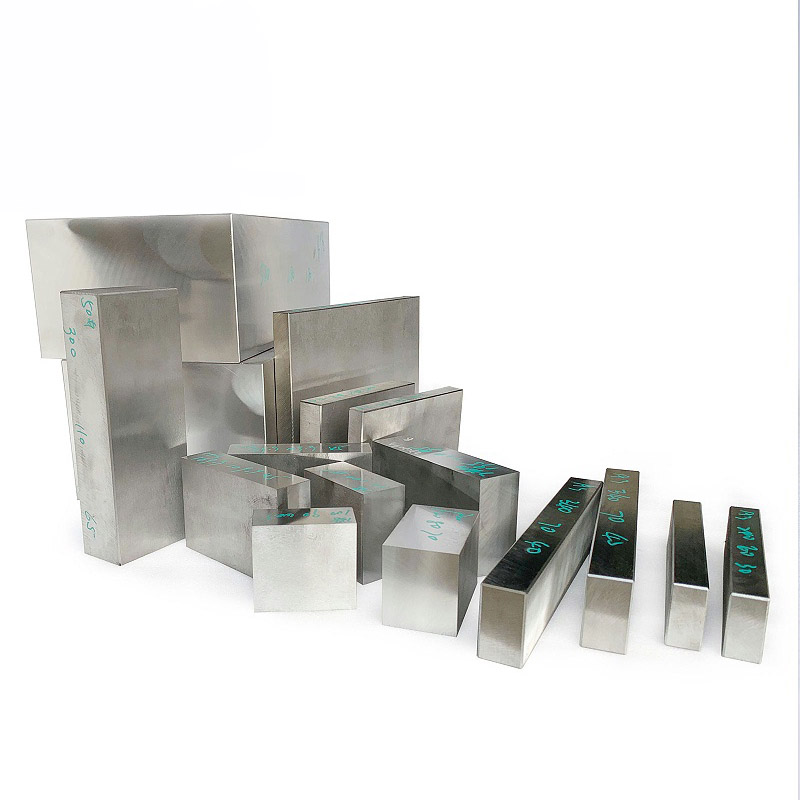
Material selection matters in mirror-finish injection molds. Not every steel can produce a true mirror surface.
NAK80 is the first choice for mirror-grade applications because its microstructure is uniform enough in the pre-hardened condition. S136 should be the electroslag remelting (ESR) version and hardened to 48-52 HRC. That is when its mirror performance appears, along with good corrosion resistance, making it suitable for PVC and medical parts. 718H offers good value, though it contains slightly more impurities and is suitable for general high-gloss appearance parts. P20 has only average polishability and should not be pushed into mirror work. H13 is a hot-work tool steel mainly used for Die Casting Molds, not the first choice for mirror-finish injection mold applications. It can still be machined by EDM, but its carbide segregation is relatively heavier, so achieving an extreme mirror finish is not cost-effective.
How moldsteells Implements This Process
Whether a mirror-finish EDM machine is truly essential depends on the supplier’s equipment list. After years of making mirror-finish parts, one point is clear at moldsteells: those two Sodick mirror-finish machines cannot be replaced. Some jobs simply cannot clear the RA requirement without them.
moldsteells runs a total of 11 EDM machines. Two Sodick mirror-finish EDM machines, purchased in 2022, are dedicated to mirror work. They work alongside machines such as the Charmilles F0350 and the Diemeng CNC-B40 for roughing and semi-finishing. EDM electrodes and inserts are processed with Sodick wire-cut EDM/wire EDM. Final dimensions are checked on a SEREIN coordinate measuring machine (CMM) using a Hexagon system. Machining accuracy is held steadily at ±0.005-0.01 mm.
A typical process chain for a mirror-finish injection mold looks like this: CNC rough-machines the mold cavity first. After Heat Treatment, wire-cut EDM/wire EDM cuts the inserts and EDM electrode datum surfaces. A grinder finishes the EDM electrodes. Then a conventional EDM (sinker EDM) machine removes stock, and the Sodick mirror-finish EDM machine runs multi-stage finishing to create the mirror surface. Final full inspection is done by CMM, followed by light manual polishing if needed.
In this chain, the mirror-finish EDM machine handles one step only: the mirror surface itself. Other steps can be substituted. This one cannot. It is like the salt in a dish. If the salt is wrong, the whole dish fails.
How to Inspect and Accept a Mirror-Finish Injection Mold
An Ra value is not valid just because the supplier reports it. Mirror-finish acceptance has methods, grades, and hidden risks.
Start with the grading.
For standard appearance parts, Ra 0.4-0.8 μm is usually enough, with no obvious EDM pattern visible to the naked eye. High-gloss injection mold parts generally need Ra 0.2-0.4 μm. To truly qualify as a mirror finish, the value needs to be within Ra 0.1 μm. Optical lens grade needs to be below 0.05 μm. A common industry rule is this: if Ra falls in the 0.1-0.2 μm range, visual reflection is clear, and further manual polishing brings no obvious improvement, then the mirror level is considered acceptable.
Then look at how it is measured.
Do not rely on a single Ra number. Different instruments and different sampling length settings can produce readings that differ by 20-30%. A formal contract should specify the instrument type clearly, whether a stylus profilometer or a white-light interferometer is used, as well as the sampling length and evaluation length. Typical sampling lengths are 0.08 mm or 0.25 mm. For mirror-grade work and above, a white-light interferometer is the better choice. For optical parts, an atomic force microscope (AFM) should be used as the final referee. In a multi-cavity Injection Mold, each cavity must be sampled separately by level. Do not let a supplier submit data from only the easiest cavity.
There is one more hidden issue to watch.
A supplier may hand over a report showing Ra 0.05, yet the molded parts later develop flow marks/splay or orange peel in mass production. Based on industry experience, that usually does not mean the roughness was too high. It means the recast layer was not removed cleanly, and microcracks plus residual tensile stress showed up under production temperature and pressure. This is the production-stage echo of the same dead end discussed earlier. So acceptance cannot stop at the RA number. It must include actual trial-molded sample evaluation.
One sentence sums it up: an RA that passes inspection does not automatically mean the mold will pass production.
One more point: mirror-finish EDM does not completely replace manual polishing. For extreme optical-grade mirror surfaces at Ra ≤0.05, light polishing may still be needed after EDM, and in some cases ion beam polishing or magnetorheological finishing is used for final correction. Even so, mirror-finish EDM has several clear advantages over pure manual polishing: multi-cavity consistency, where cavity-to-cavity variation can be controlled within a few microns; complex geometry, such as deep narrow slots and freeform surfaces that manual tools cannot reach; zero polishing deformation, because non-contact machining applies no polishing force and will not collapse thin walls or sharp corners; and repeatability, because fixed parameters deliver stable batches instead of depending on a veteran polisher’s feel. In high-volume work, complex surfaces, and applications that require high consistency, mirror-finish EDM clearly outperforms manual polishing. For simple, flat, single parts in small batches, manual polishing may not cost much more.
In the end, a mirror finish is not polished into existence later. It is determined at the moment of discharge. That is the one sentence worth remembering.
The next time a drawing calls for a mirror-finish part with Ra 0.05, ask the supplier three questions before requesting a quote: do they have the right mirror-finish EDM machine, what steel grade will they use, and can they provide actual Ra test data plus trial-molded sample results? Only if all three are answered clearly does it make sense to move forward.
If the tool is wrong, effort is wasted. The real question is: which step is blocking the mirror-finish part now?