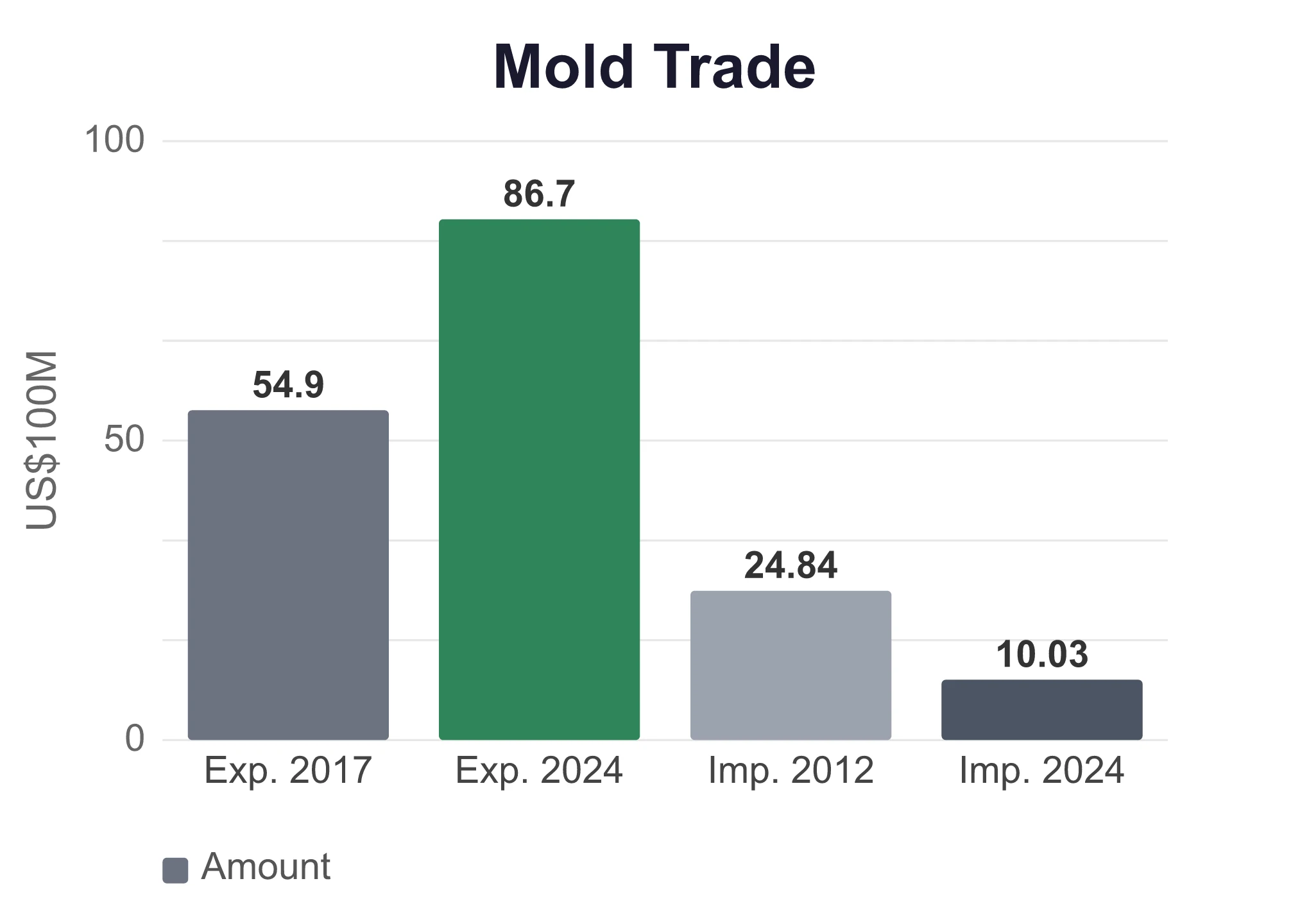
According to China’s General Administration of Customs, the country’s mold exports increased from $5.49 billion in 2017 to $8.67 billion in 2024, a rise of nearly 60% over seven years. The actual scale of overseas sourcing is clearly growing.
What buyers really need to establish is where the lower price comes from and whether quality can be verified. China’s cost advantage in mold making mainly comes from equipment utilization, industrial clustering, and supply chain efficiency. Quality, however, depends on the individual factory and cannot be judged from the words “Made in China” alone.
The Numbers Show More Buyers Are Sourcing from China
$8.67 billion is approximately RMB 61.7 billion. Molds are custom industrial products purchased far less frequently than ordinary goods, so this is not a figure that a few low-priced orders could produce.
China’s mold imports have also declined over a longer period, falling from $2.484 billion in 2012 to $1.003 billion in 2024. Rising exports indicate expanding overseas demand, while lower imports show that China’s domestic industry continues to replace imported capacity. Taken together, the two trends suggest that mold design, machining, tryout, and supporting supply chains have developed into a relatively complete manufacturing system.
US reshoring has brought some orders back to domestic manufacturers, but it has not eliminated cross-border sourcing. Buyers cannot evaluate mold procurement by country of origin alone. They still compare quotations, lead times, tryout records, and inspection reports. As long as Chinese suppliers retain an overall advantage over local overseas production, China will continue to appear on international buyers’ request-for-quotation lists.
Three Quotes Show the Price Gap Is Real
It is not unusual for quotations for the same mold to differ severalfold between countries. The following three public records come from different channels and circumstances. They cannot establish a universal price, but they do show that large gaps exist.
An Austrian buyer shared two quotations for a silicone injection mold in Reddit’s AskEngineers community: EUR 90,000 in Austria and EUR 20,000 in China, a difference of 4.5 times. Engineers in the discussion said that EUR 20,000 could reasonably produce a silicone injection mold that met the stated requirements. This was one buyer’s actual decision, not an industry average.
US injection molder Echo Supply states the difference more directly in its own cost article: a mold made in the United States typically costs four to five times as much as one sourced overseas. The comparison covers US production and several overseas regions. It demonstrates that domestic US tooling is generally more expensive, but it does not define a fixed price ratio for every US-China project.
The third quotation comes from a Quora discussion about mold pricing. A project owner sourcing a compression seal ring with a 30 mm outside diameter reported that the same mold cost approximately three times as much in the United States as in China. The example includes a specific product and sourcing context, but it remains one person’s project experience.
These three cases show project-specific differences of three to five times. The Haizol 2026 Supplier Network Report and public quotations from Rayleap, PlasticMoulds, and ZetarMold indicate that Chinese molds are typically quoted 40% to 60% below comparable prices in the United States and Europe. The difference tends to be larger for simple projects with standard tolerances and narrower for complex, high-precision work. A severalfold difference in one project should not be treated as a rule for every mold.
These ratios are meaningful only when the specifications match. When reviewing an Injection Mold quotation, buyers should align the cavity count, mold steel grade and hardness requirement, surface finish, target production life, and delivery documentation item by item. If the configurations differ, even an eye-catching price multiple has little comparative value.
Labor Is Not the Only Reason Costs Are Lower
If mold steel, machine tools, and energy all have to be paid for, how can quotations still be 40% to 60% lower? Lower labor costs alone do not explain it. A large share of a mold quotation consists of machine time. Once equipment has been purchased, its fixed cost must be allocated across productive machining hours. When equipment has a steady flow of projects, each project carries a smaller share of that fixed investment. When machines sit idle for long periods, quotations must absorb more of the cost of those unused hours.
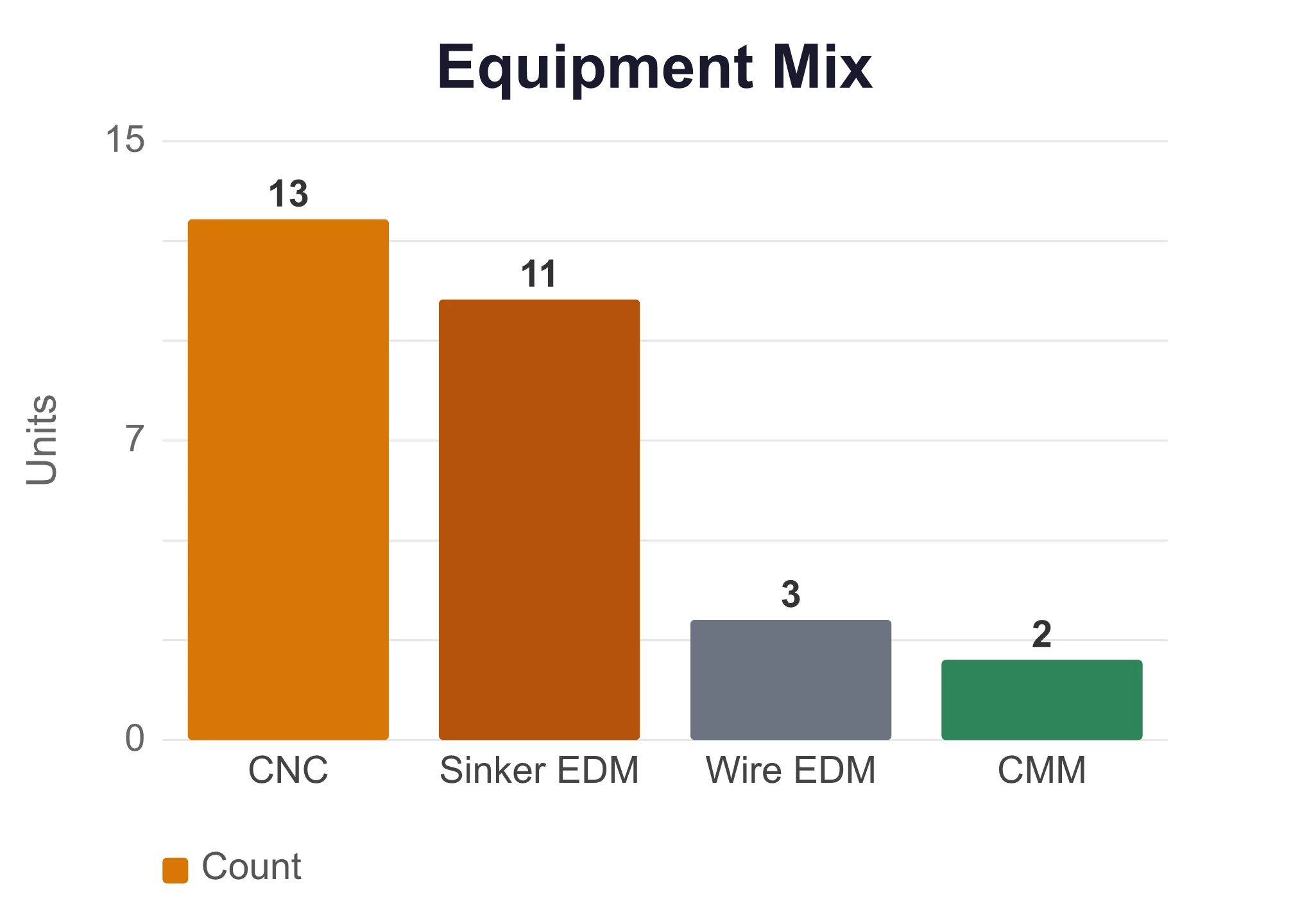
moldsteells currently operates 48 production and inspection machines, including 13 CNC machining centers, 11 sinker EDM machines, three Wire Cutting / EDM machines, and two coordinate measuring machines. The factory has expanded its equipment since 2015 and added six CNC machining centers and one 280-ton mold spotting machine in May 2026. This continued investment allows machining and inspection processes to connect within the plant. The more continuous the schedule, the more productive hours are available to absorb fixed costs. Equipment quantity does not automatically produce a low price; the key question is whether the equipment is actually used for machining and inspection.
Industrial clustering reduces waiting time. Mold industries are concentrated in Guangdong, Zhejiang, and Jiangsu, where mold steel, mold bases, hot runners, and subcontracted processes can be purchased and circulated over relatively short distances. Avoiding one long-distance shipment or one extra round of subcontractor coordination reduces the time for which a project occupies machines and personnel. The moldsteells group also operates a mold steel processing business, allowing the team to verify material origin, grade selection, and heat-treatment requirements earlier and reduce the risk of selecting the wrong material or passing along incomplete requirements.
What Evidence Actually Proves Mold Quality
A lower price does not necessarily mean lower quality, but the risk of omitted processes is real. The Quora project owner sourcing the seal-ring mold warned that some factories might skip an agreed mold steel hardening process, causing premature mold failure. One person’s experience cannot represent every Chinese factory, but it identifies a verifiable issue: did the mold steel reach the specified hardness? Buyers do not need another claim that “quality is excellent.” They need evidence left by the process.
A mold steel hardness test shows whether the material and heat treatment meet the agreement. Records from the initial T0 tryout and the T1 and T2 trials after corrections show when problems were found and what was changed. A first-article full-dimensional inspection report directly verifies whether critical sample dimensions match the drawing. These three document groups cover material, process, and result. A missing document does not automatically mean the mold is defective, but if none of the three can be explained clearly, a buyer cannot tell whether the lower price came from efficiency or from omitted work.
The existence of a report is not enough. A dimensional report must correspond to the current sample and the same drawing revision. Tryout parameters must align with the modification history, while hardness results must match the mold steel and heat-treatment requirements in the quotation. When the records agree from one stage to the next, a remote buyer has a basis for verification. A certificate marked “qualified” without a revision number or measurement points provides very limited evidence.
At moldsteells, the quality-control process has nine checkpoints, from review of the customer’s mold specification sheet to the final pre-shipment inspection. The third checkpoint is mold steel hardness testing. During machining, the team also checks electrodes, core and cavity dimensions, and assembly. Tryout reports and sample inspection results are retained after testing. Two in-house coordinate measuring machines are used for dimensional inspection, and precision machining tolerances can reach +/-0.005 to +/-0.01 mm. The useful part is not the number of checkpoints itself. It is the ability to trace hardness, dimensions, tryout parameters, and final inspection results to records that buyers can verify against the contract and delivery documents.
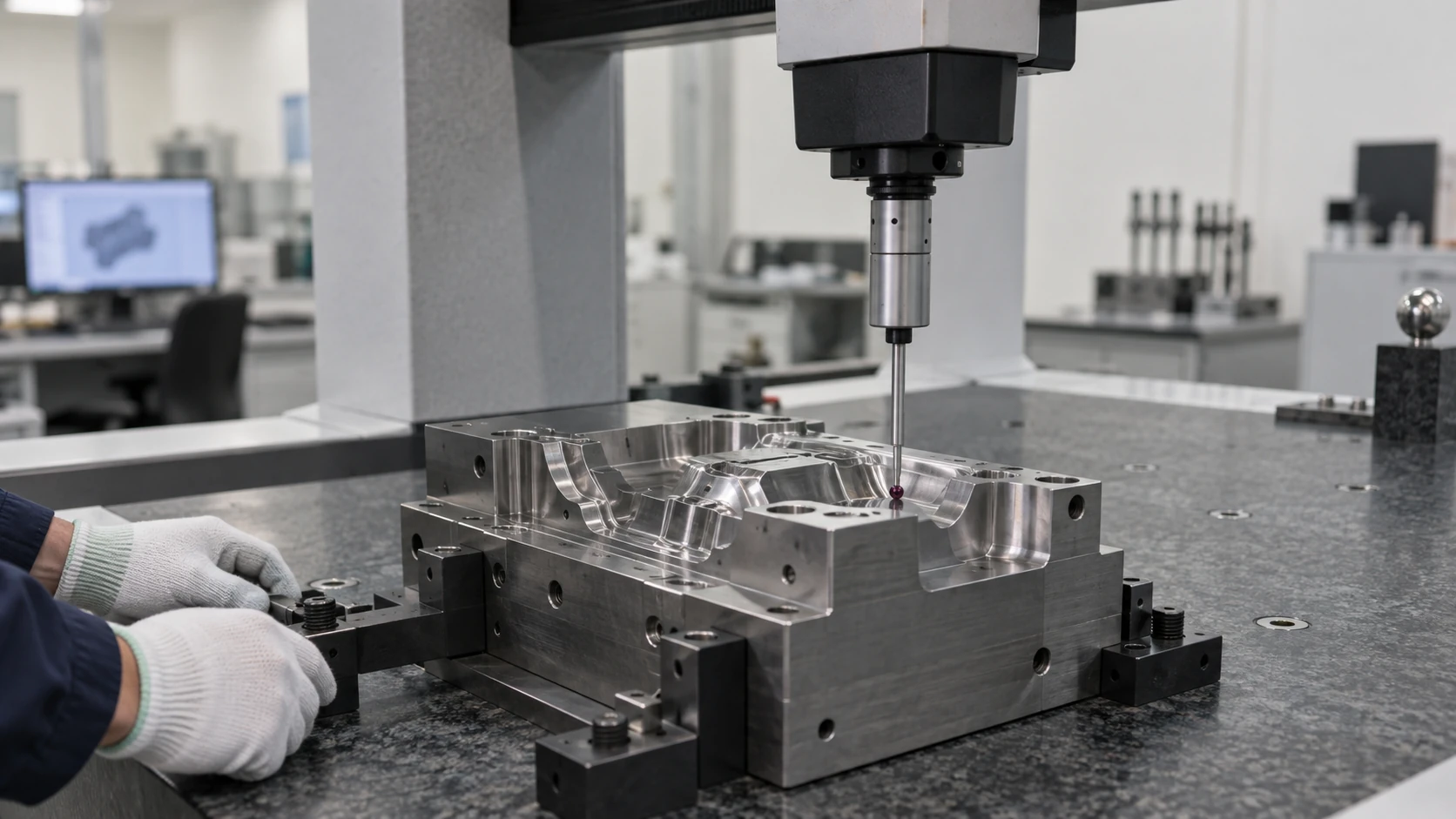
Mold quality ultimately depends on the machining and inspection performed by a specific factory, not on a broad country-of-origin label. The most useful signs of reliability are not adjectives on a website or photographs of equipment. They are a quotation that specifies mold steel and heat treatment, a continuous tryout history, and a full-dimensional report that matches the drawing revision.
When Cross-Border Mold Making Is Not a Good Fit
Based on public data from companies including PlasticMoulds and Aprios, the manufacturing time alone for a production injection mold is usually six to twelve weeks in China and approximately six to ten weeks in the United States. The difference is not large. A mold shipped from China must also allow another four to eight weeks for ocean freight.
Local mold making is often the safer option in three situations: the drawings are still changing frequently and engineers need to visit the shop at short notice; the schedule does not leave enough time for both mold manufacturing and transportation, while ocean freight alone may take four to eight weeks; or the order volume is so small that tooling savings cannot offset tariffs, freight, and repeated modification costs. Tariffs must be confirmed separately for the destination and customs classification.
Conversely, projects with frozen drawings, ongoing demand, and acceptance documents defined in the contract are more likely to turn China’s equipment utilization and supply chain efficiency into real savings. The growth in exports from 2017 to 2024 reflects this repeatable combination of cost and delivery capability, not a one-time low price.
We are moldsteells, an Injection Mold Manufacturer focused on precision mold manufacturing. If you have drawings and want to determine whether your project is suitable for mold making in China, send them to us for a manufacturability review and mold plan assessment. The first step is to make the cost, timing, and acceptance requirements clear.