What is K110 Mold Steel?
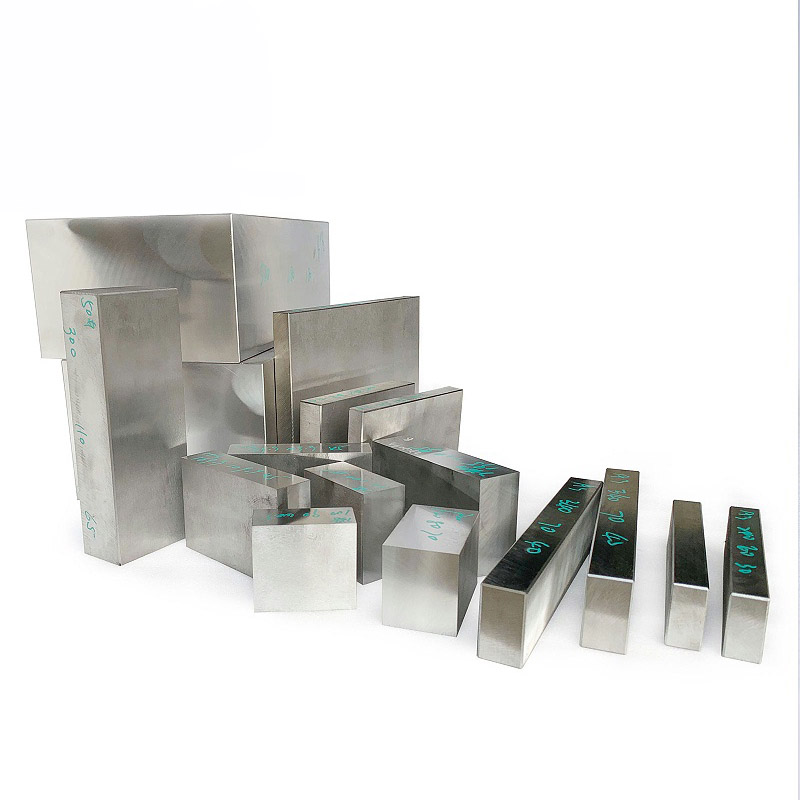
K110 is a high-carbon, high-chromium cold work mold steel with a carbon content of 1.50%-1.70% and a chromium content of 11%-13%. After quenching, its hardness can reach HRC 60-64. It boasts excellent wear resistance and good dimensional stability, with a compressive strength of approximately 2800 MPa. It is ideal for manufacturing high-load, high-wear cold work molds such as cold punching dies, cold heading dies, and drawing dies, making it the preferred material for applications requiring extreme wear resistance.
Main Characteristics of K110 Steel
- Ultra-High Hardness: Quenched hardness of HRC 60-64, superior to D2 steel, suitable for high-wear applications like high-load cold punching and heading.
- Excellent Wear Resistance: High carbon and chromium content form a large number of carbides. Wear resistance is better than Cr12 steel and second only to high-speed steel, significantly extending mold life.
- Great Dimensional Stability: Minimal deformation during heat treatment ensures mold precision, suitable for precision blanking dies and drawing dies.
- High Compressive Strength: Compressive strength is approx. 2800 MPa, with bending strength at approx. 2200 MPa, capable of withstanding heavy-duty conditions.
- Moderate Toughness: Impact toughness $\alpha_k$ is about 12-15 J/cm², maintaining high hardness while reducing the risk of brittle fracture.
- Good Polishing Performance: High surface finish can be achieved after proper treatment, suitable for precision molds requiring high surface quality.
- Basic Corrosion Resistance: Chromium content of 11%-13% provides fundamental anti-corrosion capabilities for humid environments.
- Good Grindability: Easy to grind to achieve high surface quality, facilitating finishing and repairs.
1. Chemical Composition Table
| Element Symbol | Typical Content (%) | Standard Range (%) | Core Role |
|---|---|---|---|
| Cr | 11.5 | 11.00-13.00 | Forms chromium carbides to increase hardness, improve hardenability, and provide corrosion resistance. |
| C | 1.55 | 1.40-1.60 | Provides hardness and wear resistance; forms carbides to enhance edge retention. |
| Mo | 0.7 | 0.70-1.20 | Improves hardenability and toughness; enhances wear resistance and high-temperature strength. |
| V | 1.0 | 0.50-1.10 | Refines grains; forms hard vanadium carbides to improve wear resistance and toughness. |
| Mn | 0.4 | ≤0.60 | Increases hardenability and improves processing performance and strength. |
| Si | 0.3 | ≤0.60 | Improves strength and heat resistance; acts as a deoxidizer. |
| P | ≤0.001 | ≤0.030 | Impurity element; requires strict control. |
| S | – | ≤0.030 | Impurity element; requires strict control. |
2. K110 Physical Properties Table (Inherent Material Attributes)
| Performance Index | Value Range | Unit | Remarks |
|---|---|---|---|
| Density | 7.7 | g/cm³ | At room temperature, approx. 0.278 lb/in³ |
| Melting Point | 1420 | °C | Approx. 2590°F |
| Elastic Modulus | 200 | GPa | Young’s Modulus at room temperature |
| Poisson’s Ratio | 0.28-0.30 | – | Elastic deformation parameter |
| Specific Heat Capacity | 460 | J/(kg·K) | At room temperature (20°C) |
| Thermal Conductivity | 20-25 | W/(m·K) | Increases slightly with temperature at room temperature |
| Thermal Expansion Coeff. | 10.4-11.7 | ×10⁻⁶ /°C | Temperature range 20-100°C |
| Electrical Resistivity | Approx. 0.57 | μΩ·m | At room temperature |
| Hardness (As-delivered) | ≤250 | HB | Soft annealed state |
| Hardness (Heat-treated) | 60-62 | HRC | After quenching + low-temperature tempering |
| Tensile Strength (Annealed) | ≥480 | MPa | Minimum value in annealed state |
| Tensile Strength (Quenched) | ≥2000 | MPa | High hardness state after quenching and tempering |
| Yield Strength (Annealed) | ≥275 | MPa | Minimum value in annealed state |
| Yield Strength (Quenched) | ≥1800 | MPa | High hardness state after quenching and tempering |
| Elongation | Approx. 16 | % | Under annealed state |
3. K110 Mechanical Properties Table (Stress Response Characteristics)
| Performance Index | Value Range | Unit | Remarks |
|---|---|---|---|
| Hardness (Quenched) | 63-65 | HRC | As-quenched state before tempering |
| Hardness (200°C Temper) | 61-62 | HRC | Recommended for cold work molds |
| Hardness (250°C Temper) | 59-60 | HRC | Improved toughness, slightly lower hardness |
| Tensile Strength | 2200-2500 | MPa | After quenching + low-temp tempering |
| Yield Strength | 1800-2000 | MPa | After quenching + low-temp tempering |
| Compressive Strength | 2800-3200 | MPa | Key indicator for cold extrusion dies |
| Bending Strength | 2500-2800 | MPa | Ability to withstand bending loads |
| Elongation | 1.5-2.5 | % | Low elongation for high-hardness materials |
| Impact Toughness (Unnotched) | 12-15 | J/cm² | Typical value at 200°C tempering |
| Impact Toughness (200°C Temper) | 10-12 | J/cm² | Low-temp tempering, priority on hardness |
| Impact Toughness (250°C Temper) | 13-15 | J/cm² | Mid-temp tempering, priority on toughness |
| Fatigue Strength ($10^7$ cycles) | 650-750 | MPa | Cyclic fatigue limit |
| Elastic Modulus | 200-210 | GPa | Young’s Modulus at room temperature |
| Poisson’s Ratio | 0.28-0.30 | – | Elastic deformation parameter |
| Wear Resistance (Pin-on-Disk) | 0.08-0.12 | mm³/(N·m) | Pin-on-disk wear test data |
| Wear Resistance (Dry Wheel) | 0.5-0.8 | mm³/1000 times | Dry sand/rubber wheel wear test data |
Typical Applications of K110 Mold Steel
| Application Field | Core Characteristics | Typical Products | Performance Advantage |
|---|---|---|---|
| Precision Stamping | High Wear Resistance + Dimensional Stability | Connectors, Motor Cores, Precision Springs | Life increased by 3x+ vs Cr12; 67%-100% vs D2 |
| Cold Extrusion | High Compressive Strength + Wear Resistance | Aluminum Profiles, Non-ferrous Parts | Life increased by 2-3x vs ordinary mold steel |
| Powder Metallurgy | Ultra-high Wear Resistance + Precision | Gears, Precision Structural Parts | Life increased by 4x (20k to 80k cycles) |
| Thread Processing | High Hardness + Wear Resistance | Bolt/Screw Thread Rolling Dies | Life significantly superior to D2 steel |
| Cold Heading | High Wear Resistance + Compressive Strength | Bolt/Nut Cold Heading Dies | Good performance for mass production |
| Shearing/Cutting | High Wear Resistance | Thin Sheet Shearing Dies (≤1mm) | Longer life for thin material shearing |
| Stretching/Drawing | High Wear Resistance + Dimensional Stability | Wire/Tube Drawing Dies | Excellent wear resistance and size retention |
Scenarios Where K110 is NOT Recommended
| Not Recommended Scenario | Core Limitations | Typical Failure Mode | Alternative Material Suggestion |
|---|---|---|---|
| Cold Heading/Extrusion | Low Impact Toughness (10-15J/cm²) | Chipping, Fracture (<500 pieces) | DC53, LD, S7 |
| Thick Plate Blanking (≥3-6mm) | Insufficient Toughness | Edge Chipping, Cracking | A2, D2, Cr12MoV |
| Large Molds (Length >500mm) | Limited Hardenability | Cracking, Deformation during heat treatment | Cr12MoV |
| Hot Work Molds (>250°C) | Insufficient Thermal Stability | Softening, Failure | H13 |
| Plastic Molds | Hard to Machine, No Corrosion Resistance | Difficulty in processing, Rusting | 718H, S136, NAK80 |
| Precision Progressive Dies | Insufficient Fatigue Strength | Fatigue Cracking (at 30k cycles) | SKH-9, SKH-51 |
| Deep Drawing Dies | Poor Ductility (1.5-2.5% Elongation) | Cracking | Cr12MoV |
| Shearing Thick Plates (≥6mm) | Insufficient Impact Resistance | Edge Chipping, short life (50% of D2) | LD, Cr12MoV |
| Auto Body Panel Drawing | Poor Ductility, Insufficient Toughness | Orange-peel Cracking | Specialized Drawing Steel |
| Thin-walled/Sharp Corner Molds | Stress Concentration, Low Toughness | Fracture at Sharp Corners | Higher Toughness Mold Steels |
| Mirror Polishing Required | High Chromium, Poor Polishing | Cannot reach mirror finish | S136, NAK80 |
| Powder Metallurgy Dies | Insufficient Compressive Strength | Rapid Wear due to impact | Specialized Powder Metallurgy Steels |
What Tools to Use for K110 Machining?
| Stage / Material Hardness | Tool Type | Coating Priority | Recommended Brands |
|---|---|---|---|
| Roughing (Annealed HRC25-30) | Standard Carbide (WC-Co) | TiAlN Coating | Zhuzhou Diamond YC30S, Sandvik GC4225, Zigong Great Wall 798 |
| Semi-finishing (Pre-hardened HRC35-45) | Ultra-fine Grain Carbide (0.5-1μm) | AlTiN (Priority) > TiSiN | Sandvik GC1030, Kennametal KC5010, Zhuzhou Diamond YBG205, Iscar |
| Finishing (HRC50-55) | High-performance Carbide or CBN | AlTiN (for Carbide) / No coating (CBN) | Sandvik GC1030, Kennametal KC5010, Halnn Superhard BN-H10 |
| Finishing (HRC55-65) | CBN Tools (Solid or Brazed) | No Coating | Imported: Sumitomo BN-S200/BNC200, Element Six CBN300, Sandvik CB7015, Kennametal KBN10, Seco, Walter, Kyocera; China: Funik FBN-S30, Halnn Superhard, Zhengzhou Xinya |
K110 Machining Parameter Selection Logic
| Core Dimension | Selection Logic | Practical Parameters |
|---|---|---|
| Cutting Speed ($V_c$) | Harder material requires lower speed; CBN allows high speed. | Annealed: 80-150 m/min; Quenched (HRC55-65): 150-250 m/min (CBN) |
| Feed Rate ($F$) | $F = S \times Z \times f_z$; Higher hardness requires lower feed. | Roughing: 0.1-0.25 mm/r; Finishing: 0.05-0.15 mm/r |
| Depth of Cut ($a_p$) | Max 1/10 to 1/5 of tool diameter. | Roughing (Annealed): 0.5-2 mm; Finishing: 0.05-0.3 mm |
| Spindle Speed ($S$) | $S = \frac{1000 \cdot V_c}{\pi \cdot D}$; Larger diameter requires lower RPM. | Annealed: 1200-2000 rpm; HRC55-65: 600-1000 rpm (CBN) |
| Cooling Method | High hardness requires higher pressure cooling (5-8 bar). | Annealed: Emulsion (5-10%); Quenched: High-pressure cooling or Oil-based |
| Path Strategy | Helical/Ramp entry; Climb milling to reduce wear. | Helical entry; Climb milling; Stepover: Roughing 50-70%, Finishing 10-30% |
Typical Problems and Solutions for K110 Steel Molds
1. What to do if K110 cold extrusion dies break easily?
Cause: Low toughness (10-15 J/cm²) cannot withstand the impact load of cold extrusion.
Solutions:
① Reduce hardness to HRC 58-60 to improve toughness.
② Switch to tougher materials (DC53, SKD11).
③ Perform cryogenic treatment.
④ K110 is generally not recommended for cold extrusion.
2. How to solve edge chipping in K110 stamping dies?
Cause: Excessive hardness (HRC 61) reduces toughness; stress concentration at the edge.
Solutions:
① Reduce hardness to HRC 58-60.
② Apply a radius to the edge (R0.3).
③ Check if the stamping material thickness exceeds limits.
④ Switch to Cr12MoV or DC53.
3. What to do about serious deformation after heat treatment?
Cause: Austenite temperature too high, improper cooling, or uneven original structure.
Solutions:
① Use stepped heating.
② Use isothermal quenching processes.
③ Perform spheroidizing annealing beforehand.
④ Leave 0.5-1mm machining allowance.
⑤ Find a professional heat treatment facility.
4. Difficult milling and fast tool wear?
Cause: K110’s high hardness and wear resistance are too much for standard tools.
Solutions:
① Complete most machining before heat treatment.
② Use CBN tools after heat treatment.
③ Use extreme pressure (EP) cutting fluids.
④ Consider DC53 for better machinability.
5. Cracks appearing during grinding?
Cause: Excessive grinding stress or insufficient cooling.
Solutions:
① Use resin-bonded wheels (80-120 mesh).
② Maintain grinding speed at 20-25 m/s.
③ Use ample water-soluble grinding fluid.
④ Intermittent grinding.
⑤ Low-temperature tempering (180-200°C for 2 hours) after grinding.
6. Which tools are best for K110?
Before Heat Treatment: High-speed steel (HSS) tools (W6Mo5Cr4V2) or carbide tools (YG8, YG6).
After Heat Treatment: Must use CBN tools (Sumitomo BN-S200, Kyocera CB50) or diamond tools.
Parameters: Speed 15-30 m/min, Feed 0.05-0.1 mm/r.
Download Detailed K110 Performance Parameters PDF
| Item | Details |
|---|---|
| File | k110-mold-steel-guide-properties-applications-and-machining.pdf |
| Type | application/pdf |
| Size | 219 KB |
| Link | https://moldsteells.com/wp-content/uploads/2026/03/k110-mold-steel-guide-properties-applications-and-machining.pdf |