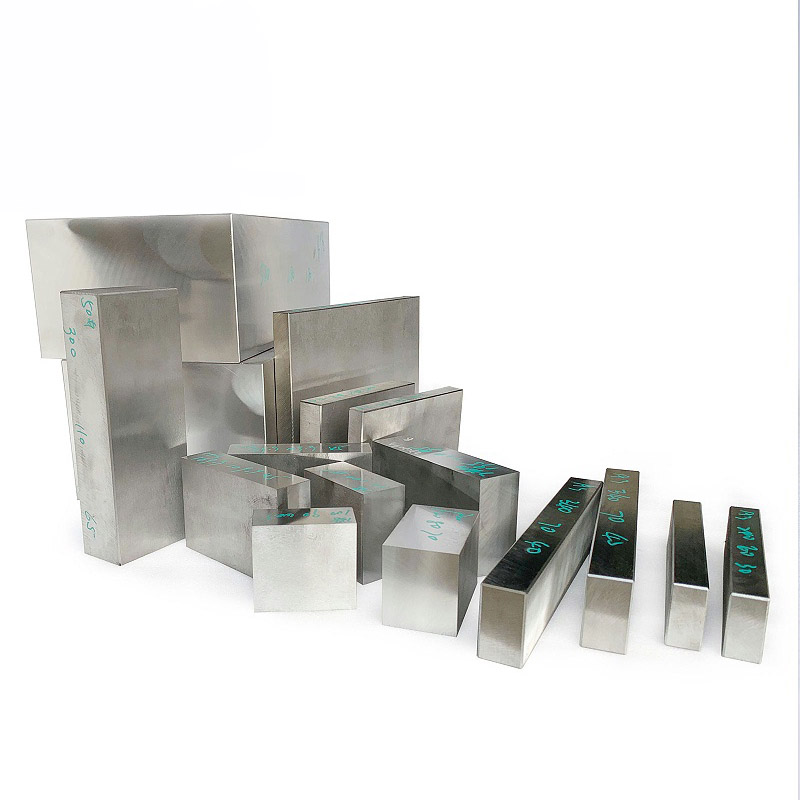
If this is your first time purchasing a full container of mold steel from China, you will most likely not lose on price negotiation.
You may negotiate the price well. You may also have confirmed the grades, such as P20 pre-hardened and H13 annealed. Furthermore, you may have exchanged more than a dozen emails with the supplier, obtained the material certificates, and finalized the payment terms. It may feel as though the hardest part is over.
Then the cargo arrives. When the container is opened, there is a layer of floating rust on the steel bar surfaces, like chili powder scattered over them. Half of the heat number labels are damaged, and the remaining few cannot be matched to the material certificates. If you want to reject the cargo, the shipping line says, “The packaging was intact, so no compensation.” If you would like to file a claim, the insurer says, “Rust is considered natural deterioration.”
This is not fictional. According to internal statistics from the China Shipowners Mutual Assurance Association, there were nearly 100 reported cases of ocean-shipping cargo damage involving steel products in 2024 (this data is internal association reference material, not publicly released, and is for reference only). An academic statistical analysis based on 206 steel cargo damage cases from a major domestic shipping company shows that rust accounted for 21.4% of all ocean-shipping losses involving steel, second only to physical collision—but it must be noted that data varies significantly among institutions due to differences in statistical methods. The international P&I association Gard reports rust damage at about 35–45% when measured by claim amount, while the 21.4% cited here is based on the number of cases. In most of these rust cases, the ship did not capsize and the container was not broken—the problem was already planted before loading.
Full-container ocean shipping of mold steel looks on the surface like “buy steel → pack the container → wait for the vessel → receive the goods,” but in reality every step has pitfalls. This article breaks the process down from the beginning.
It Is Not About Buying Directly From a Steel Mill, but From an Authorized Distributor
First, clarify a premise that many people get wrong: for overseas small- and medium-volume full-container purchases, you are not buying directly from a steel mill.
Steel mills do not deal with you directly.
How high is the threshold for a first-tier authorized distributor? Take several mainstream brands as examples. For ASSAB, domestic authorized distributors usually commit annual purchases starting at RMB 5 million to 8 million, equivalent to about USD 740,741 to 1,185,185, with a security deposit of RMB 1 million to 2 million. This is equivalent to about USD 148,148 to 296,296, and they must also have supporting Heat Treatment capability and technical service capacity. For Daido Special Steel of Japan, the threshold is RMB 4 million to 6 million per year, equivalent to about USD 592,593 to 888,889, with JIS system audit requirements, and in some regions only exclusive rights for key cities are granted. Even for first-tier distributors of Chinese Fushun Special Steel, annual commitments are still RMB 3 million to 5 million, equivalent to about USD 444,444 to 740,741, with regular inventory capital of no less than RMB 2 million, equivalent to about USD 296,296. Baosteel Special Steel is even more selective—priority is given to state-owned enterprise backgrounds or large private enterprises, and a small trading company typically cannot obtain an authorization letter.
You want to sign a contract directly with a steel mill for just 20 tons? They may not even open a customer account for you. Your actual supplier is one of these first-tier distributors—they have annual agreements with the steel mills, usually with annual commitments of 300–500 tons, and large ones exceed 1,000 tons. Their purchasing price is typically 6–10% lower than the market, and then they add 8–15% before selling to you. This is not simply a middleman margin; it is a functional division within the supply chain: the steel mill manages smelting, while the distributor manages sales channels and capital backing.
What you should verify now includes the following:
- Is the counterparty a first-tier authorized distributor or a second-tier reseller? Ask to see the authorization letter. ASSAB authorization letters have independent serial numbers that can be checked on the official website. If necessary, call the steel mill headquarters directly for verification.
- What sales territory is restricted on the authorization letter? If cross-region sales are discovered by the steel mill, rebates may be withheld or the agency rights may even be revoked—this directly affects the stability of your subsequent supply.
- How much regular stock does the supplier keep? For ASSAB, the standard is that a first-tier distributor should maintain no less than 80% coverage of standard specifications. Anything below that usually means it is either not first-tier or the capital chain is tight.
- Can the original material certificate be traced back to the steel mill heat number, or was it printed by the distributor itself?
Do not pay a deposit until these points are clarified.
What It Means to Load 20 Tons of Steel Bars Into One Container
What moves in a full-container shipment of Mold Steel is raw steel bar, not finished precision-machined stock. These are hot-rolled rectangular solid steel bars, with single-bar cross sections 300–600 mm thick and 400–800 mm wide, thicker than an adult torso, and one bar alone can weigh one to two tons.
A 20GP container has these dimensions: 5.9 m long × 2.35 m wide × 2.39 m high. Its tare weight is 2.2 tons, and the maximum payload is about 28 tons.
Mold steel has high density. Even though 18–22 tons of steel bars occupy only a small portion of the container volume, the weight is already near the limit. Freight forwarders call this “heavy cargo”—it is not about filling the container to capacity, but about reaching the weight limit first.
| Loading Weight | Status |
|---|---|
| 18 tons | Safe range, suitable for global shipping routes, no special application required |
| 22 tons | Common upper limit; container line weight restrictions must be confirmed in advance, and some routes require application for a heavy container |
| 26 tons | Theoretical extreme limit; requires heavy-container application plus destination port terminal weight approval, not recommended to attempt |
Steel bars are not loaded one by one in loose form—they are bundled first, then containerized. Rectangular steel bars are stacked layer by layer into square bundles, each bundle weighing 3–5 tons. They are tightened with 12 mm steel wire, with three straps for 6 m steel bars and four straps for 9 m and above, each strap wound 4–6 turns. Before the wire contacts the steel bars, a layer of white pearl cotton is placed at the contact points to prevent indentation damage on the steel surface.
The wrapping of finished bundles is layered. The innermost layer is VCI anti-rust paper—brown kraft paper that looks no different from ordinary packaging paper, and it cannot be visually identified whether it has corrosion-protection performance. The principle of VCI is not “coating something onto the surface.” The corrosion inhibitor molecules in the paper volatilize and form an invisible molecular protective film on the steel surface. There is no color, no oil film, and no residue. The only proof is simple: the steel arrives without rust. Outside the VCI paper is another layer of waterproof kraft paper—thicker and rougher, used to resist physical damage. Finally, the entire bundle is tightened with 19 mm steel strapping in a crisscross pattern.
Each bundle carries two metal tags—aluminum, silver-white in color, roughly one-third the size of a palm—embossed with grade, heat number, specification size, weight, and contract number. A simplified heat-number code is spray-marked in white or yellow paint on the steel bar cross section; that is the identity of the bundle. Without this tag, when the goods are inspected at the destination port and the material certificate cannot be matched to the physical goods, you do not even have the basis for filing a claim.
When loading the container, square timber blocks are laid on the bottom first as a dunnage layer (10 × 10 cm timber). Bundles are stacked longitudinally in a lying arrangement, with wooden spacers between layers. Wooden wedges are inserted between bundles and between the bundles and the container walls—ocean vibration is not a joke, and if they are not secured tightly, two months of shaking can loosen even steel wire bindings. Desiccant bags are also hung along the container walls—white cloth bags, palm-sized, 1 kg per bag, with 8 to 10 bags used in a 20GP container.
It is normal for VCI paper to darken and become mottled; under high temperatures the kraft paper will age and discolor, but that does not affect its anti-rust performance. There is only one sign that rust prevention has failed: the steel arrives rusted.
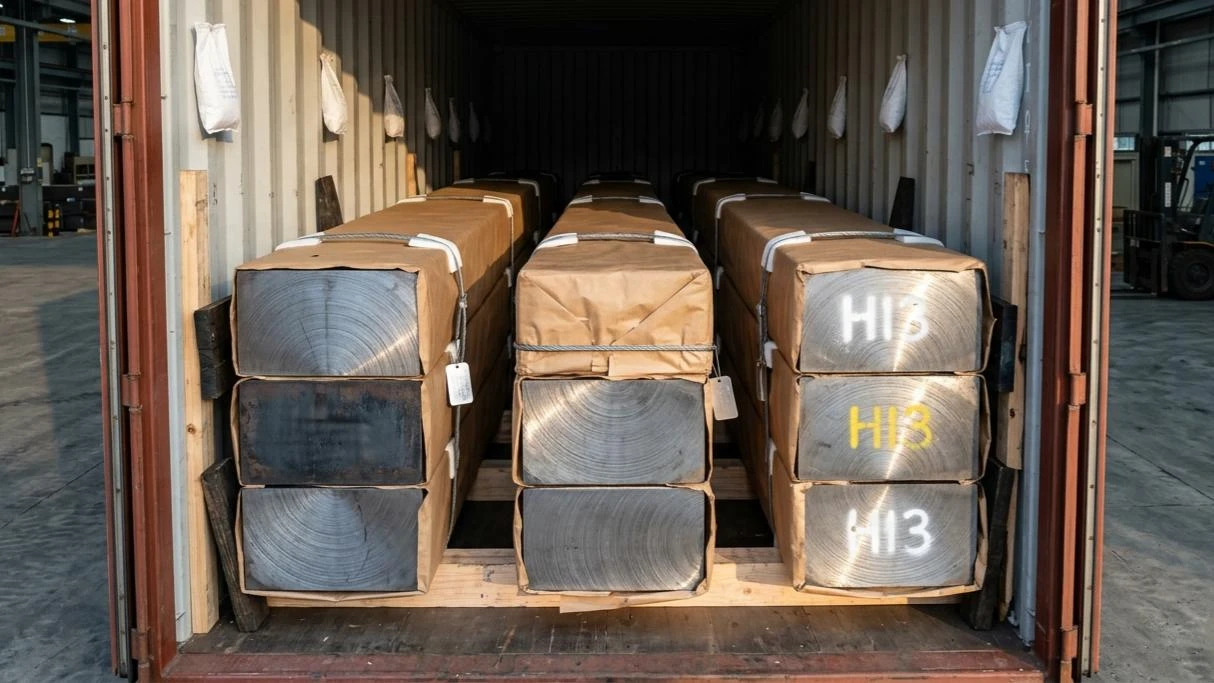
Take six photos before shipment: empty container → half loaded → fully loaded → securing completed → doors closed → seal number. The photo of the seal number may later become your only piece of evidence in a claim.
From Customs Declaration to Loading: Documents Move Before the Cargo Does
The document chain for full-container ocean shipping works like this:
Mandatory documents:
- Commercial invoice and packing list
- Material Test Certificate (MTC / Mill Test Certificate)—the core document for full-container mold steel, showing grade, heat number, chemical composition, and hardness values
- Certificate of origin (the destination country may require Form E or CO for tariff preferences)
- Bill of lading
HS code classification: mold steel bars and rods are classified under 7228.50 or 7228.60. Do not classify them under ordinary structural steel 7228.30—the wrong classification may trigger customs questioning, and port demurrage of several hundred dollars per day can quickly cost more than the classification issue itself.
Export customs declaration is not complicated. Full-container mold steel exports are subject to zero export duty, and the export rebate rate for the HS 7228 series is currently 13%. The policy adjustment at the end of 2024 that canceled export rebates applied to aluminum and copper materials; the 7228 series for mold steel was not included in that adjustment. The customs inspection probability is about 5–10%. What is checked? Whether the declared product name matches the physical goods, whether the classification is correct, and whether the material certificate corresponds to the actual cargo.
After the cargo reaches the port, it is loaded onto the vessel. Once you receive the bill of lading, you can relax for two weeks—transit time by sea is about 25–35 days to Europe, 5–10 days to Southeast Asia, 15–20 days to the Middle East, and 14–18 days to the U.S. West Coast.
Port Arrival Inspection: If These Three Things Are Not Done, the Container Should Not Be Released
The container has arrived. It is not something you can simply sign for and haul away.
First task: visual inspection. Is there rust? During transport, humidity at sea is high and day-night temperature differences are large, so “container rain” can form inside the container—condensation drips from the ceiling onto the steel bars. If no moisture barrier was laid during loading and too little desiccant was used, rust appears. Pay close attention to steel bar cross sections, edges and corners, and label areas—these are the places where water accumulates most easily. Take photographs, with front and side views, as claim evidence.
Second task: verify the heat numbers. The heat numbers on the material certificate must correspond one by one to the heat numbers spray-marked on the steel bars. If the certificate lists five heat numbers but only four can be found on arrival, do not sign for acceptance yet. What does a heat-number mismatch mean? It means this batch may not be the same goods covered by the certificate, and any subsequent hardness testing or composition analysis loses meaning.
Third task: use a handheld spectrometer for composition testing. You do not need to test every steel bar. Randomly inspect 3–5 bars, with three points tested on each. Focus on Cr, Mo, and Ni. If the chromium content is only 0.8% while the certificate states 1.40–2.00%, then what you bought may be 45# steel passed off as P20.
Hardness testing should be carried out with a portable Leeb hardness tester, and the sampling area should match the spectrometer sampling area. If the hardness deviation across 9 points exceeds 3 HRC, be alert—it may indicate uneven Heat Treatment, or it may mean different batches of steel were mixed in the shipment.
If these three checks are completed without problems, sign for acceptance and release the cargo. If there is a issue, do not move the cargo. Notify the insurance company and the shipping line within 24 hours and request a joint inspection. If you raise the objection after 24 hours, the other party will say that you have already accepted the condition of the cargo.
The Four Most Common Failures
Failure 1: rust generated during ocean shipping. This is usually not a vessel issue, but a packaging issue. According to a statistical analysis based on 206 ocean-shipping steel cargo damage cases, rust accounted for 21.4% of all cargo losses, second only to physical collision. In most of these rust cases, the container was not broken and seawater did not enter—the issues were that the VCI paper was not wrapped tightly, insufficient desiccant was used, or no moisture barrier was laid on the container floor. Any one of these three mistakes is enough.
After the VCI paper is wrapped, a layer of waterproof kraft paper must be added outside it—VCI paper itself is breathable; it only prevents rust, not water. Day-night temperature differences at sea create “container rain” inside the container—condensed water drips down from the top. If the outermost layer is only VCI paper rather than waterproof kraft paper, water penetrates directly, the VCI becomes saturated and ineffective, and the steel rusts. On the other hand, there is no need to panic if the VCI paper darkens and becomes mottled—aging and discoloration of kraft paper under high temperature is normal and does not affect anti-rust performance.
Desiccant quantity: a full 20GP container should use 8–10 bags, each with 1 kg of silica gel, not just two casually thrown inside. The hanging positions also matter—they should be evenly distributed along the container walls and in the gaps between steel bars, with two extra bags near the doors, where humid air is most likely to seep in through the door gaps.
Failure 2: mismatch between certificate and physical goods. Each bundle of steel bars leaves the factory with two metal hanging tags—silver-white aluminum tags embossed with grade, heat number, specification, and weight. These two tags are the only physical link between the material certificate and the actual goods. During port inspection, the certificate may list five heat numbers, but the physical tags may match only four—was the fifth bundle retagged, or was the tag lost? Without a tag, there is no traceability. Before loading, clearly photograph every bundle tag and match them one by one with the material certificate—this is the last chance before a problem happens. Once the container is sealed and loaded on board, all you can rely on are the photos on your phone.
Failure 3: short weight. The bill of lading shows 22 tons, but the weight at destination is only 21 tons. Where did the missing ton go? Mold steel exports usually use theoretical weight—that is, weight calculated from nominal dimensions and density. But actual mill delivery has tolerance: positive tolerance benefits you, negative tolerance costs you. How should the contract state this? Clearly specify: “Weight shall be based on port weighbridge measurement at loading, with an allowable tolerance of ±1%.” For a full container, 1% means 200 kg—reasonable in the industry. If the shortage exceeds 3%, that is short weight and can support an insurance claim.
Failure 4: customs clearance is blocked. This is the easiest issue to overlook. Different destination countries have entirely different import requirements for mold steel. India requires BIS certification, and some steel product categories have already been included in the mandatory scope. Turkey has launched anti-dumping investigations on Chinese hot-rolled steel products, and some mold steel grades may be affected. Saudi Arabia requires both PCoC and SCoC certificates under the SABER system. These are not things to think about after the cargo arrives—they must be confirmed before placing the order. The HS code used for export is not necessarily identical to the import HS code. Ask your customs broker in the destination country to confirm the import HS code and tariff rate in advance.
For full-container mold steel ocean shipping, the true cost of failure is not the freight—it is the lead time. When the goods arrive and you discover a problem, sending the container back and shipping a replacement means your customer’s mold factory cannot wait for another two months.
The best time to prevent failure is not after the cargo reaches the port, but before the container is loaded.
Before loading, verify three things: whether the distributor qualification is genuine, whether the VCI packaging is wrapped tightly, and whether the steel bar heat numbers correspond one by one with the material certificate. Three checks, half a day of work. What they save is two months of lead time, the value of a full container of Plastic Mold Steel, and a customer who cannot afford to wait.