A recurring problem on mold steel purchase orders is this: looking only at the HRC number, assuming the higher the better.
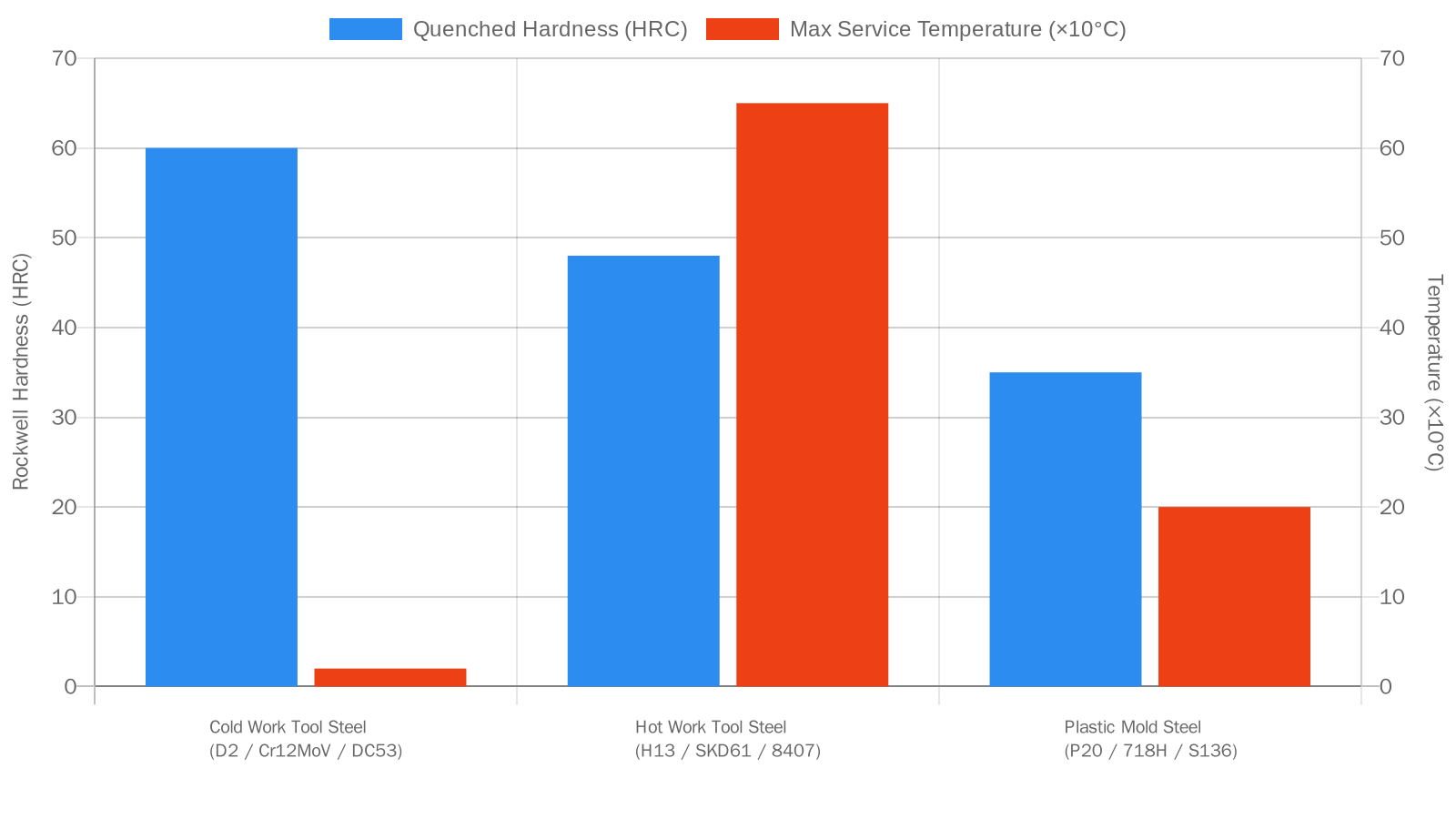
The cost of this habit is far more than simply ticking a box on a material selection sheet. Use Cr12MoV, a cold work die steel for blanking dies, in die casting instead—HRC 60+ looks impressive, but once 650°C molten aluminum is poured in, the carbide structure starts to degrade within minutes, and the cavity collapses directly. Conversely, use H13, a hot work steel, for cold blanking—at HRC 48–52, it does not even meet the entry threshold in the cold work field, and die life is measured in hours.
Mold steel for cold work, hot work, and plastic molds does not share the same service conditions. Cold work steels rely on carbides for wear resistance and routinely deal with wear and chipping; hot work steels rely on molybdenum and vanadium to withstand repeated thermal cycling at elevated temperatures; plastic mold steel is supplied pre-hardened so it can be machined and put into service directly. One ruler cannot measure three different things—yet in this industry, three fundamentally different materials are often governed by the same phrase: “the harder, the better.”
This article does not discuss theory. It focuses only on parameters: which grade your current project should use, what hardness is appropriate, and how it should be heat treated.
Cold Work Die Steel: C > 0.8%, Cr 4%–12%, Wear Resistance Built by Carbides
Cold work dies operate at room temperature—blanking, bending, cold extrusion, and cold heading—where the material does not undergo thermal softening. The primary failure modes are wear and edge chipping.
The core alloy design is high carbon + high chromium, using a large quantity of carbide particles to achieve wear resistance. After quenching, hardness is typically HRC 58–62, with some grades reaching HRC 64.
Quick Reference for Cold Work Die Steel Grades
| Grade | C% | Cr% | Others | Quenched Hardness HRC | Typical Application |
|---|---|---|---|---|---|
| Cr12 | 2.0–2.3 | 11–13 | — | 60–64 | Blanking dies requiring high wear resistance and low impact |
| Cr12MoV | 1.45–1.70 | 11–12.5 | Mo 0.4–0.6, V 0.15–0.3 | 58–62 | Cold heading / thick plate stamping with relatively high impact |
| DC53 | 1.0 | 8.0 | Mo 2.0, V 0.35 | 58–62 | Improved Cr12MoV with better toughness |
| SKD11 | 1.4–1.6 | 11–13 | Mo 0.8–1.2, V 0.2–0.5 | 58–62 | Japanese standard, corresponding to Cr12MoV |
| CrWMn | 0.9–1.05 | 0.9–1.2 | W 1.2–1.6, Mn 0.8–1.1 | 58–62 | Low quench distortion, precision small molds |
| 9CrSi | 0.85–0.95 | 0.95–1.25 | Si 1.2–1.6 | 58–62 | Low distortion, thin sheet stamping dies / taps |
A classic Cr12MoV case: when a cold heading punch is quenched to HRC 56–60, service life is 20,000–30,000 parts. Lower the hardness to HRC 50–54, and service life instead increases to 60,000–80,000 parts. The reason is that for molds with sharp corners and deep cavities, impact is the primary failure mode, not wear.
The metallurgical design logic of DC53: it is not simply “better than Cr12MoV”; it follows a wholly different alloy design route—lower carbon and lower chromium + higher molybdenum and higher silicon. Carbon is reduced from about 1.6% in Cr12MoV to about 1.0%, chromium from about 12% to about 8%, and molybdenum is increased from about 0.5% to about 2.0%. This reduces the number of coarse eutectic carbides, while shrinking carbide size to less than one-third of the original. The result: toughness is about 2 times that of Cr12MoV (Charpy V-notch impact value: DC53 20–25 J/cm² vs Cr12MoV 10–15 J/cm²), while hardness can still reach 62–64 HRC and even increase after high-temperature tempering due to the secondary hardening effect. The cost is 15–30% higher, but total service life is usually doubled.
(Data source: ASTM A681-24 standard; MoldSteelLS internal technical research)
Carbide segregation warning: high-carbon high-chromium steels of the Cr12 type must use the electroslag remelting (ESR) process. In non-ESR materials, carbide distribution is non-uniform, mold life becomes randomly distributed, and the failure mode is often directional brittle fracture. When ordering Cr12-type steel, ESR is a basic requirement, not an added advantage.
Hot Work Die Steel: C 0.3%–0.8%, Cr 3%–5.2%, Focused on High-Temperature Strength
Hot work dies repeatedly contact high-temperature molten metal at 500–850°C—aluminum alloy die casting (about 650°C), copper alloy die casting (about 900°C), and hot forging (about 600–800°C). The primary failure modes are thermal fatigue cracking, collapse, and hot wear.
The alloy design logic is completely reversed: medium carbon + medium chromium, relying on Mo. and V to maintain strength and softening resistance at high temperature. Quenched hardness is HRC 44–52—”soft” by cold work steel standards, but stable under elevated-temperature service.
The consequence of using cold work steel in hot work service: D2 (C 1.5%, Cr 12%) begins to experience carbide structure degradation above 400°C, and hot hardness drops off sharply. Put it into a die-casting die and it collapses within minutes.
Quick Reference for Hot Work Die Steel Grades
| Grade | C% | Cr% | Mo% | V% | Quenched Hardness HRC | Maximum Working Temperature °C | Typical Application |
|---|---|---|---|---|---|---|---|
| H13 / SKD61 | 0.35–0.42 | 5.0–5.5 | 1.2–1.5 | 0.8–1.2 | 44–50 | ~600 | Standard choice for aluminum alloy die-casting dies |
| 8407 | 0.38 | 5.2 | 1.4 | 0.9 | 44–50 | ~620 | Swedish clean-steel version of H13 with better toughness |
| 5CrNiMo | 0.50–0.60 | 0.5–0.8 | 0.15–0.30 | — | 38–45 | ~500 | Hot forging dies, good toughness in large sections |
| 5CrMnMo | 0.50–0.60 | 0.6–0.9 | 0.15–0.30 | — | 38–45 | ~500 | Medium and large hot forging dies |
| 3Cr2W8V | 0.30–0.40 | 2.2–2.7 | — | 0.2–0.5 | 48–52 | ~650 | Copper alloy die casting, high-temperature hot extrusion |
| H10 | 0.35–0.45 | 3.0–3.75 | 2.0–3.0 | 0.25–0.75 | 44–52 | ~620 | High-temperature hot extrusion mandrels and ejector pins |
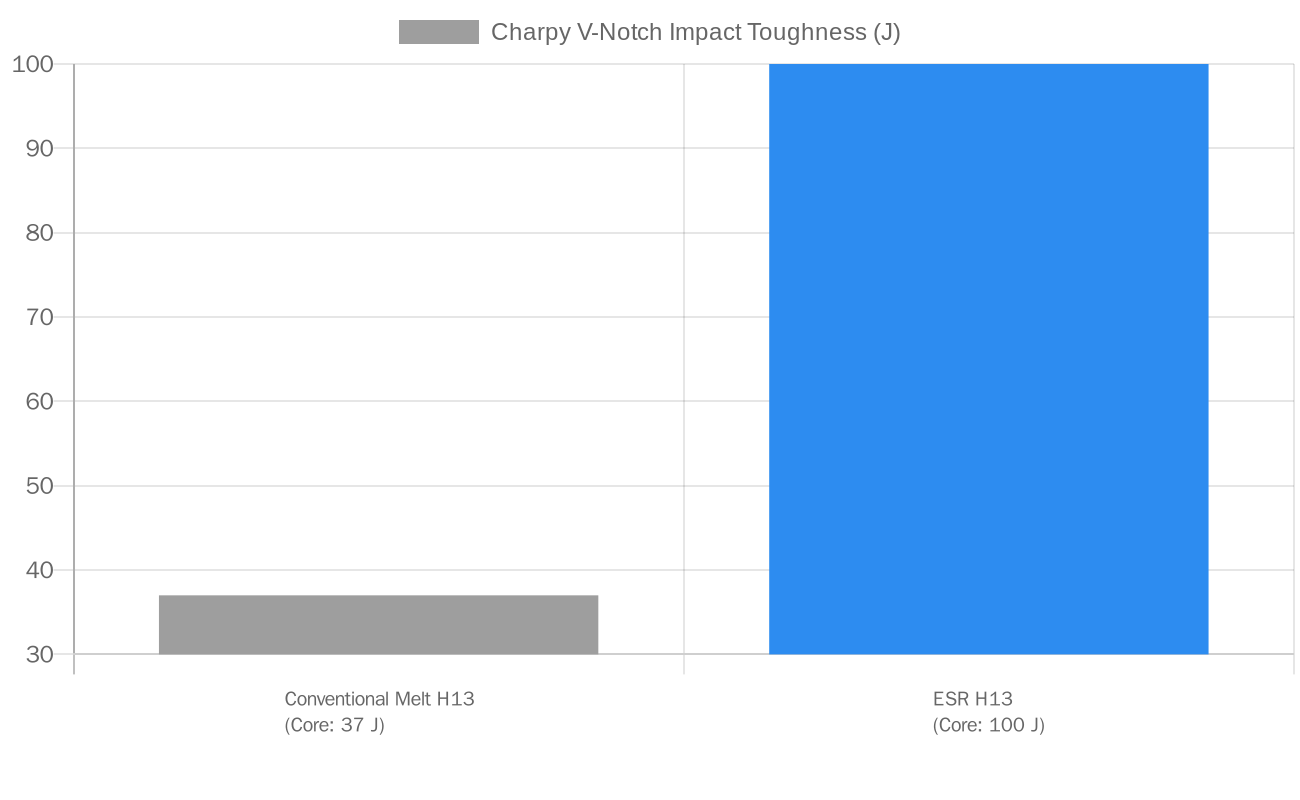
The core indicator for H13 grade differences—Charpy V-notch impact toughness:
| Grade Level | Process | Core Impact Value (J) | Surface Impact Value (J) | Transverse Toughness |
|---|---|---|---|---|
| Standard H13 | Conventional arc melting | 37 | 155 | Baseline |
| Premium H13 | ESR electroslag remelting | 100 | 175 | +40% |
Core toughness differs by nearly 3 times. For die-casting dies, the core may be bored out (shot sleeve structure), so surface data is more relevant—but even when looking only at the surface, ESR still shows a toughness advantage. An additional 20–30% in material cost significantly reduces the risk of early cracking.
The critical tempering temperature range: H13 has a secondary hardening peak near 500°C (hardness may reach HRC 55), but toughness is at its worst at this point. The optimum tempering range for aluminum alloy die-casting dies is 540–620°C, with a target hardness of HRC 48–52. Recommended process: austenitizing at 1,025–1,040°C → triple tempering (not double tempering), each cycle around 580°C → nitriding (surface hardness 60–65 HRC). Triple tempering can extend service life by about 30% compared with double tempering.
(Data source: ASTM A681-24; MoldSteelLS internal technical research)
Plastic Mold Steel: Supplied Pre-Hardened at HRC 28–45 for Direct Machining
Plastic molds usually operate below 300°C and do not experience the severe impact seen in cold work dies. The core requirements are simple: dimensional stability and good machinability. When corrosive plastics are involved (PVC, flame-retardant materials), the steel must also withstand chemical attack. For optical parts, polishability must be sufficient.
The biggest feature of plastic mold steel is that it is supplied in the pre-hardened condition—the steel mill has already completed quenching and tempering, so the user does not need to perform heat treatment. It can go directly from CNC machining to production use. For mold shops without an in-house heat treatment facility, this saves not only heat treatment costs but also the risk of distortion and the time lost to rework.
Quick Reference for Plastic Mold Steel Grades
| Grade | Pre-Hardened Hardness HRC | Corrosion Resistance | Mirror Polishing | Suitable Plastics |
|---|---|---|---|---|
| P20 | 28–35 | No | Average (~degrades after 10,000 cycles) | Standard ABS, PP, PE |
| 718H | 33–38 | No | Medium | General engineering plastics, medium to high production volume |
| NAK80 | 37–43 | No | Excellent | Optical lenses, transparent parts, high-gloss housings |
| S136 | 30–36 (can be hardened to 50) | Yes (stainless type) | Excellent | PVC, flame-retardant PC/ABS, optical parts |
| S136H | 30–36 | Yes | Excellent | Pre-hardened version of S136 |
| STAVAX | 30–36 | Yes | Excellent | Swedish standard, corresponding to S136 |
Corrosive plastics require stainless-type mold steel: PVC and flame-retardant PC/ABS release corrosive gases such as HCl during high-temperature injection molding. In this environment, standard P20 or 718H will rust within days—not a gradual issue of mirror finish degradation, but direct cavity scrapping. S136 and STAVAX are the entry-level choices for such conditions. One trend in 2026 is that the growing use of flame-retardant and bio-based plastics is further increasing the adoption of S136, even in medium-volume consumer products.
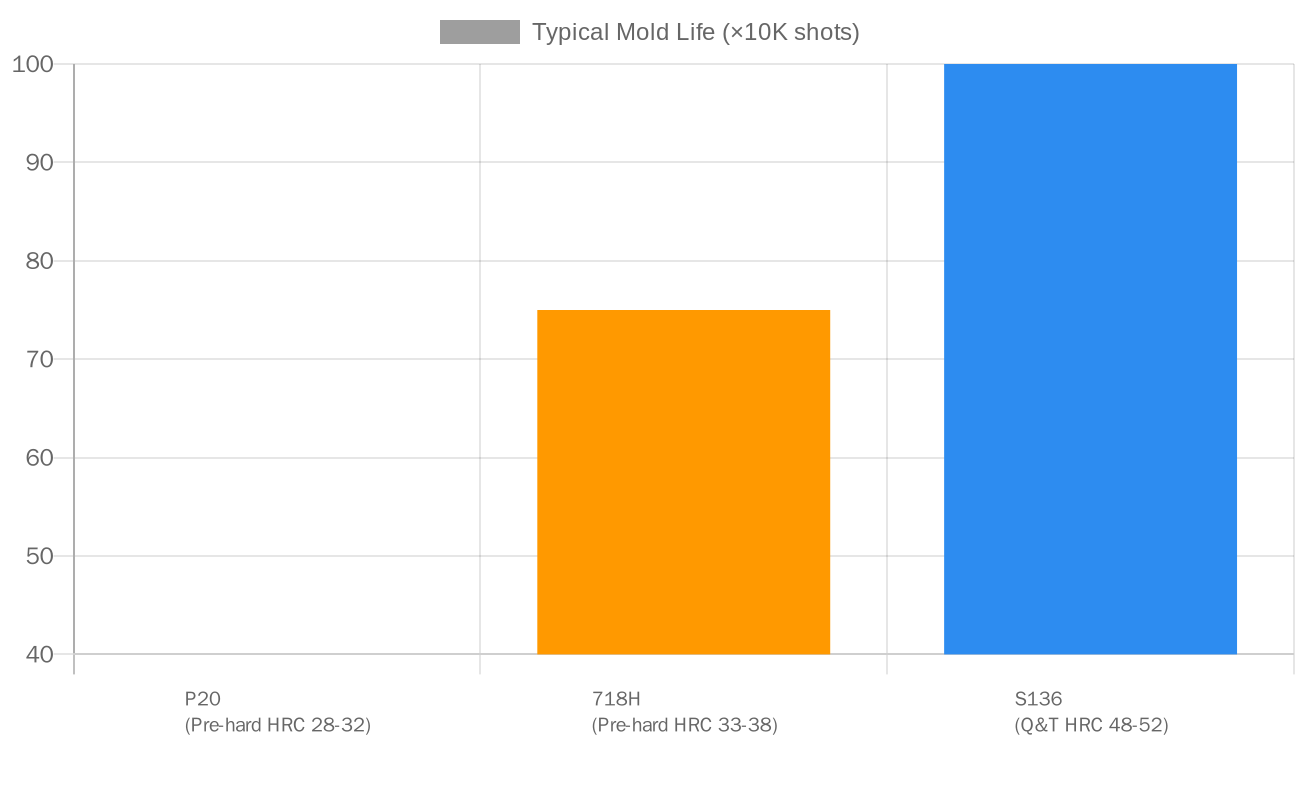
Mold life data (Data source: MoldSteelLS internal industry research, 2026):
| Grade | Typical Service Life (10,000 cycles) | Material Unit Price (USD/kg) | Suitable Production Scale |
|---|---|---|---|
| P20 | 30–50 | $2.31–$3.85 | Low to medium volume |
| 718H | 50–100 | $3.85–$5.38 | Medium to high volume |
| S136 | 100+ | $9.23–$12.31 | High volume + corrosive / optical applications |
For projects with annual production exceeding 500,000 parts, although S136 is priced at 3–4 times that of P20, total life-cycle cost is actually 15–20% lower—mainly due to fewer mold changeovers and less downtime.
Hybrid mold design is also a 2026 trend: using S136 or H13 for cavity inserts (high-wear / corrosive areas), while using P20/718H for the mold base, balancing durability and cost.
Mirror finish degradation in optical molds: the mirror finish of a P20 cavity begins to deteriorate after about 10,000 cycles—the carbide banded structure damages surface finish quality. If the product is a lens, light guide plate, or high-gloss housing, NAK80 or S136 is the minimum acceptable choice; P20 is not sufficient.
Heat Treatment — The Tolerance Window of Three Parameters
Among cases of early mold failure, about 45% are directly attributable to improper heat treatment. The following three issues are the most likely to cause problems:
Tempered Brittleness Range (200–250°C)
When carbon tool steel is tempered at 200–250°C, toughness drops sharply. For molds requiring high toughness, this range must be avoided—not “preferably avoided,” but strictly avoided. The tempering temperature must be either below 200°C or above 250°C; this middle range cannot be used.
Residual Stress Relief
If tempering is insufficient after heat treatment, or if the cooling rate is too fast, residual internal stress is locked inside the mold. After several thermal cycles on the machine, stress is released, causing distortion and dimensional out-of-tolerance conditions. For the same steel block, immediate tempering after quenching versus tempering after being left for 24 hours leads to a significant difference in residual stress distribution.
Carbide Segregation in Cr12-Type Steel
If Cr12-type steel is not produced by the ESR process, carbide distribution appears as banded or network segregation. If the loading direction of the mold happens to be parallel to the carbide bands, directional brittle fracture occurs. This is not a problem that can be corrected by heat treatment parameters; it must be controlled before placing the order. There is only one solution: specify ESR-grade material.
Four Questions to Determine Which Steel You Should Use
| Decision Step | Key Parameter | Judgment |
|---|---|---|
| What process is it for? | Blanking / cold forging → cold work | Do not cross into another major category first |
| Die casting / hot forging → hot work | — | |
| Injection molding → plastic mold steel | — | |
| What material will it contact? | Corrosive material (PVC, etc.) → stainless type | Determines the steel subcategory |
| Glass fiber reinforced → high wear-resistant steel | — | |
| Molten aluminum → start with H13 | — | |
| Molten copper → start with 3Cr2W8V | — | |
| What production volume is required? | < 10,000 cycles → pre-hardened steel for direct machining | Determines the level of investment |
| > 100,000 cycles → calculate total life-cycle cost systematically | — | |
| What surface requirement is needed? | Mirror finish → NAK80/S136 | Conversely constrains steel selection |
| Texturing / etching → confirm steel compatibility with texturing process | — | |
| Nitriding → confirm the substrate is suitable for nitriding | — |
Once these four questions are answered, you will have a clear idea of which steel to use. For cold work steel, focus on the balance between toughness and hardness; when impact is high, lower hardness to preserve service life. For hot work steel, focus on operating temperature and match the corresponding heat-resistant grade. For plastic mold steel, check whether the plastic is corrosive; if it is, use a stainless-type grade. In mold steel, the steel grade determines 50%, and heat treatment determines the other 50%. It is not uncommon for two materials both labeled “H13” to perform more than twice as differently depending on the supplier—the difference is not the grade itself, but who melted it and how it was heat treated.