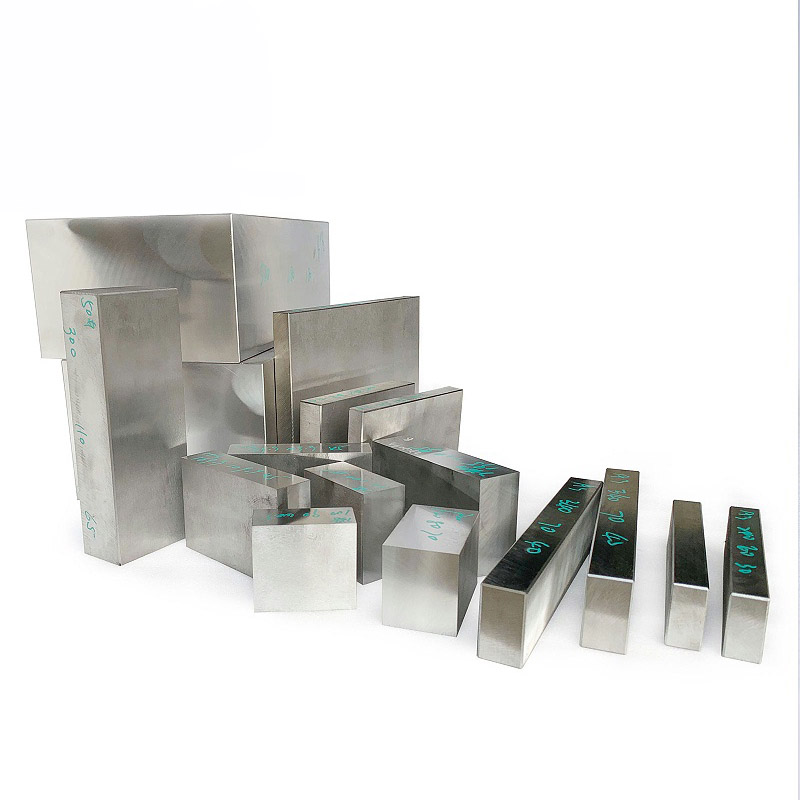
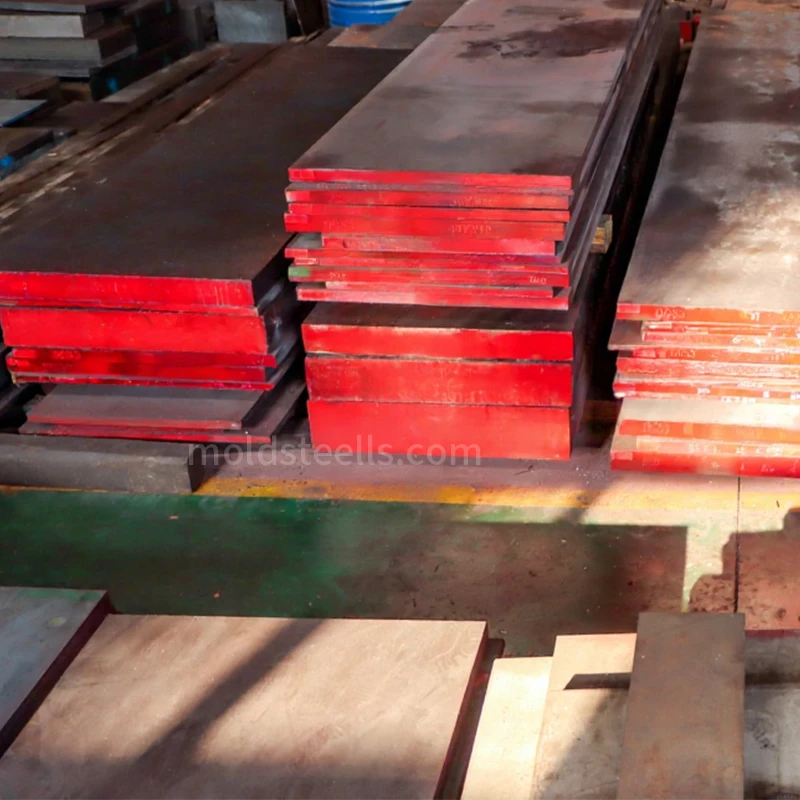
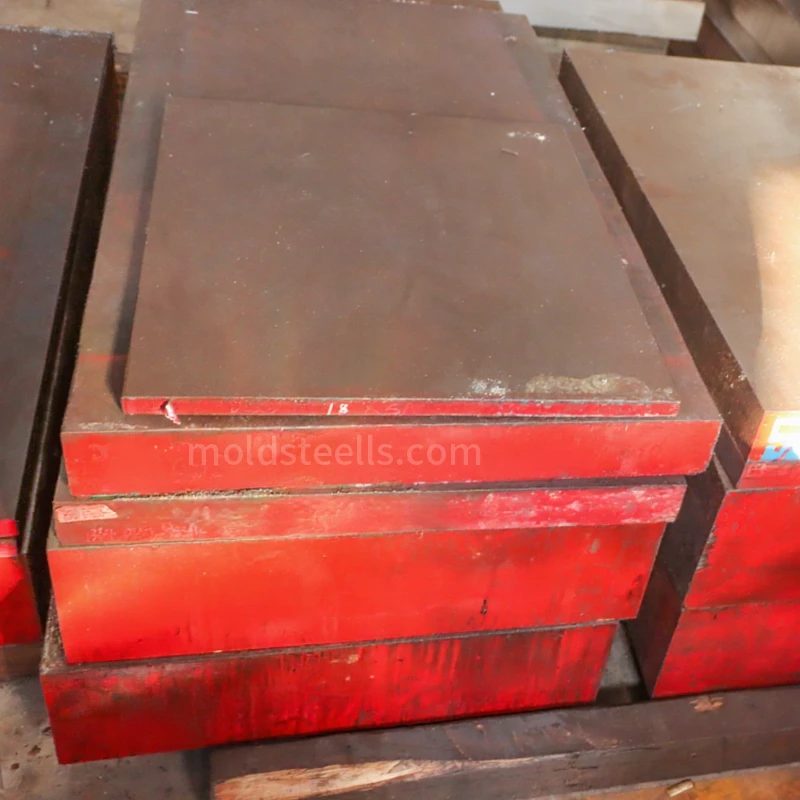
What is SKS3
SKS3 die steel is a high-carbon alloy cold work die steel under the Japanese JIS standard, corresponding to the Chinese grade CrWMn (9CrWMn). It possesses high hardenability (thin specifications can be fully hardened), high hardness (HRC 58-62), excellent wear resistance, low-heat treatment deformation, good machinability, and moderate cost. It is suitable for small and medium-sized precision cold work dies, stamping dies, gauges, and other applications requiring high dimensional accuracy and wear resistance.
Key Characteristics of SKS3 Steel
- High Hardenability: Thin materials (≤20 mm) can be fully hardened, like putting a layer of hard armor on thin steel plates.
- High Hardness: HRC 58-62 after quenching, with hardness close to that of a utility knife blade.
- Exceptional Wear Resistance: Carbides are uniformly distributed, making it more wear-resistant than ordinary carbon tool steel, like being sprinkled with wear-resistant small particles.
- Good Machinability: Hardness ≤229 HB after annealing, easy for milling and grinding, saving processing costs.
- Cost-Effective: Cost is about 20% lower than SKD11, suitable for small and medium batch dies.
- Simple Heat Treatment: Oil quenching at 830-860°C + tempering at 200 °C, which can be stably processed even by small and medium-sized factories.
- Dimensionally Stable: Deformation ≤0.02 mm after low-temperature tempering, thinner than a human hair (about 0.07 mm).
- Moderate Toughness: Better impact resistance than the Cr12 series, not prone to chipping, suitable for small and medium impact working conditions.
SKS3 Performance Parameter Tables
1. SKS3 Chemical Composition Table
| Element | Standard Range (wt.%) | Typical Content (wt.%) | Core Function |
|---|---|---|---|
| C (Carbon) | 0.90-1.00 | 0.95 | Improves steel hardness and wear resistance; the foundation for cold work die steel to achieve high hardness |
| Si (silicon) | Max 0.35 | 0.20 | Strengthens ferrite, improves steel strength and hardenability, and enhances oxidation resistance |
| Mn (Manganese) | 0.90-1.20 | 1.05 | Improves hardenability and wear resistance, refines grains, and enhances steel machinability |
| P (Phosphorus) | Max 0.030 | ≤0.025 | Harmful element: content must be strictly controlled to avoid reducing steel toughness and ductility. |
| S (Sulfur) | Max 0.030 | ≤0.025 | Harmful element: content should be controlled to reduce hot brittleness and ensure steel processing quality |
| Cr (Chromium) | 0.50-1.00 | 0.75 | Improves hardenability, wear resistance, and corrosion resistance; enhances steel tempering stability |
| W (Tungsten) | 0.50-1.00 | 0.75 | Refines grains, improves red hardness and wear resistance, and enhances steel high-temperature performance |
2. SKS3 Physical Properties Table (Inherent Material Properties)
| Property Index | Value Range | Unit | Remarks |
|---|---|---|---|
| Density | 7.75 | g/cm³ | At room temperature |
| Elastic Modulus | 193 | GPa | At room temperature |
| Average Coefficient of Thermal Expansion (near 20°C) | 10×10⁻⁶ | °C | Temperature range around 20 °C |
| Thermal Conductivity | 25 | W/m·K | At room temperature |
| Specific Heat Capacity | 460 | J/kg·K | At room temperature |
| Electrical Resistivity | 0.32 | Ω·mm²/m | Converted from electrical conductivity 3.125 m/Ω·mm² (resistivity = 1/electrical conductivity), at room temperature |
3. SKS3 Mechanical Properties Table (Stress Response Characteristics)
| Property Index | Value Range | Unit | Remarks |
|---|---|---|---|
| Yield Strength (Rp0.2) | 350-550 | MPa | Annealed state, at room temperature |
| Tensile Strength (Rm) | 650-880 | MPa | Annealed state, at room temperature |
| Elongation after Fracture (A) | 8-25 | % | Annealed state, at room temperature |
| Impact Absorption Energy (KV) | 12 | J | Quenched and tempered state, at room temperature |
| Hardness (HRC) | 34-64 | — | Applicable only to annealed or semi-finished states |
SKS3 Machining Parameters and Strategies
| Parameter Category | Cemented Carbide Tools | HSS Tools | Coated Tools/CBN Tools |
|---|---|---|---|
| Cutting Parameters | Cutting speed: 80-120 m/min Feed rate: 0.15-0.25 mm/r Cutting depth: 3-5 mm | Cutting speed: 30-50 m/min Feed rate: 0.1-0.15 mm/r Cutting depth: 2-3 mm | Cemented carbide-coated tools (TiAlN/TiCN): Cutting speed: 120-150 m/min Feed rate: 0.08-0.15 mm/r Cutting depth: 0.5-1mm CBN tools (for high precision): Cutting speed: 80-120 m/min Feed rate: 0.03-0.05 mm/r Cutting depth: 0.1-0.2mm |
| Material Heat Treatment State | Annealed state (hardness ≤HRC25): higher parameters can be used Quenched state (HRC58-62): Need to reduce speed and feed Annealed state: Cutting speed 150-200 m/min (cemented carbide), feed rate 0.2-0.3 mm/r, cutting depth 2-3 mm Quenched state: Cutting speed 80-120 m/min, feed rate 0.1-0.2 mm/r, cutting depth 1-2mm | Annealed state: Cutting speed 180-220 m/min, feed rate 0.1-0.15 mm/r, cutting depth 0.3-0.5mm Quenched state: Cutting speed 120-150 m/min, feed rate 0.05-0.1 mm/r, cutting depth 0.2-0.5 mm | — |
| Cooling Method | Cutting fluid must be used; oil-based (extreme pressure additives) or high-pressure emulsion is preferred to avoid work hardening and built-up edge | Oil-based cutting fluid (containing EP additives) or high-pressure emulsion (flow rate ≥20 L/min), forced cooling | Extreme pressure emulsion or oil mist cooling to ensure sufficient lubrication and chip removal |
| Machining Process Strategy | Climb milling + circular cutting for roughing, layered cutting (depth ≤ 1/3 of tool diameter); contour parallel milling for finishing, smooth transition of feed rate | Climb milling + circular cutting path, layered cutting depth ≤ 1/3 of tool diameter (cemented carbide) to avoid impact loads | Contour parallel milling, uniform tool path, surface roughness target Ra 0.8-1.6μm |
SKS3 Die Steel Common Questions FAQ
Q1: Why do tools wear out so quickly during CNC machining?
A: SKS3 has a high hardness of HRC 58-62, like a high-carbon, high-alloy “hard bone” that ordinary HSS tools can’t handle. Use cemented carbide-coated tools (such as TiAlN coating) with emulsion cooling; tool life can be extended by 3 times.
Q2: The machined surface is always rough, like a “pockmarked face”—how to fix it?
A: Built-up edge is prone to form, similar to “dough sticking to the knife when cutting vegetables.” Replace with sharp-coated tools, use a cutting speed of 100-120 m/min and a feed rate of 0.08-0.12 mm/r; surface roughness can be reduced to Ra 1.6 μm.
Q3: Die-cutting edges continue to chip, like “brittle biscuits”—how to solve this?
A: SKS3 has moderate toughness; avoid right-angle cutting edges. Choose a tool rake angle of 12-15° and create a negative chamfer of 0.1 mm × 10° on the cutting edge, like adding a “protective edge” to the blade; chipping rate can be reduced by 70%.
Q4: After heat treatment, it’s too difficult to machine, like “chewing iron blocks”—what to do?
A: Hardness is too high after quenching; use CBN tools or ultra-fine grain cemented carbide with a cutting speed of 80-120 m/min and a feed rate of 0.05-0.1 mm/r, like “using a diamond drill to deal with hard rocks.”
Q5: Mold deformation after machining, dimensional deviation—how to control it?
A: It work-hardens like “sandpaper that gets harder as you grind it”; surface hardness increases by HRC 5-8. Use layered cutting (each layer ≤ 1/3 of tool diameter), cooling flow rate ≥ 20 L/min, and stress relief at 200°C for 2 hours after roughing; deformation can be reduced from 0.05 mm to 0.01 mm.
Q6: What molds is it suitable for? In which scenarios can’t it “hold on”?
A: Suitable for small and medium batch cold work dies, such as electronic parts stamping dies and thin sheet metal (<3 mm) punching dies. It is not suitable for thick plate stamping (>3 mm), mass production (>100,000 cycles), and hot work scenarios, like a “sprinter who can’t run a marathon.”
SKS3 Die Steel Detailed Performance Parameters PDF
| Item | Details |
|---|---|
| File | SKS3-Cold-Work-Die-Steel_-Comprehensive-Analysis-of-Properties-Machining-Essentials-and-Precautions.pdf |
| Type | application/pdf |
| Size | 206 KB |
| Link | https://moldsteells.com/wp-content/uploads/2026/03/SKS3-Cold-Work-Die-Steel_-Comprehensive-Analysis-of-Properties-Machining-Essentials-and-Precautions.pdf |