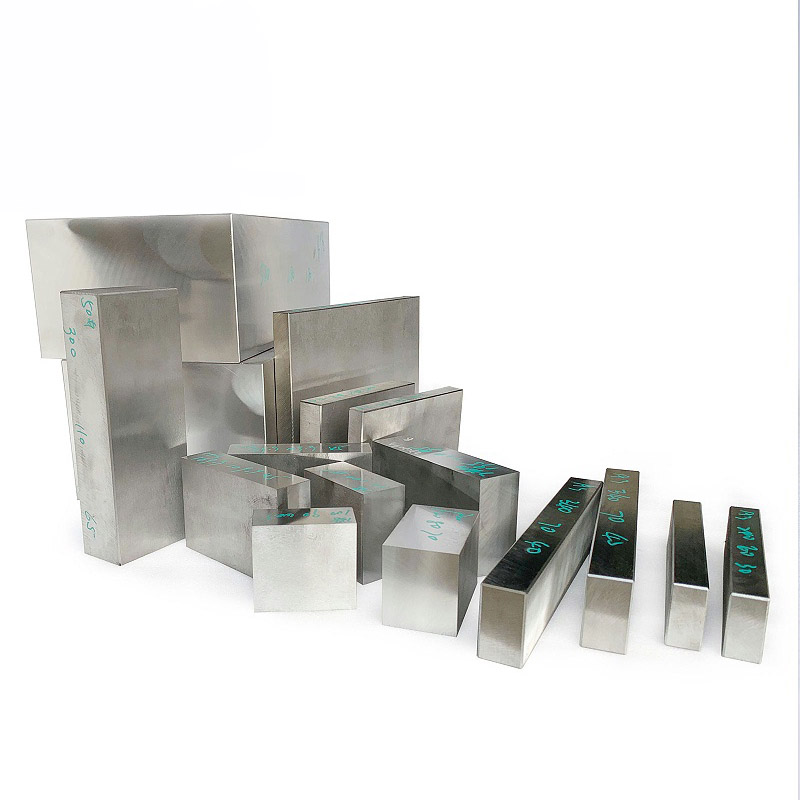
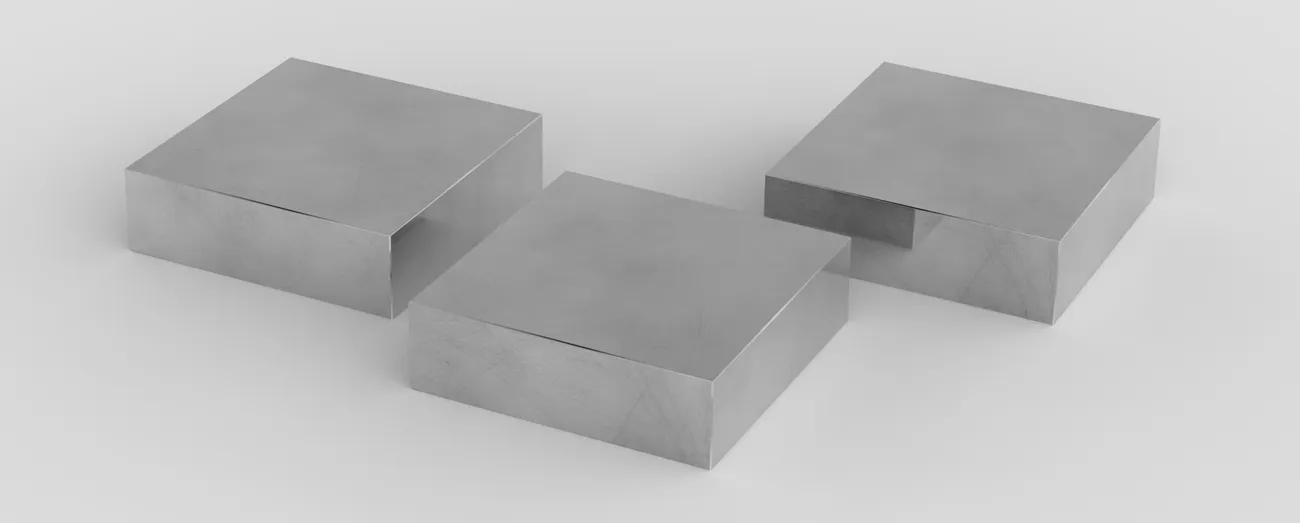
What Is SKD11 Mold Steel?
SKD11 is a high-carbon, high-chromium cold-work tool steel defined by the Japanese JIS standard, equivalent to the Chinese grade Cr12MoV.
With a chemical composition of approximately 1.5% carbon and 12% chromium, SKD11 achieves ultra-high hardness of HRC 58–64 and excellent wear resistance.
Sections up to 100 mm can be fully hardened, making it suitable for stainless steel stamping, cold extrusion, and precise electronic forming, with production cycles exceeding 100,000 strokes.
In the annealed condition, SKD11 offers good machinability.
Main Characteristics of SKD11 Steel
- High Hardness and Wear Resistance: Quenched hardness reaches HRC 58–64. Chromium carbides provide excellent abrasion resistance, ideal for stainless steel and high-strength steel stamping dies.
- Excellent Hardenability: Mo and V refine grains, enabling full hardening for sections ≤100 mm.
- High Compressive Strength: Room-temperature compressive strength reaches 2500–2800 MPa, suitable for cold heading dies.
- Balanced Toughness: U-notch impact toughness of 18–25 J, reducing chipping risks.
- Good Machinability (Annealed State): Hardness ≤235 HBW after annealing, improving rough machining efficiency.
SKD11 Chemical Composition
| Element | Typical Content (%) | Standard Range (%) | Main Function |
|---|---|---|---|
| C | 1.50 | 1.40–1.60 | Forms carbides, improves hardness and wear resistance |
| Cr | 12.00 | 11.00–13.00 | Enhances wear resistance and hardenability |
| Mo | 1.00 | 0.80–1.20 | Grain refinement and thermal stability |
| V | 0.35 | 0.20–0.50 | Forms hard carbides, improves wear resistance |
| Si | 0.30 | ≤0.40 | Deoxidation and strengthening |
| Mn | 0.40 | ≤0.60 | Improves hardenability and toughness |
| P | ≤0.025 | ≤0.030 | Impurity, causes grain boundary embrittlement |
| S | ≤0.020 | ≤0.030 | Impurity, forms inclusions |
| Ni | Trace | ≤0.50 | Slightly improves toughness |
| Cu | Trace | ≤0.25 | Improves corrosion resistance |
Physical Properties of SKD11
| Property | Value | Unit | Remarks |
|---|---|---|---|
| Hardness (After Heat Treatment) | 58–64 | HRC | Typical heat-treated hardness |
| Compressive Strength | 2500–2800 | MPa | Room temperature |
| Bending Strength | 3800–4200 | MPa | Room temperature |
| Impact Toughness | 18–25 | J | U-notch, room temperature |
| Thermal Conductivity (100°C) | 29.3 | W/(m·K) | Heat transfer capability |
| Annealed Hardness | ≤235 | HBW | Machining condition |
Typical Applications of SKD11 Mold Steel
- Stainless steel and high-strength steel stamping dies
- Cold extrusion and progressive dies
- Precision electronic connector molds
- Cold heading dies for bolts and nuts
- Fine blanking and exact cutting dies
- Powder metallurgy forming dies
- Wear-resistant parts for reinforced plastic molds
Applications Not Recommended for SKD11
- Large-size or high-impact dies
- Hot working molds (above 250°C)
- Corrosive or humid environments
- Ultra-precision and mirror-polishing molds
- Complex large cavity molds
Recommended Cutting Tools for SKD11 Machining
| Machining Stage | Tool Type | Coating Priority | Key Parameters | Recommended Brands |
|---|---|---|---|---|
| Rough Machining (≤HRC40) | Micro-grain carbide end mills, indexable cutters | TiCN > AlCrN > TiAlN | Speed: 60–120 m/min Feed per tooth: 0.1–0.2 mm Depth: 0.3–0.8 mm | ZCC, Jinjian, Sandvik, Mitsubishi, Kennametal |
| Semi-Finishing (HRC40–55) | Long-neck carbide end mills | TiAlSiN > AlTiN > AlCrN | Speed: 40–80 m/min Feed: 0.08–0.15 mm Depth: 0.1–0.3 mm | ZCC, Kyocera, Sumitomo, Walter |
| Finishing (HRC55+) | CBN / PCD / Precision Carbide | Uncoated CBN/PCD | Speed: 80–120 m/min Feed: 0.05–0.1 mm | Sumitomo, Kyocera, Sandvik |
| Deep Hole Machining | Internal coolant carbide drills | TiAlN > DLC | Speed: 80–150 m/min Peck drilling Pressure: 10–15 MPa | Guhring, Sandvik, ZCC |
SKD11 Machining Parameter Choice Logic
- Tool priority: CBN > Carbide > HSS
- For every 5 HRC increase, reduce speed by 10–15%
- Better machine rigidity allows higher cutting speed
- Corner areas require 30% feed reduction
Common Machining Problems and Solutions
1. Why Does SKD11 Crack Easily?
Due to high residual stress and network carbides, SKD11 has a 30% higher risk of cracking than standard Cr12 steels.
Solution: Quenching at 1020°C, triple tempering at 180°C, spheroidizing annealing, and radius design (R ≥ 0.8 mm).
2. Severe Work Hardening After Machining
Surface hardness may exceed HRC65 after cutting.
Solution: Intermediate tempering, high-feed semi-finishing, and manual polishing.
3. Excessive Heat Treatment Deformation
Volume growth during martensitic transformation reaches 4.5%.
Solution: Step preheating, staged quenching, cryogenic treatment, and aging.
4. Dimensional Drift After Storage
Residual austenite may reach 15–20%.
Solution: Deep cryogenic treatment, dual-temperature tempering, and low-temperature aging.
SKD11 Steel Technical Data PDF Download
| Item | Details |
|---|---|
| File | skd11-tool-steel-properties-machining-parameters-and-application-guide.pdf |
| Type | application/pdf |
| Size | 177 KB |
| Link | https://moldsteells.com/wp-content/uploads/2026/02/skd11-tool-steel-properties-machining-parameters-and-application-guide.pdf |