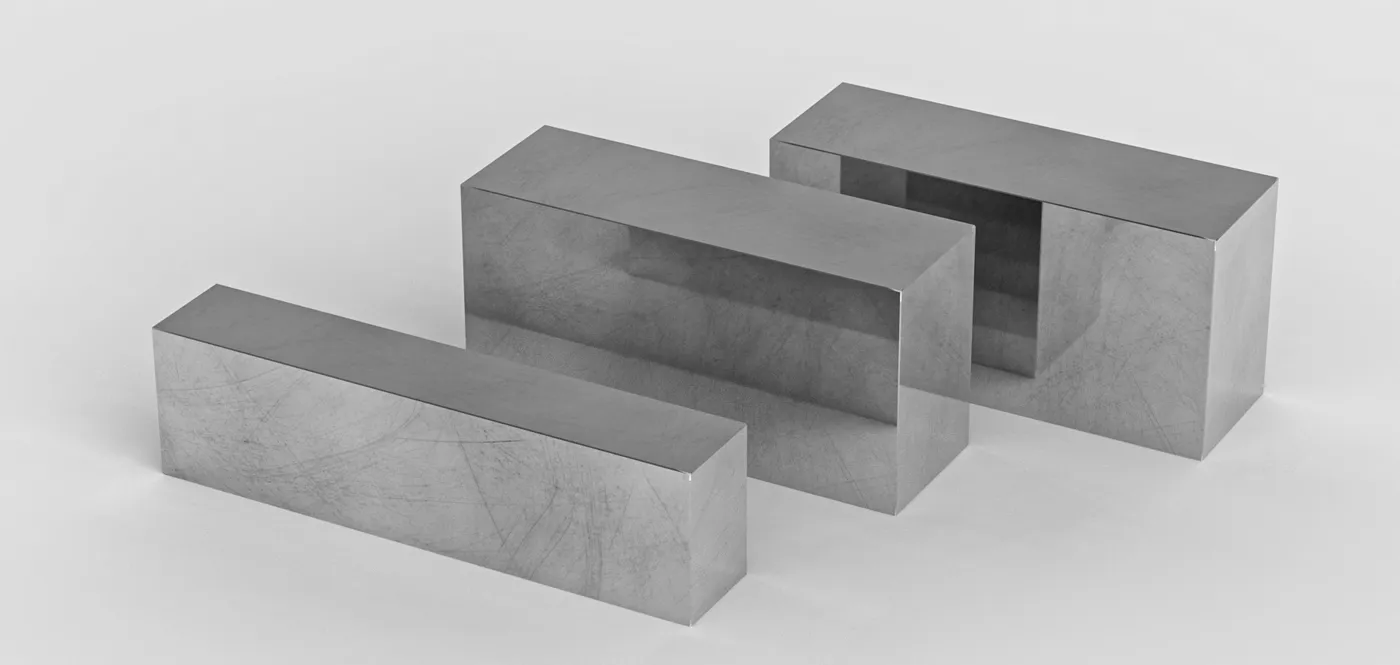
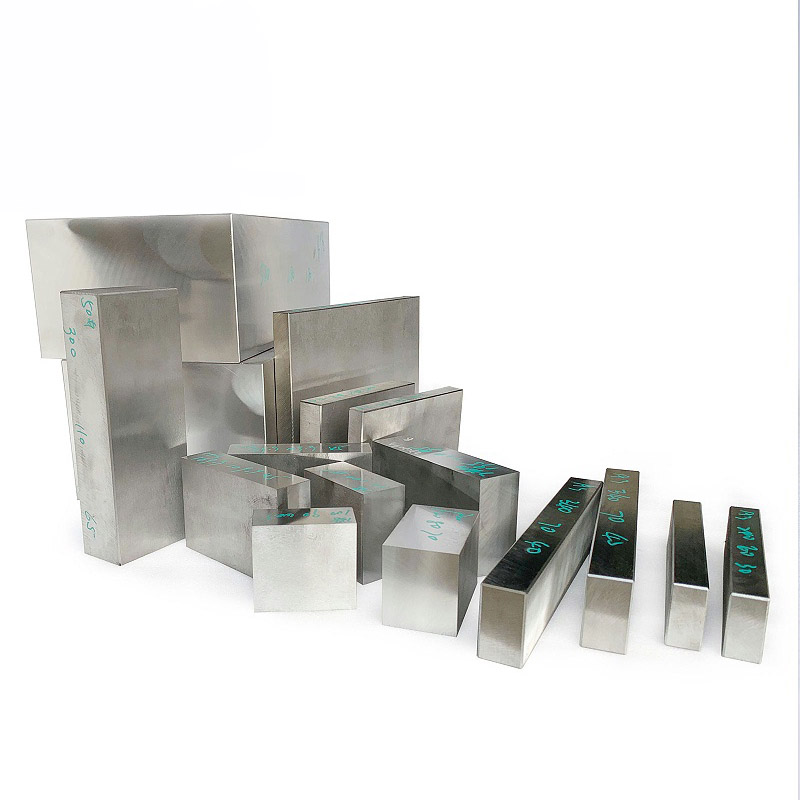
DC53 is a high-performance cold work die steel developed based on SKD11. It combines high hardness of 62–63 HRC with 2–3 times the toughness of SKD11. It features low heat treatment deformation and low risk of cracking during wire EDM processing. DC53 is primarily used in precision stamping, cold extrusion, and other cold work molds that require extremely high service life and dimensional accuracy.
Main Characteristics of DC53 Steel
- High Hardness and High Toughness: At 60 HRC, impact toughness exceeds 25 J/cm², which is 2–3 times higher than SKD11, solving the “high hardness but brittle” problem.
- Low Deformation and High Precision: Heat treatment deformation is 40% lower than SKD11, and wire cutting cracking rate is close to zero.
- High Softening Resistance: After quenching at 1040°C and tempering at 520°C, hardness reaches 62–63 HRC.
- Long Service Life and High Wear Resistance: Uniform fine carbide structure improves wear resistance by 15–20% compared to SKD11.
- Good Machinability: Annealed hardness ≤255 HB, excellent cutting and grinding performance.
- Fatigue Resistance: Bending fatigue strength reaches 1200–1400 MPa, 20% higher than SKD11.
1. Chemical Composition of DC53
| Element | Typical Content (wt%) | Standard Range (wt%) | Main Function |
|---|
| C | 0.95 | 0.90–1.00 | Ensures hardness and wear resistance |
| Cr | 8.00 | 7.50–8.50 | Improves hardenability and forms carbides |
| Mo | 2.00 | 1.80–2.20 | Prevents temper brittleness |
| V | 0.30 | 0.20–0.40 | Refines grains and improves toughness |
| Si | 1.00 | 0.80–1.20 | Strengthens matrix and oxidation resistance |
| Mn | 0.40 | 0.30–0.50 | Improves hardenability |
| P | ≤0.030 | ≤0.030 | Impurity control |
| S | ≤0.030 | ≤0.030 | Prevents toughness reduction |
2. Physical Properties
| Property | Value | Unit | Description |
|---|
| Density | 7.76 | g/cm³ | Room temperature density |
| Elastic Modulus | 21700 | MPa | Young’s modulus |
| Shear Modulus | 8480 | MPa | Shear stiffness |
| Poisson’s Ratio | 0.28 | – | Transverse/longitudinal strain ratio |
| Annealed Hardness | 210–225 | BHN | Machinable condition |
| Quenched Hardness | 62–64 | HRC | After heat treatment |
| Thermal Conductivity | 25–30 | W/m·K | Heat transfer ability |
| Expansion Coefficient | 11.0×10⁻⁶ | /°C | 20–200°C range |
3. Mechanical Properties
| Property | Value | Unit | Description |
|---|
| Tensile Strength | ≥2000 | MPa | After tempering |
| Yield Strength | ≥1900 | MPa | Plastic deformation threshold |
| Elongation | ≥3 | % | Ductility |
| Impact Toughness | 45–60 | J/cm² | No notch |
| Bending Strength | ≥4500 | MPa | Flexural resistance |
| Fracture Toughness | ≥28 | MPa·m¹/² | Crack resistance |
| Compressive Strength | ≥4000 | MPa | Compression resistance |
| High-Temperature Hardness | ≥58 | HRC | At 500°C |
| Application | Main Feature | Typical Products | Performance Advantage |
|---|
| Precision Stamping | High toughness | Electronic terminals | 40–100% longer life than SKD11 |
| Cold Extrusion | High compression resistance | Bolts | 2–3× Cr12MoV |
| Cold Heading | Fatigue resistance | Nuts | 2–3× Cr12MoV |
| Powder Metallurgy | High strength | Press molds | 30–60% higher than SKD11 |
| Drawing | Anti-sticking | Aluminum parts | 50–100% higher than SKD11 |
Not Recommended Applications
| Application Type | Main Limitation | Prohibited Products | Recommended Alternatives |
|---|
| Hot Work Dies | Poor heat resistance | Die casting molds | h23, SKD61 |
| Large Dies | Insufficient hardenability | Auto body dies | 5CrNiMo |
| Plastic Molds | Poor corrosion resistance | Mirror molds | S136, NAK80 |
| Heavy Impact Dies | Low impact toughness | Thick plate cutting | S7, HSS |
Typical Problems and Solutions
1. Rapid Tool Wear
- Use CBN or ultra-fine carbide tools
- Low cutting depth and feed
- High-pressure cooling
- Leave finishing allowance
2. Cracks After Heat Treatment
- Quenching at 1020–1040°C
- Multiple tempering cycles
- Avoid 300–400°C brittle zone
- Add fillet radius
3. Excessive Deformation
- Use fully forged materials
- Step heating
- Stress relief treatment
- Flexible clamping
4. Wire Cutting Cracks
- Stress relief before cutting
- Low current parameters
- Multiple passes
- Low-temperature tempering
5. Welding Cracks
- Use laser cladding or EDM welding
- Preheat 200–300°C
- Post-weld stress relief
- Local heat treatment