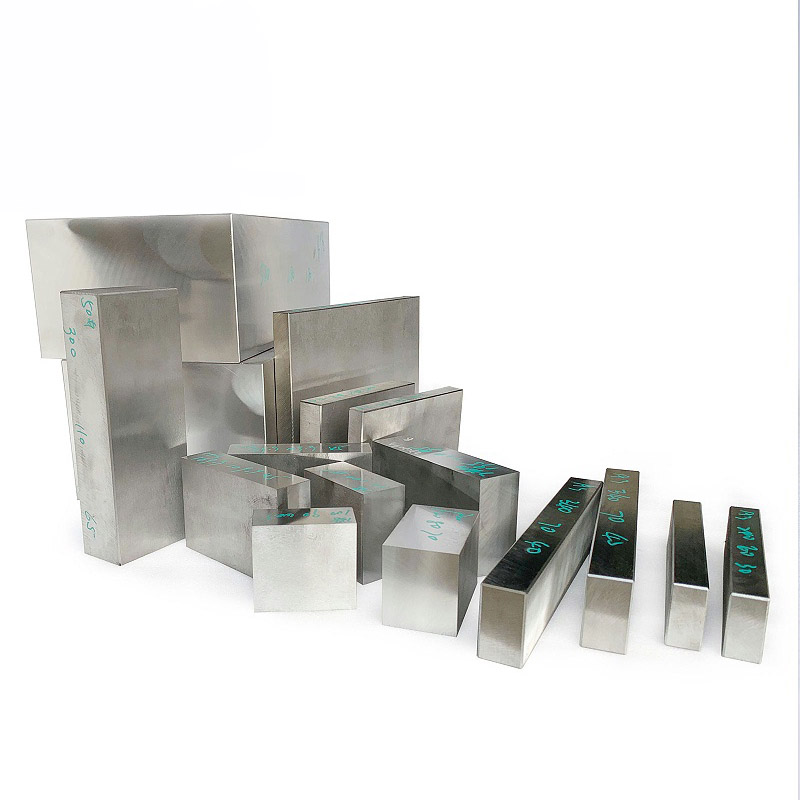
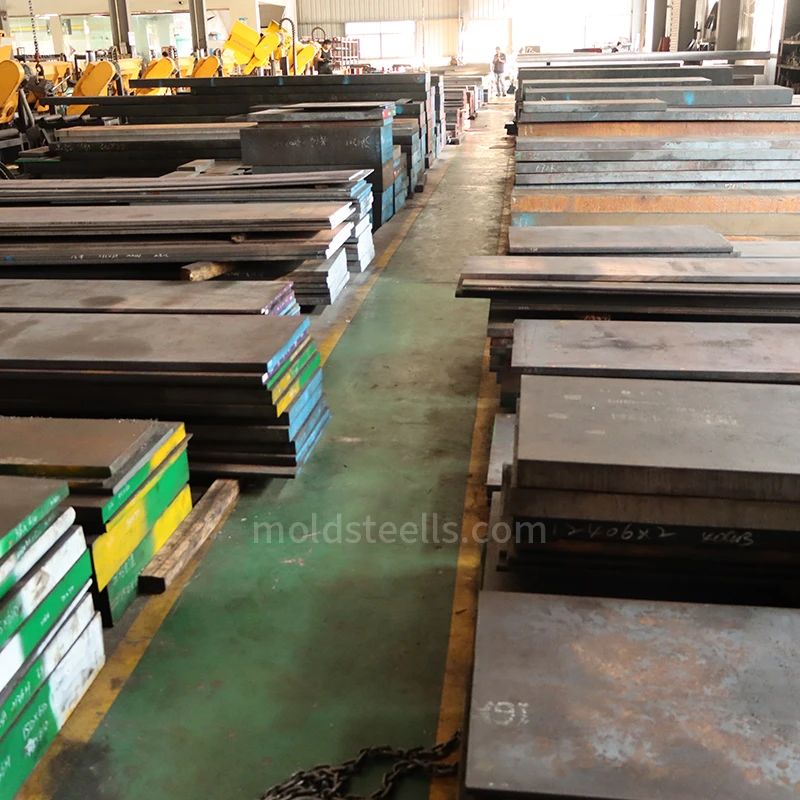
What is Cr12MoV
Cr12MoV die steel is a commonly used high-carbon, high-chromium cold work die steel in China, belonging to ledeburitic alloy tool steel. By adding Mo and V elements to the base of Cr12, it possesses high hardenability, wear resistance, dimensional stability, and better toughness than Cr12. After heat treatment, its hardness can usually reach 5862 HRC (Rockwell Hardness C Scale). It is widely used in the manufacturing of dies that withstand high wear and low to medium impact loads, such as cold stamping, cold extrusion, cold heading, wire drawing, and thread rolling.
Main Characteristics of Cr12MoV Steel
- High Hardness: The commonly used hardness after heat treatment can reach HRC 58~62, which belongs to the “sufficiently hard” category of steel.
- Strong Wear Resistance: Following the high-carbon high-chromium route, it has outstanding wear resistance and is relatively “durable.
- Good Hardenability: Even with larger cross-sections, it is relatively easy to achieve uniform hardness throughout the material.
- Good Dimensional Stability: Deformation after heat treatment is relatively small, with good precision retention.
- High Compressive Strength: It has a strong ability to withstand extrusion and compressive stress and is difficult to be “crushed.
- Medium Toughness: More stable than ordinary Cr12, less brittle, but not the type that resists violent impact.
- Hard Carbides and Good Tempering Stability: It has good hardness retention and is difficult to soften significantly once tempered.
- Ordinary Heat Resistance: Hardness will decrease at high temperatures; it is a cold work die steel, not designed for high-temperature resistance.
- Poor Weldability: It has an obvious tendency to crack during welding repair, which is not favorable.
- Ordinary Corrosion Resistance: It has average rust resistance and does not belong to the “stainless” category.
- Balanced Comprehensive Performance: The core characteristic is “wear resistance as the main focus, combined with certain toughness and stability.
Cr12MoV Performance Parameter Tables
1. Cr12MoV Chemical Composition Table
| Element | Standard Range (wt.%) | Typical Content (wt.%) | Core Function |
|---|---|---|---|
| C (Carbon) | 1.45–1.70 | 1.55 | Serves as the foundation for determining high hardness and wear resistance and provides conditions for the formation of high-hardness alloy carbides. |
| Si (silicon) | ≤0.40 | 0.25 | Mainly plays a role in deoxidization and improves strength and tempering stability to a certain extent. |
| Mn (Manganese) | ≤0.40 | 0.25 | Functions in deoxidization and solid solution strengthening, while improving hardenability. |
| P (Phosphorus) | ≤0.030 | 0.020 | An impurity element that needs strict low control to reduce cold brittleness and ensure toughness. |
| S (Sulfur) | ≤0.030 | 0.010 | An impurity element that requires strict low control to avoid toughness reduction and structural embrittlement. |
| Cr (Chromium) | 11.00–12.50 | 11.75 | The core alloying element that significantly improves hardenability, wear resistance, and resistance to temper softening and forms many hard carbides. |
| Ni (Nickel) | ≤0.20 | 0.10 | A residual control element; a small amount helps improve toughness, but it is usually not the main strengthening source of this steel. |
| Mo (Molybdenum) | 0.40–0.60 | 0.50 | Improves hardenability and tempering stability, inhibits temper brittleness, and enhances the secondary hardening effect. |
| V (Vanadium) | 0.15–0.30 | 0.20 | Refines grains, forms stable hard carbides, and improves wear resistance, strength, and dimensional stability. |
2. Cr12MoV Physical Property Table (Inherent Material Properties)
| Performance Index | Corrected Value | Unit | Remarks |
|---|---|---|---|
| Density | 7670-7700 | kg/m³ | Room temperature |
| Coefficient of Thermal Expansion | 10.4-11.0 | ×10⁻⁶/K | From 20-100°C to 20-200 °C |
| Thermal Conductivity | 20-24 | W/(m·K) | Approximately 20°C to 200 °C |
| Specific Heat Capacity | 460 | J/(kg·K) | Near room temperature |
| Electrical Resistivity | 0.60-0.65 | Ω·mm²/m | Room temperature |
3. Cr12MoV Mechanical Property Table (Force Response Characteristics)
| Performance Index | Value Range | Unit | Remarks |
|---|---|---|---|
| Hardness (Annealed) | ≤255 | HBW | Delivery hardness after spheroidizing annealing or softening annealing. |
| Hardness (Quenched + Low-temperature Tempered) | 58–62 | HRC | Common service hardness for Cr12MoV cold work dies; typical process: quenching at 950–980℃, tempering at 180–220℃. |
Note: Data such as tensile strength, yield strength, elongation, and impact energy are significantly affected by heat treatment conditions and specimen specifications, so they are not listed in this section.
Common Questions FAQ about Cr12MoV Die Steel
- What kind of material is Cr12MoV exactly, and what are its characteristics? Answer: It is a common high-carbon, high-chromium cold work die steel. Its core characteristics can be summarized in four words: hard and wear-resistant. However, the trade-offs are also obvious: average toughness, high tool wear during machining, and sensitivity to heat treatment processes.
- Chemical composition is roughly C 1.45–1.70%, Cr 11.00–12.50%, plus Mo and V to improve hardenability, tempering stability, and wear resistance.
- Delivery hardness in the annealed state is usually ≤255 HBW (Brinell Hardness with Tungsten Carbide Ball), facilitating rough machining.
- Common service hardness ranges from HRC 58–62, which is suitable for many cold work dies.
- Why is Cr12MoV particularly tool-intensive during machining? Answer: Because it contains a large amount of hard carbides. It can be understood as “steel mixed with many very hard small particles.” While cutting the steel, the tool is also like grinding on sandpaper, making it more prone to tool wear and chipping.
- Priority should be given to wear-resistant tool solutions, such as ultra-fine grain cemented carbide; for machining in the high-hardness state, consider solutions like CBN (cubic boron nitride).
- Coatings such as TiAlN (titanium aluminum nitride) and AlCrN (aluminum chromium nitride) are typically more stable.
- The cutting strategy should not be overly aggressive: shallow cutting, stable feed rate, minimal impact, with emphasis on process stability.
- Cooling methods should not be one-size-fits-all; determine based on tools and processes, but avoid thermal shock and heat dissipation loss of control.
- Why is Cr12MoV prone to cracking after quenching? Answer: This steel is relatively sensitive to heat treatment. If heating is too rapid, temperature is too high, or cooling is too drastic, internal stress will build up suddenly. Simply put, it is “the outside changes first, but the inside cannot keep up,” ultimately causing self-fracture.
- Try to perform staged preheating instead of rapid heating.
- Quenching temperature should be stably controlled. Common cold work die processes perform quenching around 950–980°C, but it cannot be mechanically applied regardless of part size and requirements.
- Oil quenching or interrupted quenching is preferred; water quenching is generally not recommended for Cr12MoV.
- Temper immediately after quenching without delay.
- Why is it prone to deformation and dimensional deviation after heat treatment? Answer: Essentially, it is still a stress issue. The material already contains internal stress, which is further increased by machining and then intensified by heat treatment, ultimately leading to “dimensional changes once the fixture is released.” This is particularly noticeable in thin-walled parts, slender parts, and parts with large machining allowances.
- A more stable process is usually rough machining in the annealed state → stress relief → quenching and tempering → aging if necessary → finish machining.
- Machining allowances should be distributed as evenly as possible, avoiding uneven thickness.
- Clamping of thin-walled and slender parts should not be overly tight; add auxiliary support if necessary.
- After heat treatment, return to room temperature first before subsequent finishing for greater safety.
- Why are die-cutting edges prone to chipping? Answer: Because Cr12MoV is typically “highly wear-resistant but average in impact resistance.” It is suitable for wear-dominated working conditions, not for severe impact loads. The risk of edge chipping increases significantly when punching thick plates, punching stainless steel, or when stress concentration occurs at sharp corners.
- Do not blindly pursue maximum hardness; in numerous instances, HRC 58–60 is more stable.
- Minimize sharp corners in the structure; add fillets wherever possible to reduce stress concentration.
- First evaluate high-impact working conditions; if necessary, switch to materials with better toughness instead of forcing application.
- Why does decarburization occur, resulting in reduced surface wear resistance? Answer: Because it has high carbon content. If not properly protected during heat treatment, carbon on the surface layer will diffuse away. Once surface decarburization occurs, it is like “the hard outer shell being thinned surreptitiously.” It may look acceptable, but the actual hardness and wear resistance have already decreased.
- Try to use protective atmosphere furnaces or vacuum furnaces for heat treatment.
- Do not only check overall hardness; it is best to inspect surface hardness and decarburization layer conditions.
- Once a decarburization layer is confirmed, grind it off before use instead of taking chances.
- When making large cross-section dies, why is it prone to “hard outside but soft inside”? Answer: Although Cr12MoV has good hardenability, it cannot achieve uniform hardness throughout regardless of cross-section size. For large parts, the core cooling cannot keep up, making it prone to sufficient surface hardness but a relatively soft core. It may still be usable in the short term, but it is more prone to deformation, loss of precision, and premature failure in the long term.
- For large cross-section parts, evaluate hardenability in advance and do not apply heat treatment processes designed for small parts.
- Heat treatment parameters should be adjusted individually instead of using a single set of parameters for all cases.
- If the size is particularly large and service life requirements are high, it is recommended to compare with other materials more suitable for large cross-sections.
Detailed Performance Parameters of Cr12MoV Steel PDF Download
| Item | Details |
|---|---|
| File | CR12MoV-Die-Steel-Detailed-Explanation.pdf |
| Type | application/pdf |
| Size | 269 KB |
| Link | https://moldsteells.com/wp-content/uploads/2026/03/CR12MoV-Die-Steel-Detailed-Explanation.pdf |