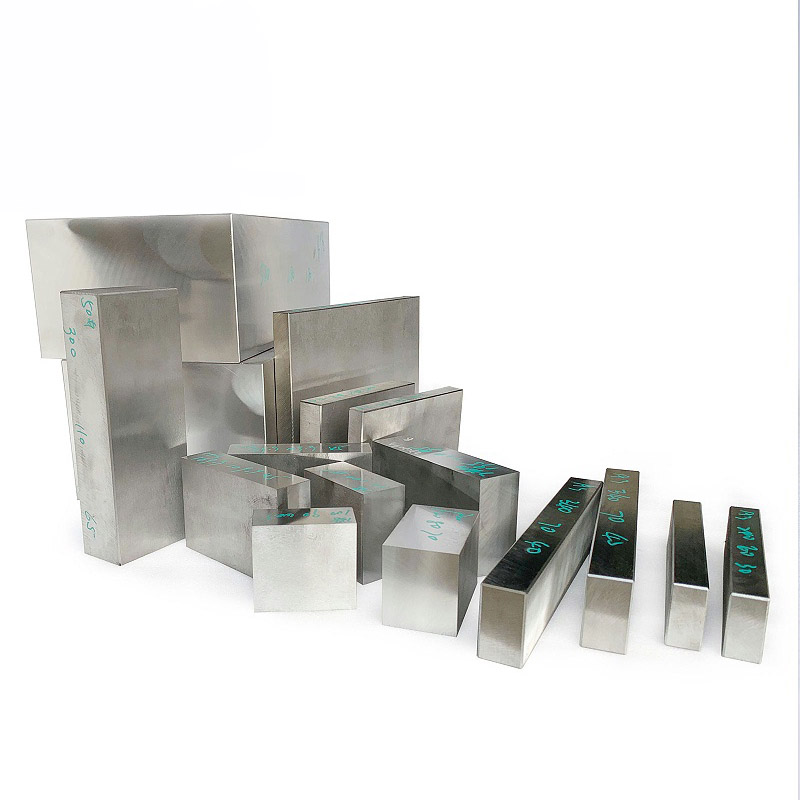
When steel arrives, its weight can come in noticeably heavier than what the finished drawing would suggest. Many mold shops have run into this. That extra material is the stock left for machining allowance. The question is simple: who decides that allowance? Is it specified by the buyer on the drawing, or added by the steel supplier or machining shop?
In principle, machining allowance is agreed by both parties in the contract. In actual orders, most buyers provide only the finished-part drawing, while the supplier works backward to define the rough block size. If the contract does not clearly state the allowance grade, the factory decides which grade to use and how much stock to leave. Control is no longer in the buyer’s hands. Steel is priced by weight—leave an extra 1 mm of stock, and the buyer pays for that extra steel.
Who Decides the Machining Allowance?
First, the core question. Machining allowance is the extra layer of material between the rough block size and the finished size. It is left there for later milling, grinding, and Wire Cutting / EDM. The decision chain usually works like this: the buyer provides the finished drawing or 3D model → the factory works backward from the steel grade, machining route, and heat-treatment distortion to determine the rough block size → the factory submits that size to the buyer for approval → production starts after approval.
The key step is in the middle—working backward to the rough block is done by the factory, and buyers usually do not see the basis behind it. ISO 4957, the technical delivery standard for tool steel, states this clearly: unless otherwise agreed at quotation and order stage, product dimensions and tolerances follow the dimensional standard for the relevant product form. In plain terms, the standard leaves the decision on allowance to the contract. If the contract does not specify it, the supplier’s default grade applies.
That is where the information gap sits. The finished dimensions are fixed, but how much stock is left, and whether the supplier uses E1 or E3, is flexible. Experienced buyers specify terms such as “delivered as E1 ground flat stock” or “single-side machining allowance not to exceed X mm” during quotation. That puts control back in their hands. If the buyer sends only the finished drawing and leaves the allowance entirely to the factory, extra steel charges often follow.
Why Allowance Can’t Be Zero
Some buyers ask a direct question: if extra allowance means extra cost, why not set the allowance at zero and cut the block to finished size from the start? That does not work for two technical reasons.
The first is the decarburized layer. During hot rolling and annealing of tool steel, the surface forms a softened layer caused by carbon loss. Its depth is usually 0.1 to 1.0 mm. If that layer is not machined off, the surface hardness after heat treatment will not reach target, and mold wear resistance and service life will drop sharply. For hot-work steel such as H13, removing decarburization usually requires grinding off 1 to 3 mm per side. For pre-hardened P20, the typical range is 0.5 to 1.5 mm per side. For cold-work D2, it is 1 to 2 mm per side. ASTM A681 sets maximum decarburization limits for tool steels, but the amount to remove still has to come from machining allowance.
The second is heat-treatment distortion. After quenching, steels such as P20 and H13 typically deform in the range of 0.1 to 0.3 mm/m. That is why the block must be remachined after heat treatment to grind the distortion back out. Precision flat stock at E0 is delivered at finished size and leaves no stock for correction. Once it warps after heat treatment, there may be no material left to restore the dimensions. Pre-hardened steel can be ordered as finished flat stock because it does not need re-quenching. Steel grades that require quenching must leave enough stock to compensate for distortion.
The allowance is not waste. It is what covers those two process risks. The real issue is how much is reasonable, and at what point it becomes excessive.
The Four DIN E0-E3 Grades
The German tool steel delivery system under DIN 17350 / SEW 550 divides machining allowance into four grades: E0 through E3. China’s mold industry also widely uses this naming system. Current ISO 4957 no longer forces this grading structure, but quotations from German mills such as ThyssenKrupp and Deutsche Edelstahlwerke, as well as Chinese suppliers, still commonly use E0-E3.
The four grades correspond to different delivery conditions and tolerances:
| Grade | Delivery Condition | Tolerance | Oversize vs. Finished Dimension (Per Side) | Does the Buyer Still Need to Machine It? |
|---|---|---|---|---|
| E0 Precision Flat Stock | All six sides milled and all six sides ground | ±0.02 mm | No oversize; finished dimension | No, it can go straight onto the machine |
| E1 Ground Flat Stock | All six sides milled, two sides ground | ±0.05 mm | +0.1 to 0.3 mm | Usually no major work; datum faces are already ground |
| E2 Semi-Finished Flat Stock | All six sides milled | ±0.1 mm | +0.3 to 0.5 mm | Yes, further precision CNC Machining is still required |
| E3 Rough-Machined Block | Rough milled or black skin | ±0.1 mm | More than +0.5 mm | Yes, substantial machining is still required |
Note: the exact allowance values for E1-E3 vary by mill standard and thickness range. The table above shows common industry ranges. Before signing the contract, use the supplier’s measured tolerance report as the reference.
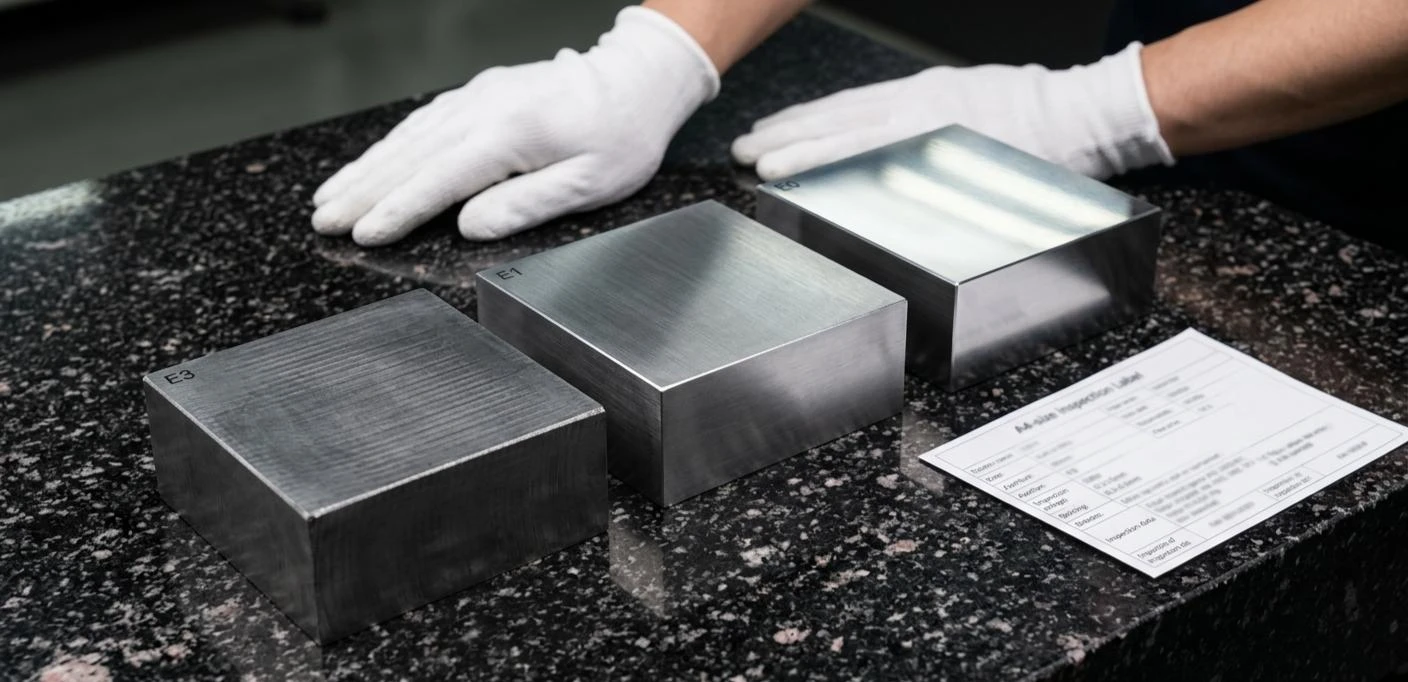
Two points matter. First, E0 precision flat stock does not involve machining allowance in the usual sense. It is already at drawing size, with all faces ground, ready for direct use on CNC or wire EDM. Second, NADCA #207-2016, the North American precision plate standard, sets stricter requirements for precision flat stock: Premium grade thickness tolerance of ±0.025 mm, flatness of 0.025 mm/300 mm, and surface roughness of Ra ≤ 0.8 μm. If that is the grade required, the contract must state NADCA #207 Premium. Writing only “precision flat stock” is too vague. Both E0 and E1 can be interpreted into that label.
The Weight-Pricing Trap
This is where the real trap appears. Steel is priced by weight, with density at 7.85 kg/dm³. If the rough block is oversized by 1 mm, the buyer pays for a full extra layer of steel. ASTM A681-18 also makes it clear that carbon steel and low-alloy steel are priced based on theoretical weight calculated from nominal dimensions.
That creates a built-in margin mismatch. There is a technically reasonable range for machining allowance. But when the supplier leaves more than necessary, the factory reduces its own risk of missing final dimensions and sells more steel at the same time. In the trade, this kind of over-allowance is often called “fat block, big charge.” The exact amount varies by supplier, but the math is simple: every extra 1 mm of single-side allowance means extra steel cost paid in cash. On tonnage orders, even a few hundred kilograms of excess becomes significant.
Three methods are common. The first is stacking allowance factors—heat-treatment compensation, inspection margin, and clamping stock are all rolled into the rough-block weight. Add them up and the yield falls to just above 60%, even though 75% to 80% is often achievable. The second is size consolidation. The buyer asks for a finished block of 280 × 320 × 450 mm, but the factory quotes a rough block of 300 × 350 × 500 mm and says there is “no exact stock size.” The extra steel is charged to the buyer. The third is tying forging-ratio requirements to machining allowance under the claim of “flow-line assurance,” then enlarging the allowance again.
It is normal for precision flat stock to cost more than black-skin rough stock. That price gap does include legitimate machining cost. The abnormal part is hidden in contracts that do not clearly state the allowance grade.
A common case in the industry makes this clear. For an automotive trim-die set, the buyer provided the finished H13 block drawing. The factory worked backward and quoted a rough block with more than 2 tons of material. When the buyer recalculated using the finished dimensions plus reasonable distortion compensation, slightly over 1.5 tons was enough. The extra several hundred kilograms came from inflated allowance during the reverse-sizing step. On a single order, that can mean thousands or even tens of thousands of renminbi in extra steel cost—converted at 1:6.75, roughly hundreds to thousands of U.S. dollars. The key point is this: if the buyer does not cap the allowance, the factory’s quotation may still look procedurally correct, because the finished drawing came from the buyer and the rough block size came from the supplier. All the elasticity in between sits with the factory. The way to break that pattern is not to argue after delivery. It is to request the forging process card and heat-treatment distortion records before placing the order, so the factory has to show the basis for its reverse sizing. If it cannot provide that basis, suspicion over excessive allowance is justified.
Scrap vs. Overpayment
The allowance problem does not move in only one direction. Too much means overpayment. Too little leads to the other extreme—scrap.
A typical under-allowance case is ordering quench-and-temper grades such as H13 or S136 as precision flat stock, with no distortion compensation left. Once quenching causes 0.1 to 0.3 mm/m of warpage, the dimensional tolerance is gone. During finish machining, the shop finds there is not enough stock left to recover size, and the whole block is scrapped. Mirror-polish steel such as S136 is especially sensitive. The buyer either uses pre-hardened S136H to avoid quenching, or leaves enough grinding stock from the start.
A typical over-allowance case is the opposite. E1 ground flat stock would have been enough, but the factory delivers E3 rough-machined blocks instead. The buyer not only pays for the extra steel, but also has to mill all six sides and grind the datum faces in-house. Machining time and lead time both go up. Any savings in the quoted price disappear.
The rule of thumb is simple. Pre-hardened steels that do not need re-quenching—P20, 718H, and NAK80—can go directly to E0 or E1 and avoid disputes over Heat Treatment allowance. Steel grades that must be quenched—H13, S136, and D2—must keep enough E2 or E3 stock for distortion compensation. They should not be ordered as precision flat stock just to save money. MoldSteelLS commonly supplies pre-hardened P20, 718H, and NAK80 as precision flat stock, while H13 and S136 are delivered as E2 or E3 ground stock with sufficient compensation left in place. Match the steel grade to the machining grade at order stage, and the allowance is far less likely to go in the wrong direction.
Three Checks on Arrival
The last line of defense is incoming inspection. Do not rush to sign off when the steel arrives. Run three checks.
First check: actual delivered dimensions versus the allowance grade on the quotation. Measure all six sides with calipers and compare them with the stated E grade. If the quotation says E1 ground flat stock, with +0.1 to +0.3 mm per side, but the delivered block is oversized by 1 mm per side, then the supplier delivered E3 material while charging E1 money.
Second check: rough block size versus the finished drawing. Work backward and estimate what the rough block should be. Then check whether the delivered size falls within a reasonable range.
Third check: billed theoretical weight versus actual weight. Steel should be billed by theoretical weight. If the delivered weight is far above the theoretical weight calculated from the nominal size, something is wrong in the numbers.
If the figures match, accept the delivery. If they do not, do not unload first. Ask the supplier for a measured tolerance report and the mill test certificate (MTC), then verify the heat number and steel grade. GB/T 21469, the Chinese national standard for machining allowance and tolerances of freely forged steel parts, is a useful domestic reference when disputes arise. Grade F, the precision class, can be used as a benchmark.
The contract should also include one sentence in advance: the single-side allowance must not exceed X% the finished dimension, and the billed weight will be based on the net finished-stock weight. That single clause blocks most allowance disputes before they start.
Frequently Asked Questions
Why does precision flat stock (E0) not involve machining allowance?
Because precision flat stock is already ground on all six sides to the finished dimensions and can go straight onto the machine. There is no concept of the rough block being larger than the finished size. What the buyer pays for is the finished dimension itself, so there is no extra allowance charge.
For pre-hardened steel, should the buyer order precision flat stock or ground flat stock?
For pre-hardened grades such as P20, 718H, and NAK80, no re-quenching is required and distortion is small. In most cases, E0 precision flat stock or E1 ground flat stock is the most economical choice because it removes the need for heat-treatment allowance. Quench-and-temper grades such as H13 and S136 should not be ordered as precision flat stock. They must keep distortion compensation.
The quotation says only “precision stock” and does not list the E grade. What should the buyer do?
Ask the supplier to state the exact grade—E0, E1, E2, or E3—and the numerical single-side allowance. “Precision stock” is too vague. Both E1 and E3 can be described that way, even though the price and machining load are very different.
Is allowance calculated per side or for both sides together?
The contract must state this clearly. A notation such as “+0.5 mm” without saying whether it is single-side or total allowance is a common source of disputes. A better practice is to write “machining allowance per face.”
What if the block warps after heat treatment and cannot be ground back to size?
That means too little allowance was left. For quench-and-temper steels, distortion compensation of 0.1 to 0.3 mm/m should be reserved before cutting the block. Steel grades with higher distortion, such as S136, need even more. Once the block has warped beyond recovery, it usually has to be scrapped and reordered.
Machining allowance is nominally a matter of agreement, but in practice the party that writes it clearly into the contract controls the outcome. The buyer provides the finished drawing, and the factory works backward to the rough block size. That is normal. But the E grade, the single-side allowance, and the billed weight basis must all be written into the quotation and contract. Steel is sold by weight, so both too much and too little allowance mean real money. Putting the allowance grade in black and white before the order is far better than arguing about it after delivery.