What is 420ESR
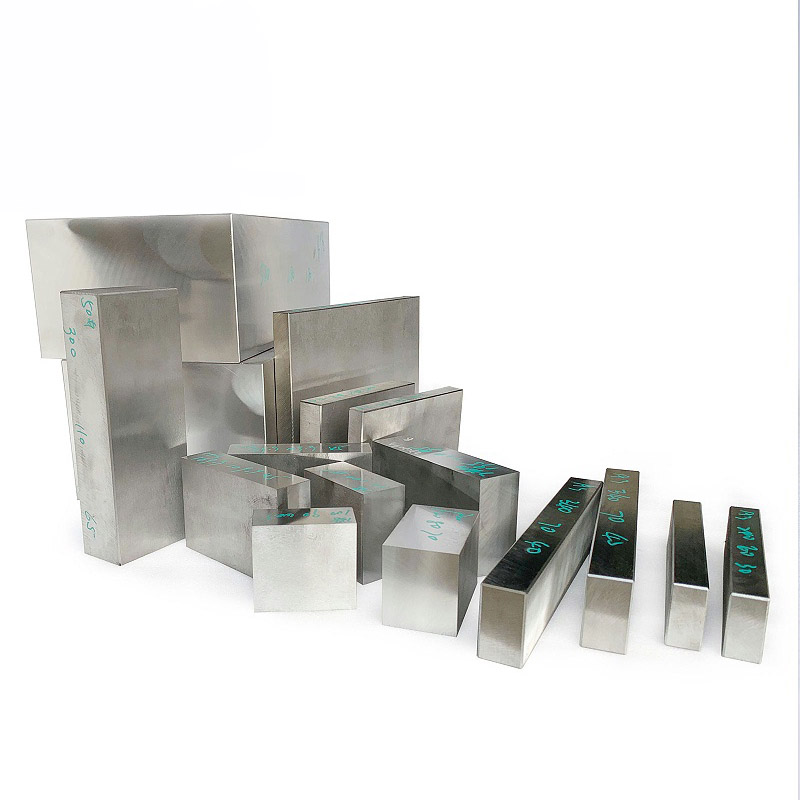
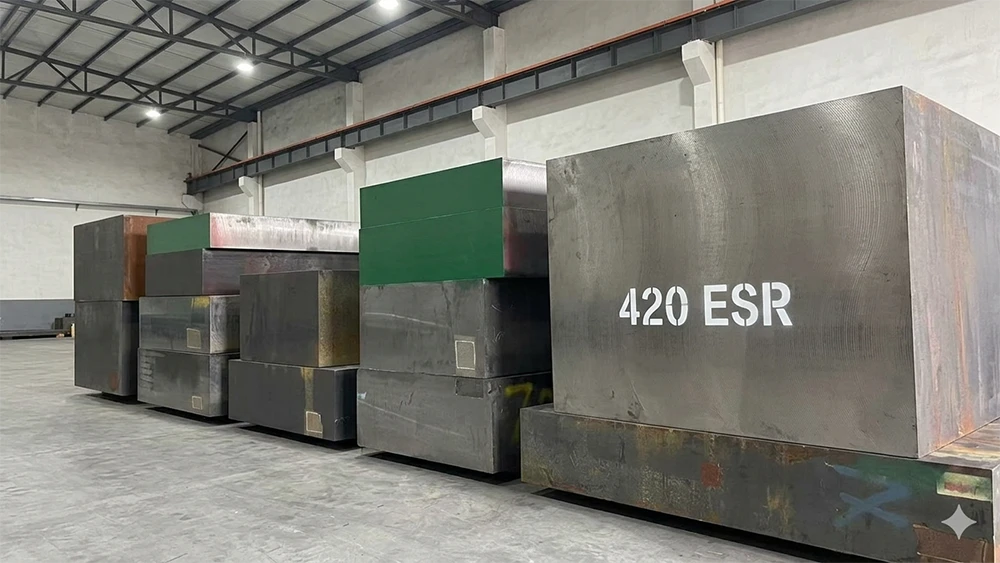
420ESR mold steel is a martensitic stainless-steel mold material refined from 420 stainless steel through the electroslag remelting (ESR) process. The ESR process significantly improves material purity and microstructure uniformity, giving it high hardness, excellent mirror polishing performance, and good corrosion resistance. It is widely used in precision fields such as high-demand plastic mold steel applications, optical lens molds, and medical device molds.
Main Properties of 420ESR Steel
- High purity and uniform microstructure: Purified by the electroslag remelting (ESR) process, it has few internal impurities, just like a dense and tight fabric, which is not prone to internal defects.
- Excellent polishing performance for mirror finish: The pure and uniform “base” allows it to be polished to extremely high brightness, easily achieving a high mirror effect, making it an ideal choice for producing transparent parts and appearance parts.
- Moderate hardness with balanced wear resistance: The hardness after quenching is generally between HRC 50 and 55, which is hard enough for wear resistance and not as brittle as some extra-hard steels.
- Certain pitting corrosion resistance: It contains about 13% chromium, has certain rust resistance, and is more durable than most mold steel products in humid environments or when contacting ordinary corrosive plastics.
- Improved toughness, less brittle: Compared with ordinary 420 steel, it has better toughness, changing from “glass brittle” to “hard biscuit,” and is less prone to chipping and cracking under medium and small impacts.
- Stable dimension, no deformation: The dimensional change during heat treatment is relatively stable and controllable, so the dimensional accuracy is better when making precision molds, and there is no need to worry about “deformation” when the temperature difference changes greatly after production.
- Durable and fatigue-resistant: There are few internal defects; under repeated stress (such as hundreds of thousands of injection molding cycles), fatigue cracks are generated slowly, leading to longer mold life.
420ESR Performance Parameter Tables
1. 420ESR Chemical Composition Table
| Composition Element | Standard Range (wt.%) | Main Function |
|---|---|---|
| C | 0.36–0.42 | Improve hardenability, hardness, and wear resistance. |
| Si | ≤1.00 | Deoxidize and improve certain strength and tempering stability. |
| Mn | ≤1.00 | Improve hardenability, assist deoxidation, and improve processing performance. |
| P | ≤0.030 | Impurity elements need to be controlled; too high content will reduce toughness. |
| S | ≤0.030 | Impurity elements need to be controlled; too high a content will affect toughness and polishing performance. |
| Cr | 12.5–14.5 | Provide corrosion resistance, hardenability, and wear resistance. |
| Fe | Balance | Matrix element. |
2. 420ESR Physical Performance Table (Inherent Material Properties)
| Performance Index | Value | Unit | Remarks |
|---|---|---|---|
| Density | 7.70 | g/cm³ | Room temperature |
| Elastic Modulus | 200 | GPa | Room temperature |
| Linear Expansion Coefficient | 10.4 | 10⁻⁶/K | Average value at 20–100℃ |
| Linear Expansion Coefficient | 10.8 | 10⁻⁶/K | Average value at 20–200℃ |
| Linear Expansion Coefficient | 11.2 | 10⁻⁶/K | Average value at 20–300℃ |
| Thermal Conductivity | 24.0 | W/(m·K) | 20℃ |
| Thermal Conductivity | 25.4 | W/(m·K) | 350℃ |
| Magnetism | Magnetic | — | Martensitic stainless steel |
3. 420ESR Mechanical Performance Table (Force Response Characteristics)
| Performance Index | Value Range | Unit | Remarks |
|---|---|---|---|
| Elastic Modulus E (20℃) | Approx. 200 | GPa | Common value at room temperature. |
| Annealed Hardness | Approx. 180–230 | HB | There are differences in the annealed delivery state of different brands, and most mainstream data fall within this range. |
| Delivery State Hardness Upper Limit | ≤230–241 | HB | The upper limit varies slightly with brand standards. |
| Hardness After Quenching | Approx. 52–56 | HRC | Corresponding to the quenching state after austenitization. |
| Hardness After Quenching and Temperature Low—48–54 Temperature Low—48–54 microelectronic and Temperature and Te, and Temperature HRC, and Temperaturetemperaturetemperature Tempering | Approx. 50–54 | HRC | Common use hardness range. |
| Recommended Use Hardness | Approx. 48–54 | HRC | Suitable for conventional applications of corrosion-resistant mirror mold steel. |
Typical Applications of 420ESR Mold Steel
| Application Field | Specific Uses | Remarks |
|---|---|---|
| High Mirror Plastic Molds | Injection molds for transparent plastic parts, such as PC, PMMA lenses, transparent covers, light guides, and transparent shells | This is the strength of 420ESR, with good polishing performance and surface purity. |
| Optical Molds | Optical lens molds, such as camera lens accessories, mobile phone camera lenses, eyeglass lenses, and other transparent parts molds | Suitable for small and medium-sized molds with high surface requirements, focusing on mirror finish and dimensional stability. |
| Corrosion-resistant Plastic Molds | Injection molds for corrosive plastics, such as PVC, POM, ABS with flame retardants, and other plastic parts molds | Cr content is about 12.5–14.5%, and corrosion resistance is one of the core selling points. |
| 3C and Home Appliance Appearance Part Molds | Mobile phone shells, tablet shells, home appliance panels, and electronic equipment appearance part molds | Suitable for scenarios that balance appearance, wear resistance, and maintenance cycle, commonly used hardness is about 48–54 HRC. |
| Precision Electronic Molds | Connectors, electronic connectors, USBLow Temperature—48–54 °C inter-cell, and iTemperature—48–54 °C cell temperature corrosion faces, sensor corrosion and temperature corrosion—and temperature-hells, temperature corrosion inter-cell faces corrosion corrosion temperature corrosion part molds | Uniform microstructure, relatively better deformation control after heat treatment. |
| Automotive Plastic Precision Molds | Automotive connector molds, interior trim strip molds, complex cavity precision injection molds | Suitable for small and medium-sized plastic molds with high precision and appearance requirements. |
| Medical Device Molds | Medical-grade plastic molds for syringes, infusion sets, push rods, medical shells, etc. | and temperature-resistant, easy-to-clean stainless steel. It is suitable for molds with cleanliness and maintenance requirements. |
| Food Packaging Molds | Food contact plastic molds for PP/PE lunch boxes, beverage cups, food containers, bottle caps, etc. | Easy to polish and clean the surface, suitable for humid and frequent cleaning environments. |
| Cosmetic Packaging Molds | High-gloss packaging molds for lipstick caps, perfume bottle caps, cosmetic shells, etc. | Suitable for high-gloss appearance parts, with relatively advantageous mirror effect and scratch resistance. |
| PET Packaging Molds | PET preform molds, PET blow molding bottle molds, such as beverage bottles, cosmetic bottles | Suitable for packaging molds that require surface finish and resistance to moisture and corrosion. |
| Cold Work Stamping Molds | Small and medium-sized blanking dies, bending dies, precision electronic part stamping dies, stainless-steel sheet stamping dies | It can be used for small- and medium-sized, light- to medium-load working conditions, but it is not a main cold work steel. |
| Sheet Drawing and Tableware Molds | Stainless-steel sheet drawing dies, stamping molds for stainless-steel table knives, spoons, and other tableware | It can be considered when surface finish and corrosion resistance are more valued, not preferred for heavy loads. |
| New Energy Battery Molds | Lithium battery pole piece blanking dies, thin sheet material precision blanking dies | Only suitable for some thin material precision blanking scenarios, need to consider life and edge load. |
| Powder Metallurgy Molds | Magnetic core pressing dies, iron-based/copper-based powder pressing dies, cemented carbide blank pressing dies | It can be used in medium-pressure occasions with corrosion resistance requirements, not the first choice for general solutions. |
| Low Melting Point Alloy Die Casting Molds | Small zinc alloy die-casting molds, such as zipper pulls, buttons, small hardware, and some small electronic shell molds | Only recommended for small, low-heat-load or local inserts, not suitable for high-heat-load die casting. |
| Rubber Molds and Inserts | Small and medium-sized mold inserts for rubber products with sulfur or corrosive formulas | More corrosion-resistant than ordinary cold-work steel, suitable for insert parts. |
| Plastic Extrusion Molds | Extrusion molds, die heads, and forming dies for corrosive plastics such as PVC | Suitable for working conditions of long-term contact with corrosive resins and additives. |
| Bathroom and Kitchen Appearance Part Molds | Faucet handles, shower shells, and kitchen and bathroom plastic part appearance molds | Suitable for mid-to-high-end plastic parts molds that require appearance and resistance to water vapor corrosion. |
| Material Selection Focus | Priority for small and medium-sized, precision, high-mirror, corrosion-resistant molds | In a word, it is good at “mirror finish + corrosion resistance + precision,” not good at high-temperature heavy-load hot work. |
Not Recommended Application Scenarios for 420ESR
The following are the core points where 420ESR is not suitable, for quick reference. The alternative grades are only for selection direction, not direct replacement, and the final selection should be determined by combining wear resistance, corrosion resistance, toughness, temperature, and heat treatment.
| Not Recommended Field | Core Reason | Typical Working Condition | Alternative Material Suggestion |
|---|---|---|---|
| High-Impact Cold Work Molds | The common hardness of 420ESR is about 48–54 HRC, and about 52–56 HRC after quenching; it has good corrosion resistance and polishing performance, but it is not good at resisting large impact and large shear and is prone to chipping and cracking. | Thick plate stamping, blanking, cold extrusion, large tonnage cold stamping; high-strength steel plate, thick plate, obvious intermittent impact. | DC53, SKD11, D2, Cr12MoV |
| Cold Heading Molds | Cold heading is subject to both impact and extrusion force, 420ESR has weak toughness and chipping resistance, and its life is usually not advantageous. | Cold heading forming of bolts, nuts, rivets, etc.; high load, high deformation, continuous striking. | Cr12MoV, DC53, high-speed tool steel type cold work mold steel |
| High-Wear Molds | The matrix wear resistance is not high; long-term friction with hard particles will easily cause cavity wear and dimensional drift. | Powder metallurgy forming molds, ceramic powder molds, and forming molds with hard particle media. | SKD11, D2, DC53, powder metallurgy high wear-resistant mold steel |
| Reinforced Fiber Plastic Molds | Fillers such as glass fiber and carbon fiber continuously grind the cavity and gate like “fine sandpaper,” and the wear resistance of the 420ESR body is often insufficient. | Plastics containing more than 20% glass fiber, carbon fiber, or other hard fillers; medium- and high-yield continuous injection molding. | S136 (suitable with surface treatment), SKD11, DC53, and high wear-resistant mold steel after surface treatment |
| Hot Work Molds | Hardness and strength decay quickly under long-term high temperature, not suitable for long-term hot work environments, prone to softening, deformation, and thermal fatigue. | Long-term working temperature >250℃; aluminum alloy die casting, hot forging, hot extrusion, thermosetting plastic molding. | H13, 8407, hot work mold steel series |
| Hot Runner Molds | The thermal conductivity is about 24.0 W/(m·K) (20℃), the heat conduction is not fast, and the temperature uniformity control is not advantageous when used as a hot runner. | Hot runner systems that require precise temperature control and high-temperature distribution uniformity, multi-point glue feeding, and high-appearance parts. | H13, 8407, special hot runner mold steel |
| Large Molds and Large Section Molds | When the size is large, the advantages of heat treatment uniformity, core performance, and overall stability are not obvious, and deformation, uneven hardness, or instability are prone to occur. | Mold length >1 m, cavity size >500 mm, or section thickness >50 mm. | 718H, P20-type pre-hardened steel, H13, and select high-toughness large module steel according to purpose |
| Deep Drawing Molds | Deep drawing pays more attention to toughness, fatigue resistance, and crack propagation resistance. 420ESR has no advantage in fillet area and sidewall stress concentration positions. | Drawing depth more than 30–50 mm; deep drawing of stainless steel, aluminum alloy, and high-strength materials. | SKD11, DC53, Cr12MoV |
| High-Speed Cyclic Load Molds | The fatigue life is moderate, and fatigue cracks are more likely to occur at stress concentration positions under high-frequency cycles. | High-speed stamping >300 times per minute or high-speed injection molding, continuous cycle of packaging molding; million-level life requirement. | D2, DC53, SKD11, H13 (selected according to specific process) |
| High-Precision Thin Material Blanking and Precision Shearing Molds | Edge retention and钝化 resistance are usually not as good as high wear-resistant cold work steel; burrs will become larger and precision will fluctuate after long-time use. | Thin material blanking, precision shearing, micro gap molds; high requirements for edge stability. | D2, SKD11, DC53, 440C (selected according to corrosion resistance or wear resistance focus) |
| Ultra-high Precision Micro Forming Molds | If you need to suppress micro deformation for a long time and pursue extreme dimensional consistency, 420ESR is usually not a priority. | Dimensional accuracy reaches the ±0.001 mm level; microelectronic parts, precision connectors, etc. | DC53, SKD11, powder metallurgy high stability mold steel |
| Ultra-high Mirror Optical Molds | 420ESR has good polishing performance, but when it meets the Ra ≤ 0.01 μm level and top optical surface requirements, higher cleanliness and stability are usually more valued. | Optical lenses, light guides, transparent appearance parts, and CD/DVD-type precision mirror molds. | S136 ESR, 1.2083 ESR |
| Strong Corrosive Medium Environment Molds | Cr content is about 12.5–14.5%, the corrosion resistance is good, but it is not suitable for long-term strong acid, strong alkali, chlorine-containing decomposition products, or strong chemical cleaning environments. | PVC, POM, and other corrosive plastic molding; frequent contact with pH < 4 or pH > 10 media; chloride-containing environment. | 1.2083 ESR, S136 ESR, stainless mold steel with a higher corrosion resistance grade |
| Low-Temperature Impact on Working Condition Molds | The brittleness risk will increase at low temperatures; it is more prone to chipping and cracking when impacted, and brittle fracture will occur in severe cases. | Working environment below -10℃, especially below -20℃; cryogenic stamping, freeze forming, high impact in low-temperature winter. | Cr12MoV, DC53, special cold work mold steel with better low-temperature toughness |
| High-Yield Continuous Production Molds | It is more suitable for conventional molds with medium and low wear, balanced corrosion resistance, and polishing; once entering high-yield continuous production, the wear and fatigue shortcomings are more likely to be amplified. | Long-term continuous operation, high shutdown maintenance cost, and life requirement significantly higher than conventional mass production conditions. | D2, SKD11, DC53, H13 (selected according to cold work or hot work conditions) |
What Tools Are Used for 420ESR Machining
| Machining Stage | Coating Selection Priority | Key Tool Parameters | Recommended Brands (Model Examples) |
|---|---|---|---|
| Rough Machining (remove large allowance) | 1. AlCrN 2. TiAlN 3. TiN (cost priority) | Material: ultra-fine/fine-grain cemented carbide Edge: slightly passivated, impact-resistant design Key parameters: cutting speed 80-150 m/min, feed 0.1-0.2 mm/r (or mm/tooth), back cutting depth set according to tool and machine rigidity. | Kennametal (KC7315, KCK15) Sandvik (GC4225, GC1025) ZCC.CT (YBC251) Xiamen Golden Egret (XGX350) |
| Semi-finishing (balance efficiency and surface quality) | 1. TiAlN 2. AlCrN 3. TiSiN (anti-sticking) | Material: ultra-fine grain cemented carbide Edge: sharp or slightly blunt, balance wear resistance and finish Key parameters: cutting speed 100-180 m/min, feed 0.1-0.2 mm/r (or mm/tooth), small back cutting depth. | Iscar (IC907, HELI3 series) Sandvik (CoroMill 390, GC1030) Seco (TP1501, TP2501) ZCC.CT (YBG205) |
| Finishing (high surface quality/precision) | 1. TiAlN (nano coating is better) 2. AlCrN 3. Composite coating (such as TiAlN+AlCrN) | Material: ultra-fine grain cemented carbide or CBN (hardness HRC55+) Edge: sharp, high-precision grinding Key parameters: cutting speed 120-200 m/min (cemented carbide) or 80-120 m/min (CBN), feed 0.05-0.15 mm/r (or mm/tooth), small cutting depth. | Iscar (ChamferMill and other finishing series) Sandvik (CoroMill 290, etc.) Kyocera (CC6050, cermet) Walter (WSM35S) |
| Drilling/special processing | TiCN, TiAlN, or special coating | Material: cobalt-containing cemented carbide (drill bit) Structure: integral cemented carbide end mill (complex curved surface) Key parameters: speed and feed need to match aperture/tool diameter, and sufficient cooling. | Sandvik (CoroDrill series) Kennametal (integral cemented carbide milling cutter) Tungaloy (T9125) |
420ESR Machining Parameter Selection Logic
Professional CNC machining of 420ESR follows the parameter logic in the table below:
| Core Dimension | Selection Logic | Practical Parameter (Rough Machining) | Practical Parameter (Semi-finishing) | Practical Parameter (Finishing) |
|---|---|---|---|---|
| Cutting Speed (Vc) | Hardness is the main barrier; for every HRC5 increase, the speed needs to be reduced by about 15%. Use a high-speed steel cutter at a lower speed, a cemented carbide cutter at a medium speed, and a CBN/ceramic cutter at a higher speed. Don’t be too slow (<60 m/min); it is easy to make the material “harden” and more difficult to cut. | 60–90 m/min | 90–110 m/min | 110–130 m/min |
| Feed Rate (f) | Directly related to cutting force. Rough machining can use higher feed to improve efficiency; finishing needs lower feed to ensure finish. Too fast will cause a rough surface; too slow will wear the cutter instead. | 0.12–0.25 mm/r | 0.15–0.20 mm/r | 0.05–0.12 mm/r |
| Cutting Depth (ap) | For rough machining, under the premise that the machine tool and cutter can bear it, try to use a larger cutting depth to remove allowance quickly. Finishing uses smaller cutting depths to ensure precision and finish. Don’t cut too thin (such as <0.5 mm); otherwise, the tool tip only rubs on the hardened layer and damages the cutter. | 1.5–3.0 mm | 0.8–1.5 mm | 0.1–0.5 mm |
| Spindle Speed (n) | Calculate by formula: n = (1000 × Vc) / (π × cutter diameter). This is the theoretical value; it depends on the rigidity of your machine tool. Equipment with poor rigidity should actively reduce the speed by 20-30%. | 800–1800 rpm | 1800–3000 rpm | 2500–4000 rpm |
| Cooling Method | Must be fully cooled! Prioritize high-pressure emulsion (concentration 8-10%) or extreme pressure cutting oil. For hard materials above HRC50, compressed air or oil mist cooling can be considered to avoid thermal shock that breaks the tool tip. | Emulsion/cutting oil, high pressure, sufficient cooling (rough/semi-finish/finish) Compressed air/oil mist cooling (suitable for high hardness finishing) | ||
| Path Strategy | Climb milling is preferred for its greater stability, longer tool life, better surface quality. For complex cavity cutting, cut in layers; each layer should not exceed 1/3 of the cutter diameter. For curved surface finishing, use helical down milling or contour surrounding; do not directly plunge down. | Climb milling, layered cutting | Climb milling, layered cutting | Climb milling, helical down milling/contour surrounding |
Frequently Asked Questions About 420ESR Mold Steel
Q1: Why is 420ESR very tool-consuming during machining?
A: This steel has high hardness (above HRC50); ordinary tools are like using nails to scratch stones—they will be worn out quickly. You must use ultra-fine grain cemented carbide or CBN tools and select a TiAlN coating.
Q2: What to do if 420ESR is prone to cracking during heat treatment?
A: It is like a thick glass cup; it is easy to crack when suddenly exposed to cold. Preheat in stages before quenching; do not cool too fast. It is recommended to use isothermal quenching or control the cooling medium.
Q3: Why do 420ESR molds crack easily during use?
A: Its toughness is relatively low; like a brittle biscuit, it is easy to chip when impacted or when the shape is complex. Avoid sharp corner design, and do not control the hardness too high (recommended HRC50-52).
Q4: 420ESR is stainless steel; why does it rust?
A: It is rust-resistant but not as good as 304; it will still rust in humid or corrosive environments (such as PVC injection molding). Clean it in time after use, apply anti-rust oil, and chrome plating can be considered for important parts.
Q5: What is the reason for small cracks on the surface of the 420ESR mold after long-term use?
A: These are fatigue cracks, just like a wire will break after repeated bending. After high cycle use (such as hundreds of thousands of injection molding cycles), the material will be “fatigued.” It is recommended to inspect regularly and optimize the structure to reduce stress concentration.
Q6: Can 420ESR molds be repaired by welding after damage?
A: Its weldability is poor; like repairing a broken mirror, it is easy to crack. Preheating and post-heat treatment are necessary, but the performance after repair may be uneven; it is usually recommended to replace the damaged part directly.
Download the 420ESR Steel Detailed Performance Parameter PDF.
| Item | Details |
|---|---|
| File | 420esr-mold-steel-detailed-guide-to-properties-machining-points-and-precautions.pdf |
| Type | application/pdf |
| Size | 225 KB |
| Link | https://moldsteells.com/wp-content/uploads/2026/03/420esr-mold-steel-detailed-guide-to-properties-machining-points-and-precautions.pdf |